Flap Technique in Skin Cancer Surgery: Reconstruction Guide
Complete guide to flap surgery for skin cancer reconstruction and optimal healing outcomes.
Understanding Flap Surgery in Skin Cancer Treatment
When dermatologists and plastic surgeons remove skin cancer, they must address not only the malignant tissue but also the resulting surgical defect. While procedures like Mohs micrographic surgery effectively eliminate cancerous cells with precision, reconstruction of the surgical site requires careful planning and expertise. Flap surgery is one of the most effective techniques for closing these wounds, offering superior aesthetic and functional outcomes compared to alternative closure methods.
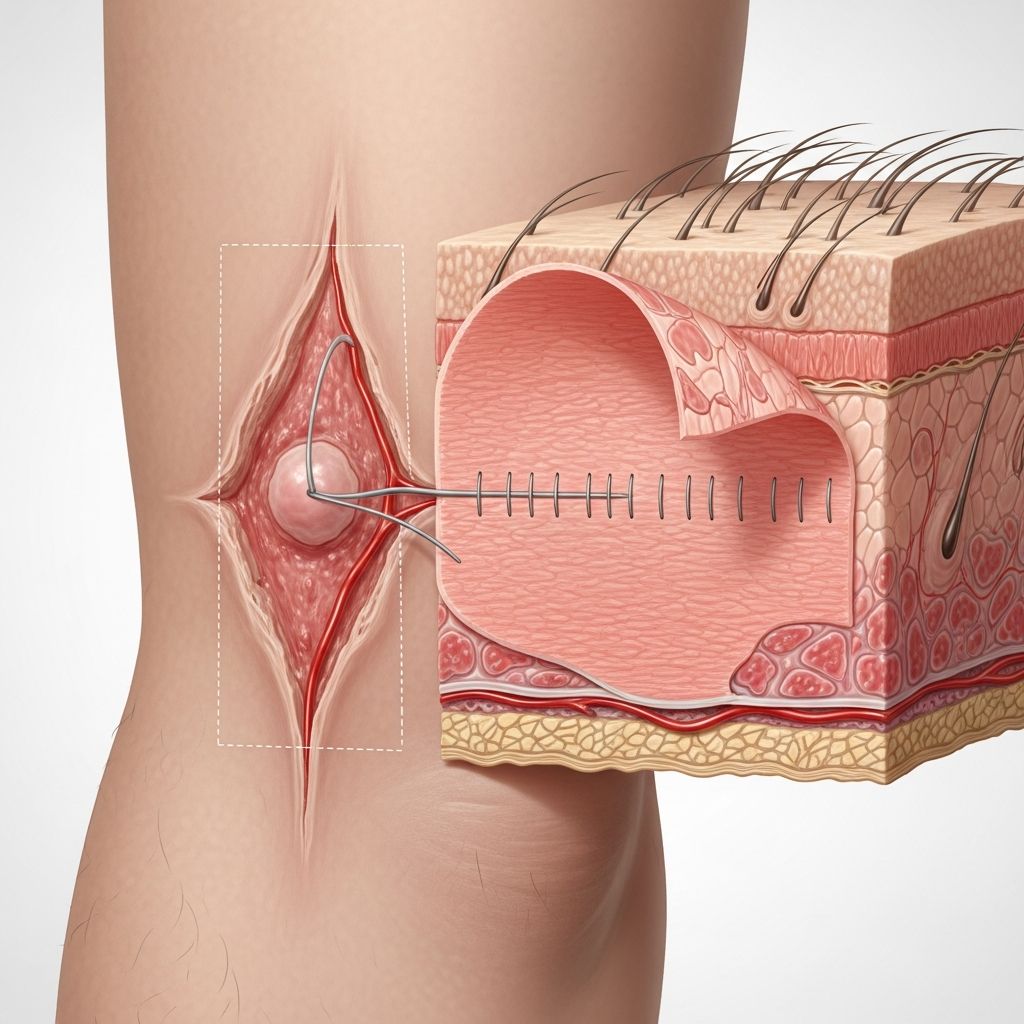
Flap surgery involves using the body’s own tissue to reconstruct the surgical defect left behind after skin cancer removal. Unlike simpler closure methods, flap surgery preserves the blood supply to the tissue being moved, which promotes better healing, reduces scarring, and maintains natural skin characteristics at the surgical site.
What Is Flap Surgery?
Flap surgery is a reconstructive procedure that uses tissue still attached to the body and maintaining its blood supply to close surgical wounds. As explained by board-certified plastic and reconstructive surgeons, this technique differs fundamentally from skin grafts, which involve tissue without an active blood supply. The preserved blood supply in flap surgery allows for superior healing and more natural-looking results.
The decision to use flap surgery depends on several critical factors that surgeons evaluate during preoperative consultation:
- The location of the wound created by cancer removal
- The size of the surgical defect
- The desired aesthetic and functional outcome
- Available tissue in adjacent areas
- Patient preferences and medical history
One primary advantage of flap surgery is its ability to prevent scar contracture, also known as shrinkage. During normal wound healing, specialized cells increase collagen production, which can cause the wound to shrink considerably. In sensitive facial areas like the nose, eyelids, or lips, this shrinkage can lead to distortion and functional problems. Flap surgery provides tissue that maintains its original dimensions, preventing these undesirable outcomes.
Why Choose Flap Surgery Over Other Options
Patients and surgeons select flap surgery for several compelling reasons. Many patients prefer this approach because it offers an alternative to allowing open wounds to heal naturally, a process that typically requires four to six weeks and leaves significant scarring.
Local flaps provide an ideal match to the surgical site because they generally have the same color and skin texture as the area where cancer was removed. This tissue matching results in superior cosmetic outcomes and allows the reconstructed area to blend seamlessly with surrounding skin. The preserved blood supply ensures that the tissue maintains its viability and natural appearance throughout the healing process.
Related Stories



Types of Flap Surgery
Local Flaps
Local flaps are the most commonly used option for reconstructing skin cancer defects. These flaps utilize tissue adjacent to the surgical site that is lifted, rotated, and repositioned to cover the wound while maintaining its blood supply. Local flaps are particularly valuable because they provide the best tissue match in terms of color, texture, and thickness.
Local flaps are subdivided into several categories based on the movement technique:
- Advancement Flaps: Tissue is moved directly forward to cover the defect without lateral movement. This straightforward technique works effectively for smaller surgical defects.
- Rotation Flaps: Tissue is rotated around a pivot point to cover the adjacent defect. This approach allows for better alignment with surrounding skin and improved cosmetic outcomes. The O-to-T flap is a specialized rotation flap commonly used for chin defects.
- Transposition Flaps: Tissue is completely repositioned to cover the defect while maintaining its blood supply. This technique is particularly useful for larger defects where advancement or rotation alone would be insufficient.
Local flaps are preferred whenever possible because they require only one surgical stage, have lower infection rates, and produce the most natural-looking results.
Regional Flaps
For larger surgical defects, surgeons may need to create a flap using tissue from areas more distant from the defect site. A common example is the forehead flap, where skin from the forehead is moved to reconstruct the nose while remaining connected to its blood supply. These procedures are often multi-staged, requiring initial flap placement, a healing period of three to four weeks, and then division of the blood supply connection once the tissue has established new blood vessels at the recipient site.
Free Flaps
Free flaps are reserved for extensive defects that cannot be adequately covered by local or regional tissue. This advanced technique involves removing tissue from a distant site on the body and completely detaching it from its original blood supply. The flap is then transferred to the surgical site and surgically reattached using microsurgical techniques to restore blood flow.
Free flap reconstruction requires sophisticated surgical skill and specialized equipment, including an operating microscope for precise blood vessel reattachment. For example, skin from the forearm might be transferred to reconstruct a large facial defect or areas such as the lower lip where significant tissue loss has occurred. While free flaps represent a more complex surgical undertaking, they provide exceptional results for extensive reconstructive needs.
The Flap Surgery Procedure
Flap surgery is typically performed as an outpatient procedure under local anesthesia, allowing patients to remain awake while the surgical area is completely numb. For patients with significant anxiety, surgeons may administer a mild sedative. The procedure generally takes 30 to 90 minutes, depending on the complexity and location of the defect.
The surgical steps generally follow this process:
- The surgeon marks the donor site using a surgical pen to outline the flap boundaries
- An incision is made to outline the flap
- The flap is carefully elevated while maintaining its blood supply connection
- The tissue is rotated, advanced, or transposed to cover the surgical defect
- Sutures are placed to secure the flap in its new position
- For free flaps, blood vessels are reattached using microsurgical techniques with an operating microscope
- The donor and recipient sites are covered with gauze and protective dressings
Many patients find that combining Mohs surgery with flap reconstruction on the same day is efficient, though it does result in a longer surgical session. Following cancer removal, patients typically wait a few hours during histological analysis before proceeding to flap reconstruction.
Recovery and Postoperative Care
Proper postoperative care is essential for optimal results following flap surgery. Patients typically return home with bandages, adhesive strips, or wrap bandages over the surgical sites. Most individuals can resume their usual routines within a few days, experiencing only mild soreness or tightness at the operative site.
Postoperative care instructions typically include:
- Keeping the surgical dressing clean and dry
- Taking prescribed antibiotics as directed
- Managing pain with over-the-counter or prescribed medications
- Avoiding strenuous activity and heavy lifting for several weeks
- Protecting the surgical site from sun exposure
- Attending scheduled follow-up appointments for suture removal and healing assessment
- Avoiding smoking, which impairs wound healing
Suture removal typically occurs one to two weeks after surgery, depending on the location and type of flap. Most patients experience complete wound healing within three to four weeks, though final aesthetic results continue to improve over several months as swelling resolves and scars mature.
Potential Complications and Considerations
While flap surgery is generally safe and effective, patients should be aware of potential complications. The donor site, where the flap originated, may develop a visible scar despite meticulous surgical closure. Careful surgical technique minimizes this risk, but some scarring is often unavoidable and represents the trade-off for superior reconstruction of the primary defect.
Other potential complications include:
- Flap failure due to compromised blood supply
- Infection at either the donor or recipient site
- Bleeding or hematoma formation
- Temporary numbness or altered sensation
- Asymmetry requiring revision procedures
These complications are rare when surgery is performed by experienced surgeons using meticulous surgical technique. Open communication with your surgical team about concerns and expectations helps ensure the best possible outcomes.
Flap Surgery Versus Skin Grafts
While flap surgery is often preferred, skin grafts represent an alternative for certain situations. Skin grafts involve tissue without a blood supply and are more delicate than flaps. They require a well-vascularized recipient bed and have lower success rates in areas with compromised blood flow. However, skin grafts may be appropriate when local flap tissue is unavailable or when the surgical defect is in an area where the superior blood supply of a flap is less critical.
The choice between flap and graft depends on defect location, size, tissue availability, and patient factors. Board-certified dermatologists and plastic surgeons evaluate these considerations to recommend the optimal reconstructive approach for each patient.
The Importance of Specialized Expertise
Successful flap surgery requires significant education, training, and experience. The decision regarding which surgical procedure to use and how to best perform it involves complex cognitive and technical skills developed over years of practice. Board-certified dermatologists and plastic surgeons possess the expertise necessary to assess each patient’s unique anatomy, select the most appropriate flap technique, and execute the procedure with precision.
Collaboration between dermatologists and plastic surgeons often provides optimal outcomes, with the dermatologist focusing on cancer removal and the plastic surgeon specializing in reconstruction. This team approach combines expertise in both oncologic safety and aesthetic reconstruction.
Patient Success Stories
Many patients experience excellent outcomes with flap surgery following skin cancer removal. One patient with basal cell carcinomas located around the eye and nose underwent Mohs surgery followed by flap reconstruction. The flap was taken from the upper eyelid area and repositioned to reconstruct the lower eyelid and corner of the eye. Despite some initial concern about visible scarring, the patient recovered well and expressed satisfaction with the surgical outcome, particularly given the early cancer diagnosis and successful removal.
Another patient presented with a basal cell carcinoma on the chin. Following Mohs surgery, an O-to-T flap was performed to close the surgical defect. This specialized rotation flap technique was selected because a simple linear closure would have required excessive skin tension and extended into the lip region. Just one month after surgery, the scar was nearly undetectable, demonstrating the aesthetic excellence achievable with appropriate flap selection and meticulous surgical technique.
Frequently Asked Questions
Q: How long does flap surgery take?
A: Flap surgery typically takes 30 to 90 minutes, depending on the complexity of the defect and the type of flap being performed. Combined Mohs surgery and flap reconstruction may extend the total operative time to several hours.
Q: Will flap surgery leave a visible scar?
A: While all surgery creates some scarring, flap surgery generally produces superior aesthetic results compared to other closure methods. The donor site may have a visible scar, but careful surgical technique minimizes this appearance. Scars continue to improve in appearance for up to one year after surgery.
Q: How long is the recovery period after flap surgery?
A: Most patients return to their usual routines within a few days, with only mild soreness or tightness. Complete wound healing typically takes three to four weeks, though final aesthetic results continue to improve over several months.
Q: What is the difference between a flap and a skin graft?
A: A flap maintains its blood supply while tissue is transferred and repositioned, whereas a skin graft involves tissue without a blood supply. Flaps generally produce better aesthetic and functional outcomes but may be more complex to perform.
Q: Can flap surgery prevent scar contracture?
A: Yes, flap surgery is specifically chosen to prevent scar contracture (shrinkage) in sensitive areas like the nose, eyelids, and lips where shrinkage could cause distortion or functional problems.
Q: Is flap surgery performed under general or local anesthesia?
A: Flap surgery is typically performed under local anesthesia, keeping you awake but completely numb. Mild sedation may be offered for anxious patients, but general anesthesia is not required for most cases.
References
- What is the Flap Technique in Skin Cancer Surgery? — American Academy of Dermatology Association (Skin Cancer Organization). 2024. https://www.skincancer.org/blog/what-is-the-flap-technique-in-skin-cancer-surgery/
- The Complete Guide to Flap Closure After Mohs Surgery — Dermatology Surgery & Laser Center. 2024. https://dermskinhealth.com/mohs-surgery-flap-closure/
- Mohs Micrographic Surgery: Design and Execution of Tunneled Flaps — National Center for Biotechnology Information (NCBI). 2024. https://www.ncbi.nlm.nih.gov/books/NBK613295/
- Flap Reconstruction — University of Utah Health. 2024. https://healthcare.utah.edu/plastic-surgery/reconstructive/flap-reconstruction
- Skin Grafts and Flaps — TeachMeSurgery. 2024. https://teachmesurgery.com/plastic-surgery/burns/skin-grafts-and-flaps/
- O-to-T Flap Surgery: Used to Repair Surgical Defects from the Removal of Skin Cancer — Clarus Dermatology. 2024. https://clarusdermatology.com/o-to-t-flap-surgery-used-to-repair-defects-from-removal-of-skin-cancer/
Similar Articles








Read full bio of Sneha Tete