Skin Flaps: 5 Key Benefits And Reconstruction Options
Comprehensive guide to skin flaps in dermatologic surgery for optimal wound closure and reconstruction.
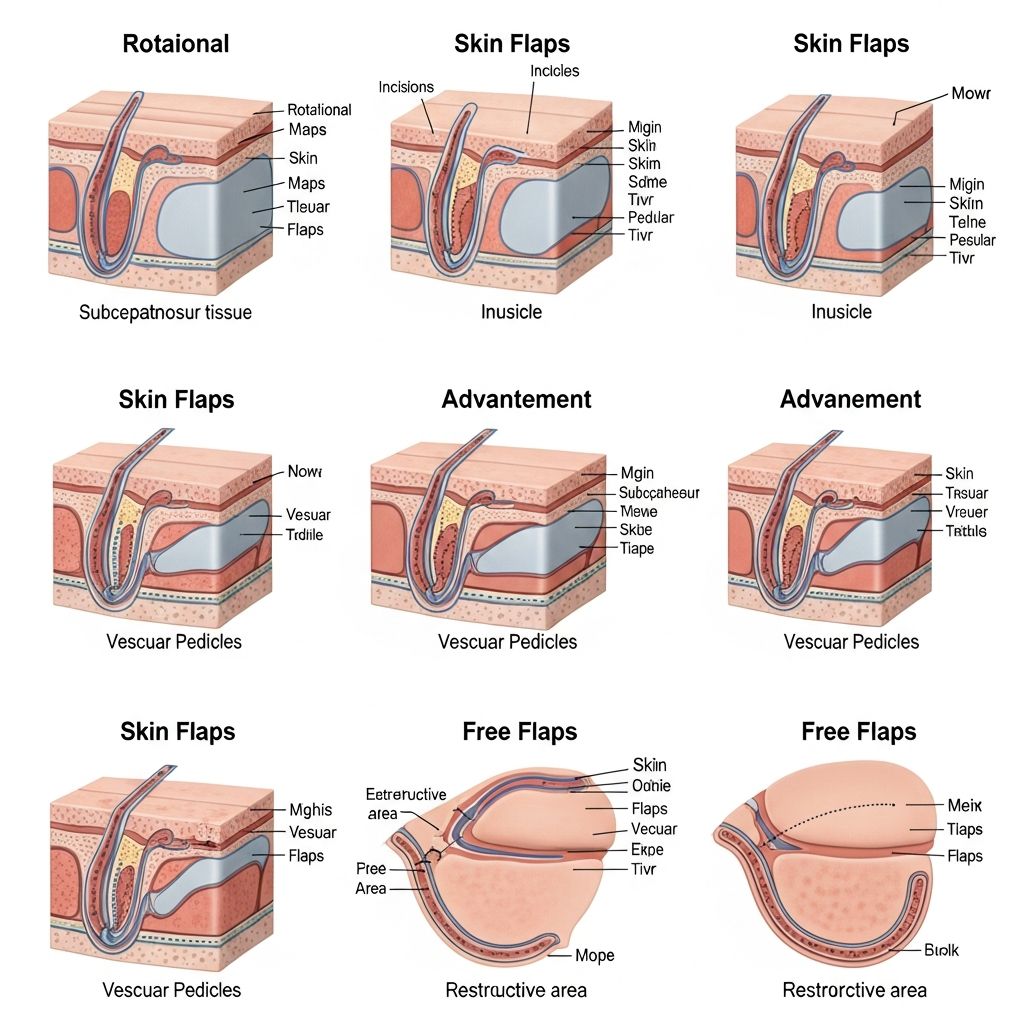
A
skin flap
is a reconstructive technique in dermatologic surgery where skin and underlying tissue from an adjacent area are transferred to cover a surgical defect, maintaining an intact blood supply from the donor site.What is a skin flap?
Skin flaps serve as a primary method for wound closure when direct edge approximation is not feasible due to large defects from excisions, such as those following skin cancer removal. Unlike skin grafts, which are completely detached and rely on the recipient bed for neovascularization, flaps retain their vascular pedicle, ensuring immediate viability and faster healing.
This technique is essential for defects too extensive for primary closure, providing coverage that matches the colour, texture, and thickness of the lost tissue. Flaps promote rapid integration as new vessels from the recipient site eventually supply the flap, typically within 2-3 weeks.
How to use skin flaps
Skin flaps are indicated when the wound cannot be closed primarily or by secondary intention healing. Surgeons select flaps based on defect size, location, available donor tissue, and cosmetic considerations. Preoperative planning involves assessing vascular anatomy to preserve the pedicle.
Common applications include reconstruction after Mohs surgery for basal cell carcinoma or other skin lesions on the face, where aesthetics are paramount. Flaps are preferred over grafts for areas with thin skin or high mobility, like the nose or lips.
Benefits of skin flaps
Skin flaps offer several advantages:
- Superior cosmetics: Tissue similarity yields better colour match and contour than grafts.
- Reliable blood supply: Reduces necrosis risk compared to grafts.
- Faster healing: Intact vasculature supports quicker epithelialization.
- Minimal donor morbidity: Adjacent sites avoid distant harvesting wounds.
- Versatility: Adaptable to various defect shapes and sizes.
Studies confirm locoregional flaps achieve optimal outcomes in midface defects by respecting subunit principles and vascular pedicles.
Different types of skin flaps
Skin flaps are classified by blood supply, tissue type, donor site location, and movement dynamics. Key categories include:
| Category | Description |
|---|---|
| Blood Supply | Random pattern (diffuse dermal plexus) vs. axial pattern (named artery/vein). |
| Tissue Type | Cutaneous, fasciocutaneous, muscle, bone-containing. |
| Donor Site Location | Local (adjacent), regional, distant (free flaps). |
| Movement | Advancement, rotation, transposition, interpolation. |
Local flaps
Most common in dermatology, sourced from adjacent lax skin. Examples:
- Advancement flaps: Tissue slides directly into defect. Used on cheeks or forehead; requires undermining and dog-ear correction.
- Rotation flaps: Semicircular pivot around a point. Ideal for triangular defects on scalp or cheek.
- Transposition flaps: Tissue rotates over intact skin, e.g., rhomboid (90° parallelogram) or bilobed flaps for nasal ala.
Interpolation flaps
Pedicled flaps tunnelled through intact skin, divided in a second stage. Examples include nasolabial, paramedian forehead, melolabial, and retroauricular flaps. The nasolabial flap (NLF), based on facial artery branches, reconstructs medium nasal sidewall/ala defects.
Regional and distant flaps
From nearby regions (e.g., cheek for lip) or distant sites with microvascular anastomosis (free flaps), less common in outpatient dermatology.
How skin flaps work
Flaps survive via the pedicle until recipient site angiogenesis occurs. Random flaps rely on dermal plexus; axial on direct vessels for longer reach.
Procedure steps:
- Defect excision/Mohs confirmation.
- Flap design matching defect size/orientation (Langer’s lines).
- Undermining donor tissue preserving fat/subcutis.
- Pedicle identification and incision.
- Inset into defect with tension-free closure.
- Donor site primary closure or grafting.
- Two-stage for interpolation: pedicle division after 2-3 weeks.
Related Stories



In midface, algorithms guide selection: defects >3cm use perforator flaps; nasolabial fold proximity influences choice.
Key techniques from literature
| Flap Name | Type | Main Region | Defect Size |
|---|---|---|---|
| Nasolabial Flap | Advancement | Nose | Medium |
| Paramedian Flap | Rotational | Nose | Medium-Large |
| Retroangular Flap | Transpositional | Cheek | Medium |
Complications and considerations
Potential issues include:
- Tip necrosis: Due to pedicle compromise; <5% with proper design.
- Tension/pinch: Avoid by wide undermining.
- Donor mismatch: Colour/texture differences.
- Infection/hematoma: Prevented by sterile technique, drains if needed.
- Scarring: Optimized by elective tension lines.[10]
Hypertrophic scars or keloids risk higher in predisposed patients.[10] Postoperative care: elevate, avoid smoking, monitor pedicle colour.
Aftercare
Expect tenderness 1-2 hours post-anesthesia wear-off. Dressings cover both sites. Clean daily with saline; antibiotics if indicated. Avoid strenuous activity 1-2 weeks. Sutures removed 5-14 days based on site.
Interpolation flaps require second surgery ~3 weeks. Full healing 4-6 weeks; sun protection vital for scars.
Frequently Asked Questions (FAQs)
What is the difference between a flap and a graft?
A flap retains its blood supply via pedicle; a graft is avascular initially, relying on recipient bed.
Are skin flaps painful?
Local anesthesia minimizes intraoperative pain; mild soreness managed with analgesics.
How long until I can resume normal activities?
Light activities in days; full after 2-4 weeks, per surgeon.
Will the scar be noticeable?
Flaps yield excellent camouflage due to tissue match; fades over months.
Can anyone get a skin flap?
Suitable for most; contraindicated in uncontrolled vascular disease or infection.
Related topics
References
- Flaps — DermNet NZ. 2007 (Updated). https://dermnetnz.org/topics/flaps
- Locoregional Flaps for the Reconstruction of Midface Skin Defects — J Clin Med. 2023-05-26. https://pmc.ncbi.nlm.nih.gov/articles/PMC10253803/
- Wound closure techniques — DermNet NZ. https://dermnetnz.org/topics/wound-closure
- Bioengineered skin — DermNet NZ. https://dermnetnz.org/topics/bioengineered-skin
- Skin Grafting — DermNet NZ. https://dermnetnz.org/topics/skin-grafting
Similar Articles








Read full bio of medha deb