Focal Cutaneous Mucinosis Pathology: Clinical And Histology
Detailed pathology of focal cutaneous mucinosis: clinical features, histopathology, diagnosis, and management of this benign dermal mucin deposition disorder.
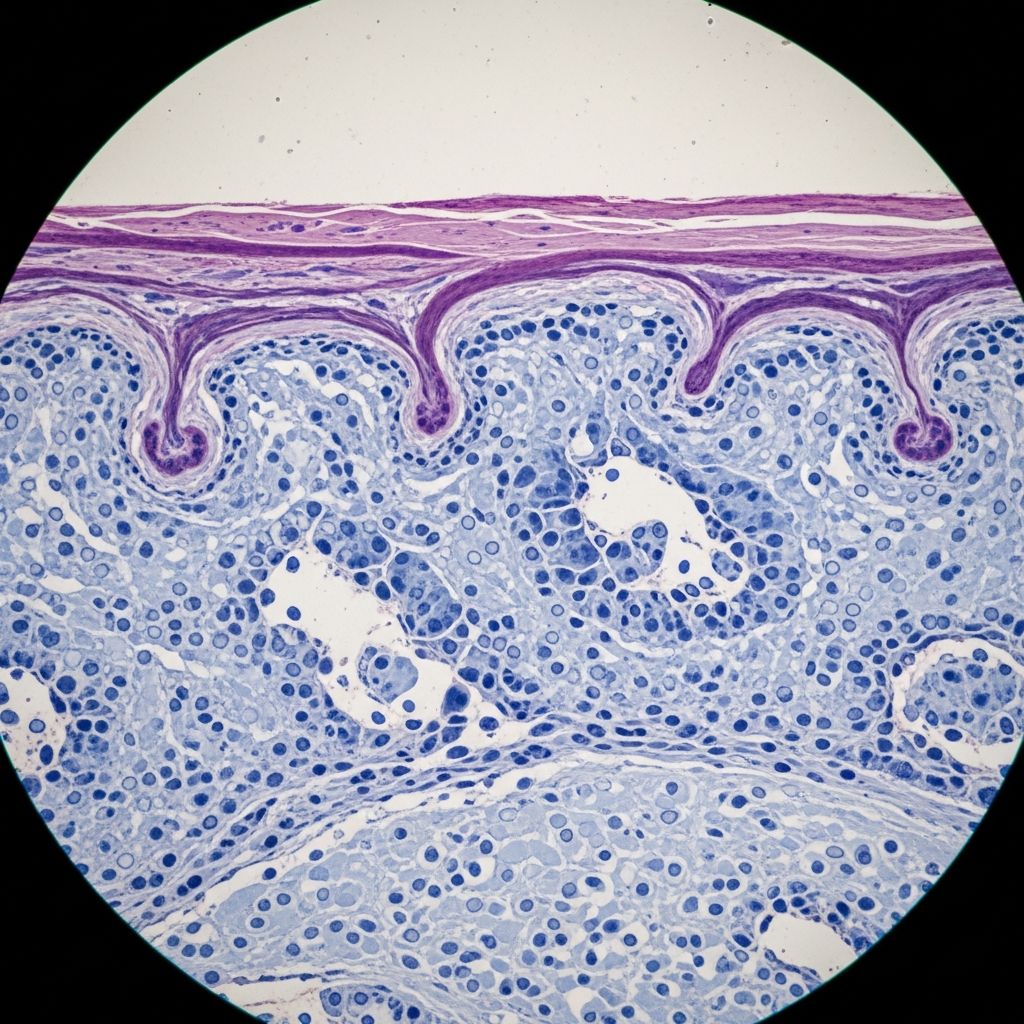
Author: Dr. Harriet Cheng, Dermatopathologist, Reviewed: Dr. Amanda Oakley, Dermatologist
Introduction
Focal cutaneous mucinosis, also known as cutaneous focal mucinosis (CFM), represents a rare, benign primary cutaneous mucinosis characterized by localized deposition of mucin—a gel-like substance composed primarily of hyaluronic acid—in the dermis. This condition typically manifests as a solitary, asymptomatic, dome-shaped papule or nodule, distinguishing it from generalized mucinoses associated with systemic diseases. First described by Johnson and Helwig in 1966, focal cutaneous mucinosis is not linked to extracutaneous involvement in its solitary form, making it a self-limited entity often managed by simple excision.
The pathology of focal cutaneous mucinosis reveals a well-circumscribed pool of mucin in the upper dermis, eliciting a loose stromal reaction with fibroblasts but lacking significant inflammation or vascular proliferation. Clinically, lesions measure less than 1 cm in diameter, appear flesh-colored to translucent, and favor acral sites like the extremities, though occurrences on the trunk, head, neck, or even unusual locations such as the mammary areola have been documented. Unlike multiple lesions, which may signal scleromyxoedema or lupus erythematosus, solitary cases require no systemic workup.
This article delves into the clinical presentation, histopathology, differential diagnosis, and management of focal cutaneous mucinosis, synthesizing evidence from peer-reviewed case series and histopathological studies to aid dermatologists and pathologists in accurate recognition.
Clinical features
Focal cutaneous mucinosis presents as a solitary, asymptomatic lesion, typically a smooth-surfaced, dome-shaped papule or nodule ranging from 2–10 mm in diameter. The surface is often shiny or slightly umbilicated, with colors varying from flesh-toned to white, pink, or reddish. Lesions are firm to soft on palpation due to the underlying mucinous pool.
- Site predilection: Predominantly upper extremities (arms > legs), upper back, and trunk; rare sites include head, neck, fingers, palms, and mammary areola.
- Age and sex: Most common in adults aged 29–60 years, with a slight male predominance (reported in approximately 55% of cases across 182 documented patients).
- Duration: Slow-growing over months to years; non-tender and non-pruritic.
- Associations: Solitary lesions lack systemic links; multiple lesions warrant investigation for thyroid disease, scleromyxoedema, or SLE.
Dermoscopy may show a non-specific homogenous whitish pattern or, rarely, a sharply demarcated yellow border. Trauma, such as laser epilation or piercing, has been implicated as a trigger in select cases, particularly at the areola.
Pathology
Microscopic features: The hallmark is a circumscribed, unencapsulated pool of pale basophilic mucin occupying the upper-to-mid dermis, often bulging the overlying epidermis into a dome shape. Mucin deposits form nodular or polylobulated patterns, separated by thin fibrous septa containing stellate or spindle-shaped fibroblasts. There is no encapsulation, inflammation, or increased vascularity. The epidermis is normal or slightly atrophic with a peripheral collarette; elastic fibers may be diminished.
- Low power: Well-demarcated dermal mucin pool elevating the epidermis.
- High power: Abundant metachromatic mucin with scattered fibroblasts (normal density); occasional FXIIIa-positive dendritic cells; no atypical cells or mitoses.
Special stains:
- Confirm mucin with Alcian blue (pH 2.5) or colloidal iron (dark blue staining); toluidine blue also positive.
- Mucin is hyaluronidase-sensitive, distinguishing it from dermal sclerosis or amyloid.
Related Stories



Immunohistochemistry reveals vimentin-positive fibroblasts; partial FXIIIa expression in stromal cells (20–30%); negative for CD34, SMA, desmin, CD68, and S-100, ruling out neural or vascular lesions.
Differential diagnosis
The clinical mimicry of focal cutaneous mucinosis necessitates biopsy for confirmation, as it is rarely suspected preoperatively. Key differentials include:
| Condition | Key Distinguishing Features |
|---|---|
| Dermatofibroma | Entrapped collagen, epidermal hyperplasia, increased fibroblasts/capillaries; no mucin. |
| Neurofibroma | Wagner-Meissner bodies, S-100+; diffuse growth, not focal mucin pool. |
| Dermal adnexal cyst | Epithelial lining, keratin content; no stromal mucin. |
| Basal cell carcinoma | Peripheral palisading, retraction artifact, basaloid cells. |
| Myxoma/Angiomyxoma | Prominent vessels, multinucleated giants, subcutis extension; SMA+ stroma. |
| Seborrhoeic keratosis | Stuck-on appearance, horn cysts, acanthosis. |
Histologically, plaque-type or aggressive angiomyxoma show more vascularity and cellularity. Multiple lesions evoke scleromyxoedema (systemic mucin with monoclonal gammopathy).
Management
Observation suffices for asymptomatic lesions, but complete surgical excision is curative and diagnostic, with no recurrences reported post-excision. Topical steroids may flatten plaque variants, though evidence is anecdotal. No role for systemic therapy in solitary cases. Patients with multiple lesions require thyroid function tests, ANA, and SPEP to exclude associations.
Frequently asked questions
What is focal cutaneous mucinosis?
A benign skin condition with localized dermal mucin deposition, presenting as a solitary papule without systemic involvement.
Is focal cutaneous mucinosis cancerous?
No, it is entirely benign with no malignant potential.
How is focal cutaneous mucinosis diagnosed?
By skin biopsy showing dermal mucin pool confirmed with Alcian blue or colloidal iron stains.
Does focal cutaneous mucinosis require treatment?
Excision if symptomatic or for cosmesis; otherwise, observation.
Can trauma cause focal cutaneous mucinosis?
Yes, cases linked to laser epilation or piercing suggest a reactive etiology.
Etiology and pathogenesis
The precise cause remains elusive, posited as a reactive fibroblast dysfunction leading to hyaluronic acid overproduction. Trauma may incite localized mucin accumulation via CD44 receptor dysregulation. Unlike metabolic mucinoses, no fibroblast proliferation or inflammation occurs.
Prognosis
Excellent; excision prevents recurrence. Solitary lesions carry no systemic risk.
References
- Solitary Cutaneous Focal Mucinosis — Nihal Wollina et al. 2021-10-28. https://pmc.ncbi.nlm.nih.gov/articles/PMC8580111/
- Trauma-Induced Cutaneous Focal Mucinosis of the Mammary Areola — Isabelle Moulonguet et al. 2016-01-01. https://pmc.ncbi.nlm.nih.gov/articles/PMC4772926/
- Case report and review of solitary cutaneous focal mucinosis — eScholarship Repository. 2018-01-01. https://escholarship.org/content/qt33m815p3/qt33m815p3_noSplash_0a0e24bf2a3df32f4e32bef31e494690.pdf
- Cutaneous mucinoses — DermNet NZ. 2023-01-01. https://dermnetnz.org/topics/cutaneous-mucinoses
- Focal cutaneous mucinosis pathology — DermNet NZ. 2023-01-01. https://dermnetnz.org/topics/focal-cutaneous-mucinosis-pathology
Similar Articles








Read full bio of Sneha Tete