Folliculitis Keloidalis Nuchae Pathology
Understanding the histopathological features and diagnostic criteria of folliculitis keloidalis nuchae.
Folliculitis Keloidalis Nuchae Pathology: An Overview
Folliculitis keloidalis, also referred to as folliculitis keloidalis nuchae (FKN), represents one of the most significant neutrophilic scarring alopecias affecting the hair follicles of the occipital scalp and nape of the neck. While commonly known as acne keloidalis nuchae (AKN), this chronic inflammatory condition is not related to acne vulgaris, and the scars that form are not true keloid scars. Understanding the pathological features of this condition is essential for accurate diagnosis and effective management strategies. The histopathological examination reveals distinctive characteristics that differentiate FKN from other inflammatory and infectious follicular disorders.
Classification and Disease Category
Folliculitis keloidalis is best classified as one of the neutrophilic scarring alopecias, a group of conditions characterized by neutrophil-predominant inflammation that results in permanent hair loss. This classification distinguishes FKN from other forms of folliculitis and places it in a specific category of scarring hair disorders. The neutrophilic infiltrate, combined with the presence of dermal scarring and follicular disruption, defines the pathological signature of this disease. This classification is clinically important because it helps guide treatment approaches and prognostic counseling for affected patients.
Microscopic and Histological Features
Low Power View Findings
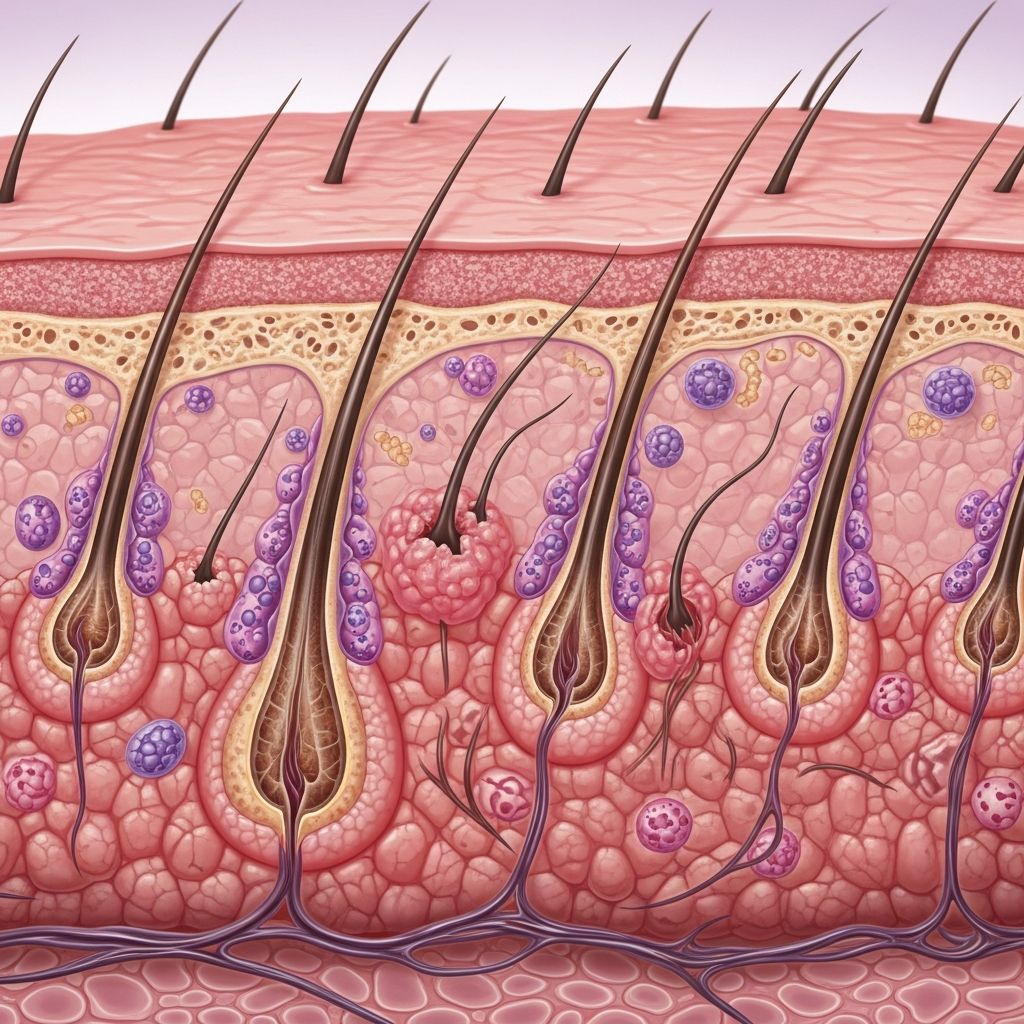
At low magnification, histological examination of folliculitis keloidalis nuchae reveals several characteristic features. A dense superficial and deep inflammatory process is evident, accompanied by dermal scarring and follicular disruption. The lesions often display variable degrees of overlying scale and crust formation, with tufted hair follicles appearing as multiple hair shafts within widened follicular infundibulae. These tufted follicles represent a hallmark finding that contributes to the distinctive appearance under microscopy and aids in clinical-pathological correlation.
High Power View Findings
Upon higher magnification, the dermis shows disrupted hair follicles with scattered naked hair shafts embedded within a fibrotic dermal environment. The inflammatory infiltrate is composed predominantly of a dense lymphoplasmacytic population, with scattered neutrophils distributed throughout the tissue. This cellular composition distinguishes FKN from other follicular disorders and reflects the chronicity and intensity of the inflammatory process. The naked hair shafts observed in the dermis indicate the degree of follicular destruction and help explain the progressive hair loss associated with this condition.
Inflammatory Pattern and Cellular Composition
The inflammatory infiltrate in folliculitis keloidalis nuchae demonstrates a characteristic pattern that helps differentiate this condition from other dermatological disorders. The presence of a dense lymphoplasmacytic infiltrate with scattered neutrophils creates a distinctive histological signature. This inflammatory composition reflects the chronic nature of the disease, as the predominance of lymphocytes and plasma cells indicates a long-standing immune response, while the presence of neutrophils suggests episodes of acute inflammation or secondary infection. Understanding this pattern is crucial for pathologists in making accurate diagnoses and for clinicians in understanding the disease pathophysiology.
Follicular Disruption and Scarring Mechanisms
One of the defining pathological features of folliculitis keloidalis nuchae is the extent and nature of follicular disruption. The condition leads to progressive destruction of hair follicles, with multiple disrupted follicles evident throughout the affected tissue. The follicular damage results in the release of hair shafts into the dermis, creating a foreign body-type inflammatory response that perpetuates the disease process. This follicular destruction is irreversible, leading to permanent scarring alopecia if the condition is not managed effectively in its early stages.
The dermal scarring component of FKN reflects the tissue’s response to chronic inflammation and repeated follicular rupture. Fibrosis develops as the dermis attempts to repair the damage caused by the inflammatory infiltrate and follicular disruption. This scarring process converts the early papular and pustular lesions into the characteristic keloid-like plaques and nodules that define advanced disease. The progressive nature of scarring underscores the importance of early intervention and aggressive management to prevent cosmetically disfiguring outcomes.
Related Stories



Tufted Follicles and Pathognomonic Features
The presence of tufted hair follicles, characterized by multiple hair shafts within widened follicular infundibulae, represents a pathognomonic feature of folliculitis keloidalis nuchae. This finding occurs due to the follicular damage and disruption that allows multiple hairs to become grouped within abnormally enlarged follicular structures. Tufted follicles can be observed both on histological examination and sometimes on dermoscopic evaluation, making them useful diagnostic markers for clinicians. This feature distinguishes FKN from other forms of folliculitis and contributes to the distinctive clinical appearance of the condition.
Differential Diagnosis: Pathological Distinctions
Distinction from Deep Infectious Folliculitis
Folliculitis keloidalis nuchae must be distinguished from deep infectious folliculitis, a critical differentiation that requires careful histopathological analysis. In cases of deep infectious folliculitis, the inflammatory infiltrate tends to form tightly around the involved follicle with less extensive follicular disruption or dermal scarring compared to FKN. Special stains are invaluable in making this distinction, as they can identify specific pathogens that may be responsible for infectious folliculitis. When diagnostic uncertainty exists, culture studies should be recommended to exclude bacterial or fungal infections. This differentiation is clinically important because it fundamentally alters the treatment approach, with infectious folliculitis requiring antimicrobial therapy whereas FKN requires anti-inflammatory and immunosuppressive strategies.
Distinction from True Keloid Scars
Although folliculitis keloidalis nuchae produces keloid-like lesions, the pathological features differ significantly from true keloid scars. True keloids represent dermal fibroproliferative growths caused by pathologic wound healing following skin injury, with characteristic histological findings of dense collagen deposition without significant inflammatory infiltrates. In contrast, FKN maintains an active inflammatory process with lymphoplasmacytic infiltration throughout the disease course, distinguishing it as an inflammatory rather than purely fibroproliferative disorder. This distinction has important implications for treatment selection, as true keloids and inflammatory keloid-like lesions respond differently to various therapeutic modalities.
Relationship to Clinical Presentation
The histopathological features of folliculitis keloidalis nuchae correlate directly with clinical manifestations observed on physical examination. The early papules and pustules correspond to the acute inflammatory phase dominated by neutrophilic infiltration. As the disease progresses, repeated cycles of inflammation and follicular rupture lead to increasing dermal fibrosis, which manifests clinically as firm, hypertrophic plaques and keloid-like nodules. The development of scarring alopecia and permanent hair loss directly results from the destruction of hair follicles seen on histology. This clinical-pathological correlation emphasizes that FKN is a progressive disease if left untreated, progressing from a superficial folliculitis to a deeply scarring alopecia.
Scale and Crust Formation
The variable degrees of overlying scale and crust observed in folliculitis keloidalis nuchae reflect the chronic inflammatory state and secondary events such as infection or drainage of pustules. The scale formation results from abnormal keratinization in response to inflammation, while crust formation indicates open or draining pustules. These features are important diagnostic clues that help clinicians recognize FKN in its early stages and distinguish it from other scalp conditions. The presence of scale and crust should prompt evaluation of the underlying follicular structures to assess the degree of follicular involvement and determine the appropriate treatment intensity.
Diagnostic Approach and Biopsy Considerations
While folliculitis keloidalis nuchae is primarily a clinical diagnosis based on characteristic physical findings of papules, pustules, and keloid-like plaques on the occipital scalp and nape of the neck, biopsy can provide valuable confirmatory information when diagnostic uncertainty exists. When a biopsy is considered necessary, ideally a punch biopsy should include a suspected keloidal papule and the base of the hair follicle to capture the full spectrum of pathological changes. The histology of FKN is characteristically distinctive, and the aforementioned features will reliably differentiate it from other inflammatory and infectious conditions affecting the hair follicles.
Fibrosis and Hypertrophic Scar Development
The progression from active inflammation to fibrosis and hypertrophic scarring represents a critical pathological transition in folliculitis keloidalis nuchae. Early in the disease, neutrophilic and lymphoplasmacytic infiltration predominates, but as the condition progresses, fibroblast activation and collagen deposition increase. This results in the development of hypertrophic scars and keloid-like plaques. The degree of fibrosis often reflects the chronicity and severity of the antecedent inflammation, with longer-standing disease showing more extensive scarring. Understanding this progressive nature underscores why early treatment is so important in preventing advanced cosmetic deformity.
Key Pathological Features Summary
The essential pathological findings in folliculitis keloidalis nuchae include:
- Dense superficial and deep inflammatory infiltrate with prominent lymphoplasmacytic cells and scattered neutrophils
- Disrupted hair follicles with naked hair shafts in the dermis
- Tufted hair follicles with multiple shafts in widened infundibulae
- Progressive dermal fibrosis and scarring
- Variable overlying scale and crust formation
- Absence of true keloid histology despite keloid-like clinical appearance
Clinical Implications of Pathological Understanding
A comprehensive understanding of the pathological features of folliculitis keloidalis nuchae has significant clinical implications. First, it explains why this condition is classified as a scarring alopecia—the follicular destruction is permanent. Second, it justifies aggressive early treatment approaches aimed at controlling inflammation before extensive fibrosis develops. Third, it clarifies why late-stage disease with large keloid-like plaques is more difficult to treat, as the pathological process has shifted from predominantly inflammatory to predominantly fibrotic. Finally, it highlights the importance of patient education regarding prevention strategies, such as avoiding trauma to the nape of the neck through appropriate hair care practices.
Frequently Asked Questions
Q: Is folliculitis keloidalis nuchae the same as true acne vulgaris?
A: No. Although commonly called acne keloidalis nuchae, FKN is not related to acne vulgaris. Instead, it is a chronic scarring folliculitis with a distinct pathological process involving follicular disruption and permanent scarring, whereas acne vulgaris involves pilosebaceous unit inflammation without the same degree of scarring.
Q: Are the scars in folliculitis keloidalis nuchae true keloid scars?
A: No. Although FKN produces keloid-like lesions clinically, they are not true keloid scars histopathologically. True keloids are fibroproliferative growths without significant inflammatory infiltrate, whereas FKN maintains an active lymphoplasmacytic infiltrate throughout the disease course.
Q: Why is biopsy rarely necessary for diagnosis?
A: Folliculitis keloidalis nuchae can be diagnosed clinically based on the characteristic appearance of papules, pustules, and keloid-like plaques on the occipital scalp and nape of the neck. However, when diagnostic uncertainty exists, particularly to exclude infectious folliculitis, a biopsy can provide confirmatory histopathological findings.
Q: What is the significance of the tufted follicle finding?
A: Tufted hair follicles, characterized by multiple hair shafts within widened follicular infundibulae, represent a pathognomonic feature of folliculitis keloidalis nuchae. This finding aids in diagnosis and indicates follicular damage and disruption as part of the disease process.
Q: How does understanding the pathology help guide treatment?
A: Understanding that FKN involves progressive follicular destruction and dermal scarring justifies early, aggressive anti-inflammatory treatment to prevent irreversible damage before the condition transitions to predominantly fibrotic disease. This emphasizes the importance of early intervention for optimal cosmetic outcomes.
References
- Folliculitis keloidalis nuchae pathology — DermNet New Zealand. Accessed 2026-01-28. https://dermnetnz.org/topics/folliculitis-keloidalis-nuchae-pathology
- Keloid scars: recognition and management — The Pharmaceutical Journal. 2024. https://pharmaceutical-journal.com/article/ld/keloid-scars-recognition-and-management
- Folliculitis keloidalis — DermNet New Zealand. Accessed 2026-01-28. https://dermnetnz.org/topics/folliculitis-keloidalis
- Folliculitis — StatPearls, National Center for Biotechnology Information, National Institutes of Health. 2024. https://www.ncbi.nlm.nih.gov/books/NBK547754/
- Acne Keloidalis Nuchae: What It Is, Causes & Treatment — Cleveland Clinic. 2024. https://my.clevelandclinic.org/health/diseases/22891-acne-keloidalis-nuchae
- Acne Keloidalis Nuchae: Signs and Symptoms — American Academy of Dermatology. Accessed 2026-01-28. https://www.aad.org/public/diseases/a-z/acne-keloidalis-nuchae-symptoms
Similar Articles








Read full bio of Sneha Tete