Forceps Delivery: Purpose, Procedure & Safety
Understanding forceps delivery: when it's used, how it works, and what to expect.
What Is a Forceps Delivery?
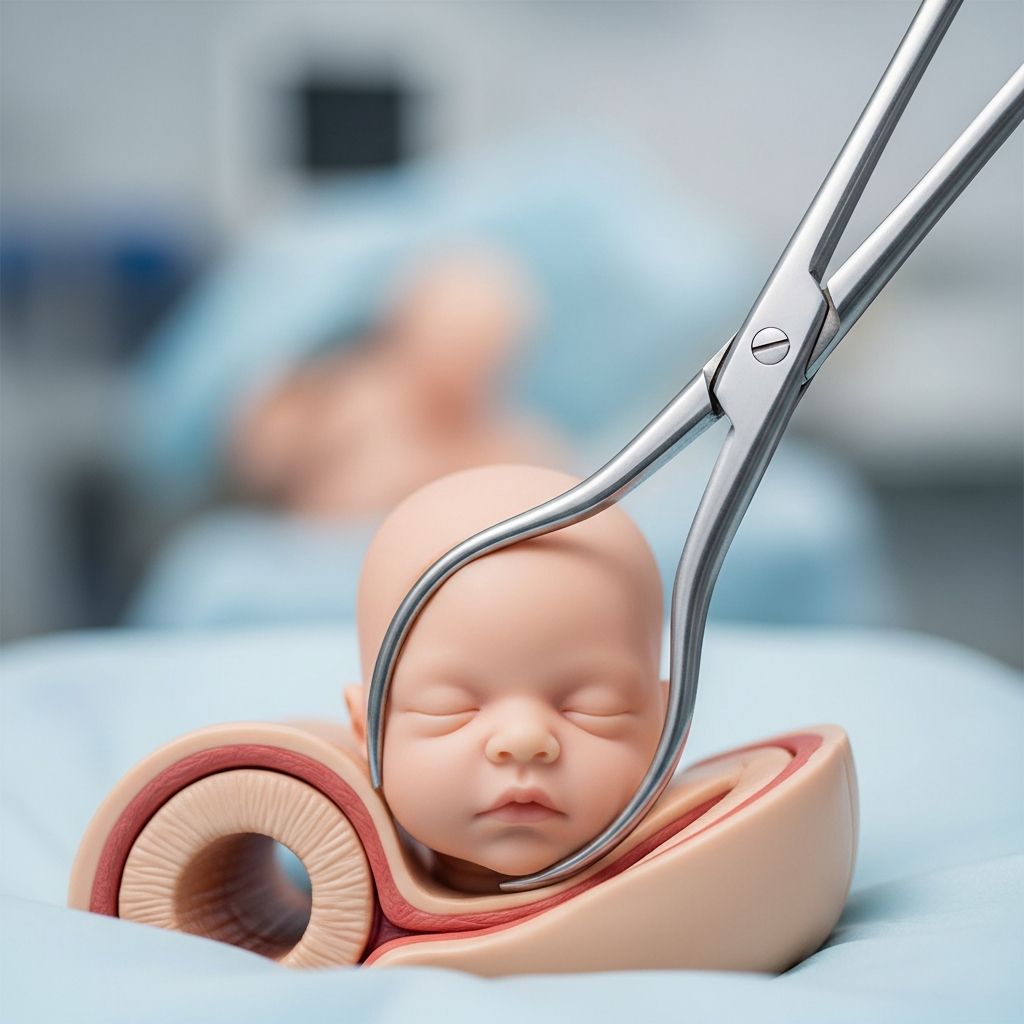
A forceps delivery is an assisted vaginal delivery method in which an obstetrician uses specialized medical instruments called forceps to help guide your baby through the birth canal during labor. Forceps resemble two large spoons or salad tongs and are designed to gently cradle the baby’s head while providing traction and guidance during the second stage of labor. This procedure is performed when vaginal delivery becomes complicated or prolonged, and it serves as an alternative to vacuum extraction or cesarean section delivery.
During a forceps delivery, the doctor carefully inserts the forceps one at a time and locks them in position around the baby’s head. As you push during contractions, the doctor guides the baby downward through the birth canal. The procedure requires specific conditions to be met and careful technique to ensure the safety of both mother and baby.
When Is Forceps Delivery Used?
Forceps delivery is indicated in specific clinical situations where assisted delivery becomes necessary to facilitate vaginal birth or protect maternal health. Understanding when forceps are appropriate helps expectant parents and healthcare providers make informed decisions about delivery options.
Medical Indications for Forceps Delivery
Forceps delivery may be recommended in the following circumstances:
– Prolonged second stage of labor extending beyond the normal timeframe from full cervical dilation until delivery of the fetus- Suspicion of fetal compromise indicated by abnormal fetal heart rate patterns or other signs of fetal distress- Maternal exhaustion from pushing during prolonged labor, when the mother can no longer effectively push during contractions- Maternal cardiac dysfunction or neurologic disorders that contraindicate pushing efforts- Need to shorten the second stage of labor for maternal benefit- Situations where the baby is stuck in the birth canal and showing signs of distress- Delivery of premature infants where specific conditions are met- Multiple pregnancies requiring assisted delivery of one or more babies
When Forceps May Be the Safest Option
Your healthcare provider may recommend forceps delivery when:
– The baby is in face presentation, with the back of the baby’s skull against the baby’s upper back- The baby is premature and requires careful delivery assistance- The mother has high blood pressure, heart disease, or other health conditions that make pushing risky- The mother is experiencing severe exhaustion and cannot continue pushing effectively- The baby is positioned in a way that makes vaginal delivery challenging but possible with assistance
Preparation for Forceps Delivery
Before proceeding with forceps delivery, specific criteria must be met to ensure patient safety and increase the likelihood of successful vaginal delivery. The American College of Obstetricians and Gynecologists outlines essential requirements that must be fulfilled before attempting operative vaginal delivery.
Required Criteria Before Forceps Delivery
Your healthcare team must verify the following conditions are present:
– Cervix is fully dilated to 10 centimeters- Membranes are ruptured- Fetal head is engaged in vertex presentation (head first position)- Fetal position is known and determined by the examining physician- Fetal weight has been estimated- Maternal pelvis is determined to be adequate for vaginal delivery- Appropriate anesthesia has been administered- Maternal bladder is empty- Maternal consent has been obtained with thorough explanation of risks and benefits- A backup plan exists if the operative delivery method fails
Preparation and Team Coordination
Successful forceps delivery requires careful preparation and coordination among the healthcare team. Your anesthesia team must be notified in advance to prepare appropriate pain management, typically regional anesthesia such as epidural or pudendal block along with local perineal anesthesia. The pediatric team should also be alerted and prepared for immediate assessment and care of the newborn following delivery.
Related Stories



An episiotomy, often a right mediolateral episiotomy, is usually performed to provide additional space and reduce the risk of vaginal lacerations. Preparation for acid-base cord blood sampling should be included for all complicated deliveries to assess the baby’s condition at birth. The entire healthcare team must work together to ensure smooth coordination and readiness throughout the procedure.
The Forceps Delivery Procedure
Understanding the step-by-step process of forceps delivery can help reduce anxiety and prepare you for what to expect during this assisted vaginal delivery method.
How the Procedure Works
Once all prerequisite conditions are met and your healthcare team is prepared, the forceps delivery procedure begins. The doctor inserts the forceps one at a time, carefully positioning each blade alongside the baby’s head. The forceps are then locked together to secure them in position around the baby’s head. Traction is applied in a steady, controlled manner without rocking motion during contractions while you continue to push.
The application of traction should be gentle and progressive, typically resulting in delivery within the first, second, third, or fourth pull. The doctor guides the baby downward and outward through the birth canal, following the natural curve of the pelvis. When the baby’s head passes the vulvar ring, the forceps are removed in reverse order. Most cases progress smoothly, with delivery occurring within a few pulls when the procedure is performed correctly by an experienced provider.
Benefits of Forceps Delivery
Forceps delivery offers several important advantages compared to alternative delivery methods, particularly vacuum extraction and cesarean section delivery.
Advantages Over Vacuum Extraction
Forceps have distinct advantages when compared to vacuum-assisted delivery:
– Forceps are unlikely to detach from the baby’s head during the procedure- Forceps can be used for premature infants when appropriate conditions are met- Forceps allow for fetal rotation when needed to reposition the baby- Forceps result in less bleeding from the baby’s scalp- Forceps delivery is associated with less neonatal encephalopathy- Vacuum extraction is less likely to result in successful vaginal delivery compared to forceps
Advantages Over Cesarean Section
When applied properly during second stage labor arrest, forceps delivery has the potential to eliminate the need for cesarean section. Cesarean delivery is a more invasive surgical procedure with increased risk of postpartum infection and other complications. By successfully completing vaginal delivery with forceps when appropriate, both mother and baby avoid the risks associated with major abdominal surgery. Forceps delivery preserves the benefits of vaginal delivery while providing the necessary assistance during complicated labor.
Complications and Risks
While forceps delivery is generally safe when performed by experienced providers under appropriate conditions, potential complications can occur if forceps are improperly used or applied inappropriately.
Potential Complications for the Baby
If forceps are improperly used, the following complications may occur:
– Facial paralysis or nerve damage- Brachial plexus injury resulting in arm weakness or paralysis- Erb’s palsy affecting shoulder and arm movement- Skull fractures- Brain damage that can lead to cerebral palsy- Seizures- Scalp trauma and bruising- Eye trauma in rare cases
Potential Complications for the Mother
Maternal injuries from forceps delivery may include:
– Vaginal tears or lacerations- Rectal tears or anal sphincter injuries- Perineal trauma- Bladder or urethral injuries- Increased postpartum bleeding- Infection or sepsis
When Forceps Should Not Be Used
Forceps delivery should not be attempted when:
– The baby cannot fit through the mother’s pelvis- The baby has a bleeding disorder or weak bones- The baby’s position is unknown or cannot be determined- The baby is leading with their arms or shoulders during birth- The baby is significantly premature (more than 6 weeks)- The baby’s estimated weight suggests cephalopelvic disproportion- Maternal cervix is not fully dilated- Membranes have not ruptured
Recovery After Forceps Delivery
Recovery following forceps delivery typically follows the normal postpartum recovery timeline for vaginal delivery, though the extent of recovery depends on the degree of maternal and fetal trauma sustained during the procedure.
Immediate Postpartum Period
Immediately after delivery, your healthcare team will assess both you and your baby for any injuries. Your baby will receive standard newborn screening and assessment, with additional monitoring if complications are suspected. You will be monitored for bleeding and signs of infection. Pain management will be provided as needed, and your perineal area will be assessed and treated appropriately.
Recovery Timeline
Most women recover from forceps delivery within four to six weeks, similar to uncomplicated vaginal delivery. However, if significant perineal trauma occurred, recovery may take longer. You may experience perineal discomfort, which can be managed with ice packs, sitz baths, and pain medication. Pelvic floor physical therapy may be recommended to address any muscle or nerve injuries. Follow-up appointments with your obstetrician will monitor your healing and address any complications.
Safety and Medical Considerations
Forceps delivery requires specific training and expertise to perform safely. As cesarean sections have become more common, some doctors have less hands-on experience with forceps-assisted deliveries. In fact, only 0.5% of vaginal births involve forceps, according to recent data. This declining experience underscores the importance of having trained providers available at facilities equipped to perform forceps delivery.
Interprofessional Team Coordination
Successful forceps delivery outcomes depend on effective collaboration among healthcare professionals from different departments. This interprofessional approach requires advance planning to coordinate readiness from anesthesia, obstetrics, pediatrics, and nursing teams. Institutions practicing forceps deliveries must have systems in place that allow smooth transition from planned delivery to emergency intervention, ensuring positive outcomes in all scenarios.
Forceps Delivery vs. Other Delivery Methods
| Delivery Method | Maternal Safety | Fetal Safety | Success Rate | Invasiveness |
|---|---|---|---|---|
| Forceps Delivery | Moderate risk | Lower risk of complications | Higher when properly applied | Minimally invasive |
| Vacuum Extraction | Lower risk | Higher risk of complications | Lower success rate | Minimally invasive |
| Cesarean Section | Higher risk of infection | Safer in some situations | 100% operative success | Major surgery |
| Spontaneous Vaginal Delivery | Lowest risk | Lowest risk | Highest when uncomplicated | Non-invasive |
Frequently Asked Questions About Forceps Delivery
Q: Is forceps delivery safe for my baby?
A: Forceps delivery is generally safe when performed by trained providers under appropriate conditions. Your healthcare team will only recommend forceps if the benefits outweigh the risks and all required criteria are met. The procedure can actually prevent the need for cesarean section, which carries its own risks.
Q: Will forceps leave marks on my baby?
A: Temporary bruising or marks may occur on the baby’s face or head where the forceps were applied, but these typically fade within a few days to a week. Permanent marks are uncommon when forceps are used appropriately by experienced providers.
Q: How common is forceps delivery?
A: Forceps are used in approximately 0.5% of vaginal births in the United States. While less common than in previous decades, forceps remain an important tool for managing complicated deliveries when vacuum extraction is not suitable.
Q: What is the difference between forceps and vacuum extraction?
A: Both are assisted delivery methods, but forceps resemble spoons and grasp the baby’s head, while vacuum uses suction. Forceps are generally more successful at achieving vaginal delivery, while vacuum extraction may be safer for the mother in some cases. Forceps cannot detach and can be used for premature infants.
Q: Can I refuse forceps delivery?
A: Yes, you have the right to informed consent. However, if your healthcare provider recommends forceps to avoid cesarean section or for medical reasons, refusing the procedure may result in the need for surgery. Discuss the risks and benefits thoroughly with your doctor.
Q: Will I have an episiotomy with forceps delivery?
A: An episiotomy is common with forceps delivery to provide extra space and reduce the risk of severe lacerations. However, your healthcare provider will make this decision based on your specific situation and may attempt to avoid it if circumstances permit.
Q: What is the recovery time after forceps delivery?
A: Most women recover within four to six weeks, similar to uncomplicated vaginal delivery. Recovery time may be longer if significant perineal trauma occurred. You may experience discomfort managed with ice packs, sitz baths, and pain medication.
References
- Forceps Delivery — National Center for Biotechnology Information (NCBI), National Institutes of Health. 2024. https://www.ncbi.nlm.nih.gov/books/NBK538220/
- Operative Vaginal Delivery — MSD Manuals Professional Version. 2024. https://www.msdmanuals.com/professional/gynecology-and-obstetrics/labor-and-delivery/operative-vaginal-delivery
- Forceps Delivery Complications — American College of Obstetricians and Gynecologists (ACOG). 2024. https://www.cerebralpalsyguide.com/birth-injury/forceps-delivery-complications/
- Types of Delivery: Childbirth Options, Differences & Benefits — Cleveland Clinic. 2024. https://my.clevelandclinic.org/health/articles/9675-pregnancy-types-of-delivery
- Vaginal Delivery: What To Expect, Benefits & Complications — Cleveland Clinic. 2024. https://my.clevelandclinic.org/health/articles/23097-vaginal-delivery
- Vacuum Extraction Delivery: Procedure, Risks & Recovery — Cleveland Clinic. 2024. https://my.clevelandclinic.org/health/treatments/22305-vacuum-extraction-delivery
Similar Articles








Read full bio of medha deb