Fordyce Spots: 5 Cosmetic Treatment Options And Outcomes
Common, harmless ectopic sebaceous glands on lips, mouth, and genitals – no treatment usually needed.
Fordyce spots, also known as Fordyce granules or Fordyce glands, represent a common and entirely benign condition characterized by
ectopic sebaceous glands
—oil-producing glands that appear in unusual locations without associated hair follicles. These glands are typically visible on thelips
,oral mucosa
(inner cheeks and gums), andgenital mucosa
(such as the inner labia minora in women or the glans penis and scrotum in men). Present in up to 80-95% of adults, they increase in visibility with age and stretching of the skin or mucosa, but pose no health risk, are non-contagious, and rarely require intervention.What are Fordyce spots?
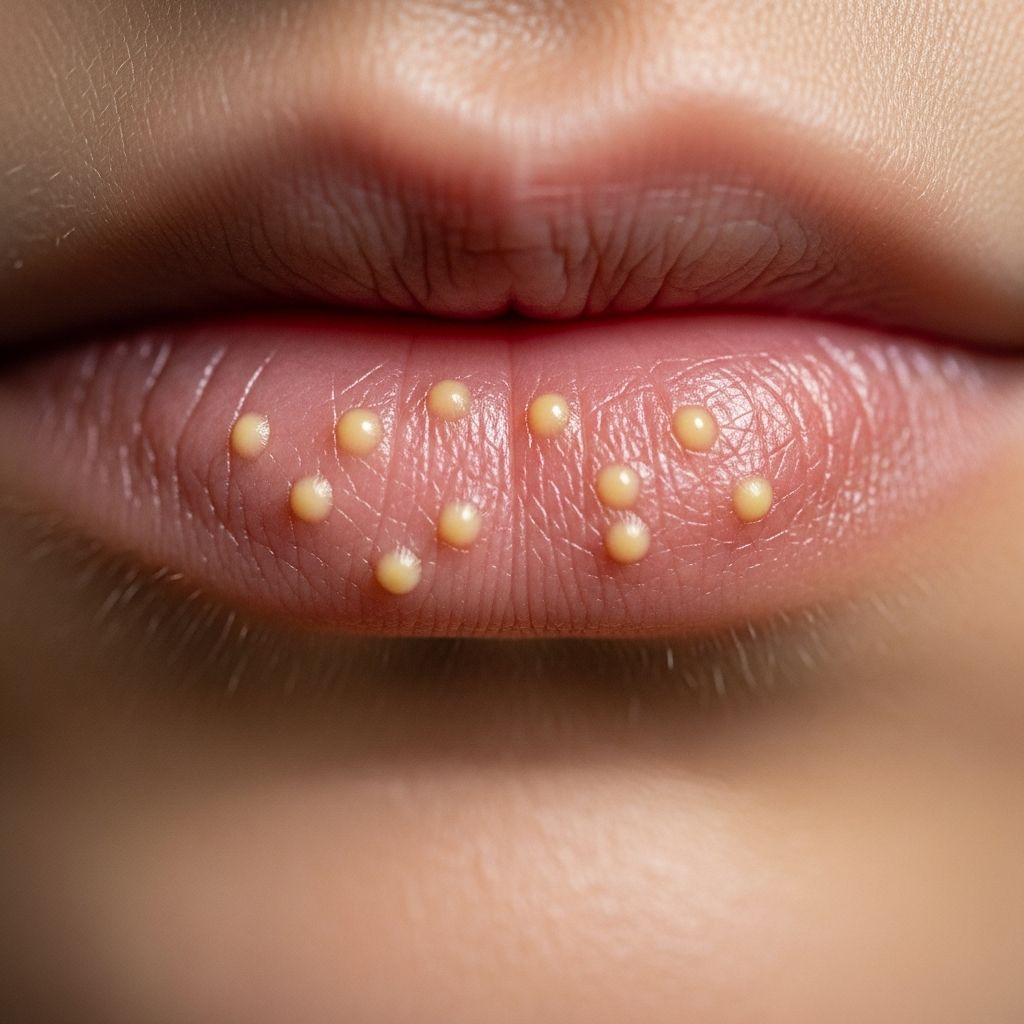
Fordyce spots consist of mature sebaceous lobules located in the dermis or submucosa, often opening directly onto the mucosal surface without connecting to hair follicles. Unlike normal sebaceous glands, which are paired with hairs, these are free-standing and produce sebum that can make them appear oily or yellowish. They measure 1-3 mm in diameter, presenting as small, discrete, whitish-yellow, pale red, or flesh-colored papules that may cluster together.
Histologically, the glands range from 1.62 ± 0.55 mm in size, predominantly in the upper dermis (81.3%), with sebaceous ducts opening directly to the surface in most cases (81.3%). No inflammation or atypical cells are present, confirming their benign nature.
Who gets Fordyce spots?
Fordyce spots affect nearly all adults to some degree, with prevalence rising from about 20-30% in childhood to 80-95% by adulthood. They are more prominent in men and increase with age due to glandular hypertrophy. Rare ectopic sites include the esophagus, cervix, or tongue, but oral and genital locations predominate.
In a clinicopathologic study of 16 patients (mean age 37.9 years), lesions appeared after an average incubation of 1.9 years (range: days to 5 years), mostly in early to middle adulthood.
What causes Fordyce spots?
The exact etiology remains unclear, but they likely arise from abnormal embryonic disposition of sebaceous glands. Hormonal influences, particularly androgens, may contribute to their enlargement with puberty and aging, as incidence correlates with sebaceous activity. They are not linked to infection, poor hygiene, or STIs, and no genetic predisposition is firmly established.
What do Fordyce spots look like?
Lesions are
asymptomatic small papules or plaques
(1-3 mm), whitish-yellow, slightly elevated, and clustered. They are most visible on:- Vermilion border and inner lips (50% upper lip, 25% both lips).
- Buccal mucosa and gingiva.
- Genital areas: glans penis, penile shaft, scrotum, labia minora.
They become more apparent when mucosa is stretched and do not itch, hurt, or bleed unless irritated.
How are Fordyce spots diagnosed?
Diagnosis is
clinical
, based on characteristic appearance—no biopsy needed in typical cases. Dermoscopy may confirm sebaceous lobules. Biopsy, if performed, shows normal sebaceous glands without hair follicles. Rule out mimics via history and exam; biopsy rarely for atypical features.What is the treatment for Fordyce spots?
**No treatment is necessary**, as they are harmless and asymptomatic. Interventions are cosmetic only, with risks often outweighing benefits.
Related Stories



Options include:
- CO2 laser ablation: Effective for reduction; combine with trichloracetic acid (TCA) or bichloracetic acid to minimize scarring.
- Electrodesiccation/electrosurgery: Burns spots away; low recurrence.
- Pulsed dye laser: Targets enlarged glands; good cosmetic results, low recurrence (up to 84 months).
- Topical agents: TCA, tretinoin, or oral isotretinoin (short-term); may cause irritation.
- Micro-punch surgery: Precise removal under local anesthesia.
Side effects: scarring, pigmentation changes, burning. Recurrence possible; patient counseling emphasizes benignity.
What is the outcome for Fordyce spots?
Fordyce spots persist lifelong but may fade slightly; no spontaneous resolution. No malignant potential or complications. Post-treatment, monitor for recurrence or scarring.
Differential diagnosis of Fordyce spots
| Condition | Key Features | Differentiator from Fordyce |
|---|---|---|
| Herpes simplex (cold sores) | Painful, tingling blisters that crust; recurrent. | Symptomatic, vesicular; viral culture/PCR positive. |
| Milia | Tiny white keratin cysts on face. | Harder, no oiliness; upper epidermal. |
| Lymphangioma circumscriptum | Clear/translucent vesicles. | Softer, fluid-filled; biopsy shows lymphatics. |
| Syringoma | Symmetrical facial papules. | More uniform, eccrine origin. |
| Genital warts (HPV) | Rough, pedunculated; contagious. | HPV testing; responds to specific therapies. |
| Sebaceous hyperplasia | Central umbilication on face. | Associated with hair follicle; older patients. |
Malignancies like basal cell carcinoma are rare mimics; biopsy if irregular growth.
Frequently Asked Questions (FAQs)
Are Fordyce spots contagious or an STI?
No, they are normal anatomy, not infectious. Unlike herpes or warts, they lack symptoms like pain/itching and test negative for pathogens.
Do Fordyce spots go away on their own?
Typically no, but they are harmless and often unnoticeable.
Can I remove Fordyce spots at home?
No—avoid self-treatment to prevent scarring/infection. Seek dermatologist for lasers/cautery.
Why do Fordyce spots appear on genitals?
Ectopic glands migrate during development; hormonal changes enlarge them post-puberty.
Are Fordyce spots cancerous?
No, fully benign with no progression risk.
Patient discussion
Many patients, especially with genital spots, fear STIs or cancer. Reassurance is key: educate on normalcy, avoid unnecessary biopsies/treatments. For cosmetics, discuss risks/benefits; observation preferred.
References
- Clinicopathologic Manifestations of Patients with Fordyce’s Spots — Kim NR et al. Annals of Dermatology. 2012-02-21. https://pmc.ncbi.nlm.nih.gov/articles/PMC3283840/
- Fordyce spots: Treatments, risk factors, and symptoms — Medical News Today. 2023-10-12. https://www.medicalnewstoday.com/articles/256918
- Fordyce Spots: Causes, Symptoms & Treatment — Superdrug Online Doctor. 2024-01-15. https://onlinedoctor.superdrug.com/fordyce-spots.html
- Fordyce Spots: Why They Develop and How to Get Rid of Them — Riverchase Dermatology. 2023-05-10. https://www.riverchasedermatology.com/blog/fordyce-spots-why-they-develop-and-how-to-get-rid-of-them/
- Fordyce Spots: Identification, Treatment, and More — Healthline. 2023-11-08. https://www.healthline.com/health/fordyce-spots
Similar Articles








Read full bio of medha deb