Foreign Body Granuloma: Causes, Diagnosis, And Treatment Guide
Understanding the immune response to foreign materials in skin: causes, diagnosis, and treatment options.
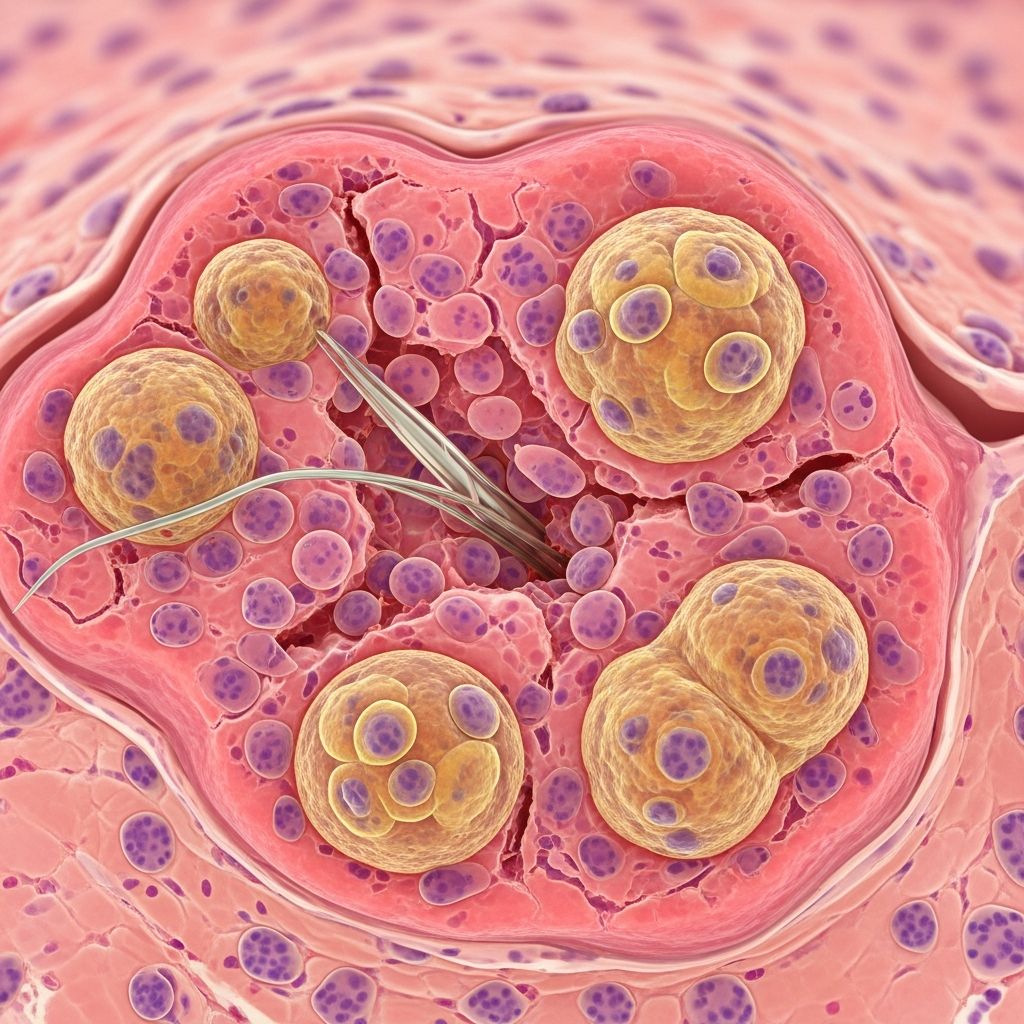
A
foreign body granuloma
is a chronic inflammatory reaction in the skin triggered by the immune system’s recognition of exogenous or altered endogenous materials as ‘non-self’, leading to granuloma formation when the material cannot be fully eliminated.What is a foreign body granuloma?
The body perceives any introduced material—living or non-living—as foreign if it elicits an immune response. Neutrophils initially attempt phagocytosis, but persistent materials activate macrophages and histiocytes, forming multinucleated giant cells, T cells, and fibroblasts to wall off the irritant. This granulomatous response isolates indigestible particles, commonly in the dermis or subcutaneous tissue.
Foreign bodies enter voluntarily (e.g., tattoos, fillers) or involuntarily (e.g., trauma from splinters, metals in construction workers). If small, keratinocytes may dissect surface debris during wound healing via fibrin and collagen migration.
Who gets foreign body granulomas?
Anyone exposed to foreign materials is at risk. High-risk groups include:
- Tattoo enthusiasts, especially with red inks
- Cosmetic filler patients (hyaluronic acid, collagen)
- Construction or industrial workers (silica, metals)
- Trauma victims (splinters, thorns, stitches)
- Post-surgical patients (suture reactions)
Delayed reactions occur, e.g., tattoo granulomas up to 17 years later.
What causes foreign body granulomas?
Exogenous substances trigger most cases:
- Tattoo pigments: Red inks (mercury sulfide/cinnabar), green/blue (chromium/cobalt), yellow (cadmium), black (iron oxides)
- Fillers: Hyaluronic acid, collagen, silicone, polymethylmethacrylate
- Trauma-related: Wood splinters, thorns, cactus spines, glass, metal fragments, pencil graphite, starch (glove powder), insect parts
- Medical: Sutures, talc, corticosteroids injections, artificial hair
- Other: Beryllium (berylliosis), zirconium, gold (acupuncture)
Endogenous materials (e.g., altered keratin, urates) may mimic but are distinct.
Pathophysiology
The response evolves dynamically:
- Acute phase: Neutrophils infiltrate but fail against large/indigestible particles.
- Chronic phase: Monocytes/macrophages phagocytose; resistant material persists in cytoplasm, activating cytokine release (e.g., TNF-α, IL-1).
- Granuloma formation: Macrophages fuse into foreign body giant cells (random nuclei) or Langhans cells; fibroblasts deposit collagen to encapsulate.
Birefringence under polarized light aids identification (e.g., talc, starch). Secondary infection may complicate.
Clinical features
Lesions present as
red or red-brown papules, nodules, or plaques
, often tender; ulceration possible.| Type | Features |
|---|---|
| Tattoo granulomas | Erythematous nodules/plaques in tattoo; lichenoid/eczematous; delayed |
| Filler granulomas | Delayed (months-years); nodules at injection sites |
| Trauma | Linear nodules along wound; chronic post-injury |
| Suture | Thread-like reactions post-surgery |
Symptoms: Pruritus, pain, swelling; systemic if widespread (e.g., beryllium).
Diagnosis
Clinical suspicion guides:
- History: Trauma, tattoos, fillers, occupation
- Examination: Lesion distribution, color match to ink
- Biopsy: Essential; shows histiocytes, giant cells, foreign material (polarized light for birefringence)
- Differential: Sarcoid, infection (TB, fungi), rheumatoid nodules; rule out with stains/special tests
What is the treatment for foreign body granulomas?
Treatment targets removal/isolation; varies by cause:
- Observation: Asymptomatic cases may resolve spontaneously
- Surgical excision: Small nodules, splinters; complete removal curative
- Intralesional steroids: Triamcinolone (10–40 mg/mL); reduces inflammation (60–80% response)
- Topicals: High-potency steroids, tacrolimus for superficial
- Systemic: Allopurinol (600–900 mg/day) for filler granulomas; hydroxychloroquine, minocycline, imatinib for refractory
- Laser: Q-switched for tattoos (532/694 nm targets pigments)
- Other: 5-FU, cryotherapy; hyaluronidase for HA fillers
Related Stories



Tattoo removal challenging; recurrence common if pigment remains.
What is the outcome for foreign body granuloma?
Prognosis excellent with removal; chronic/persistent if material endures. Scarring possible post-treatment. Recurrence risk high without excision (e.g., fillers 10–20%). Monitor for infection/malignancy.
Prevention
- Use hypoallergenic inks/fillers; patch test
- Proper wound care, foreign body removal
- Absorbable sutures
- Occupational PPE (construction)
Frequently Asked Questions
Can foreign body granulomas appear years after exposure?
Yes, delayed reactions occur, e.g., tattoo granulomas up to 17 years post-placement due to slow pigment degradation.
Do all tattoos cause granulomas?
No, but red inks are highest risk; incidence <1% but rising with fillers.
Is biopsy always needed?
Recommended for confirmation, material ID, excluding infection/sarcoid.
Can granulomas resolve without treatment?
Some yes, if macrophages digest material; others persist indefinitely.
Are they cancerous?
No, benign inflammatory; rare squamous transformation reported.
References
- Foreign body granuloma – DermNet — DermNet NZ. 2023. https://dermnetnz.org/topics/foreign-body-granuloma
- Foreign Body Granulomas — PubMed (Metzger et al.). 2015-07. https://pubmed.ncbi.nlm.nih.gov/26143429/
- Granuloma – types, diagnosis and treatment — Healthdirect (Australian Government). 2024. https://www.healthdirect.gov.au/granulomas
- Foreign Body Granulomas — Plastic Surgery Key. 2023. https://plasticsurgerykey.com/foreign-body-granulomas/
- Granuloma: Locations, Types, Causes, Symptoms & Treatment — Cleveland Clinic. 2024-01-25. https://my.clevelandclinic.org/health/diseases/24597-granuloma
Similar Articles








Read full bio of Sneha Tete