Frontal Lobe: Function, Location & Damage
Understand your frontal lobe: its vital functions, anatomy, and effects of damage.
Understanding the Frontal Lobe
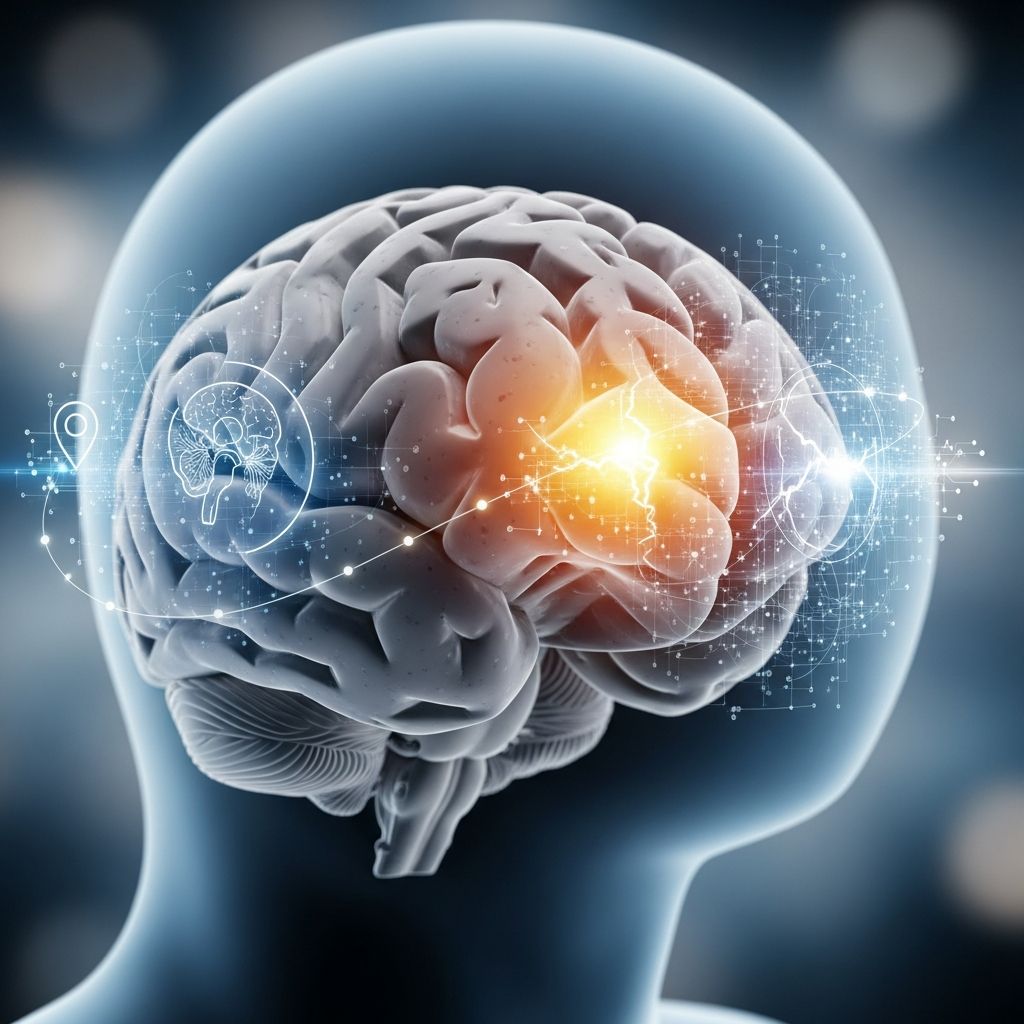
Your brain’s frontal lobe is one of the most critical regions of your brain, home to areas that manage thinking, emotions, personality, judgment, self-control, muscle control, movements, memory storage, and much more. Just as its name indicates, it’s the forward-most area of your brain, representing a key area of study for both brain-related and mental health-related fields of medicine. The frontal lobe is the largest section of your brain, allowing you to move your muscles, talk, solve problems, and engage with other people in social interactions. Understanding how your frontal lobe works is essential to comprehending how your brain controls nearly every aspect of your daily functioning.
Location of the Frontal Lobe
The frontal lobe is positioned at the front of your head, specifically in the section of your brain just behind your forehead. It extends back approximately halfway through your skull, where it meets your parietal lobe. Your brain contains two frontal lobes: one in the right hemisphere and one in the left hemisphere. This bilateral structure means that damage to one side can have different effects than damage to the other.
The frontal lobe occupies a prominent position in your skull, making it particularly vulnerable to injuries and damage. Its forward location means it’s often the first area to bear the brunt of head trauma or injury, which is why understanding frontal lobe damage is important for anyone interested in neurological health.
Key Functions of the Frontal Lobe
The frontal lobe is responsible for an extensive range of functions that make you who you are as an individual. The frontal lobes are extensively connected with nerve pathways to other areas of the brain, reinforcing their importance in a vast array of functions. Here are the primary functions managed by this essential brain region:
Motor Control and Movement
One of the most important functions of the frontal lobe is controlling voluntary movements—movements you actively control—of the opposite side of your body. Researchers have mapped the areas of the frontal lobes that control the movement of specific body parts in what’s called the motor homunculus. The precentral gyrus contains your primary motor cortex, which allows you to move specific body parts.
The frontal lobe also manages the sequencing of complex or multistep movements, such as getting dressed or making a cup of tea. This coordination between different muscle groups requires precise orchestration from your motor cortex. Each side of the frontal lobe controls the opposite side of your body, with cortical neurons radiating to your brain stem and down your spinal cord, telling your body what movement to complete.
Language and Speech Production
Speech and language production occur in the dominant frontal lobe, which is typically opposite your dominant hand. Broca’s area, located in the left hemisphere’s inferior frontal gyrus for most people, produces speech and helps with articulation. This region is crucial for forming words and speaking.
Your frontal lobe controls how you use and process language in three specific ways:
- Articulation — pronouncing words correctly
- Voice — using your vocal cords to adjust your sound and tone
- Fluency — using proper rhythm and tone to convey feeling
Executive Functions and Decision-Making
Your prefrontal cortex, situated in the front part of your brain’s frontal lobe, is in charge of “executive functions,” such as thinking and problem-solving. It also supervises and directs other areas of your brain. This region handles critical cognitive processes including reasoning, judgment, organization, and planning. The prefrontal cortex helps with attention, emotions, self-control, and decision-making.
Related Stories



Attention and Concentration
The frontal lobe maintains your ability to focus on tasks and maintain attention and concentration. This function is essential for work, studying, and any activity that requires sustained mental effort. The middle frontal gyrus also controls your frontal eye fields, which allows you to scan details within a scene or image right in front of you.
Memory and Information Processing
Working memory, which involves processing recently acquired information, is managed by your frontal lobe. The superior frontal gyrus helps you temporarily store and process information you need to learn, reason, and understand language.
Emotion and Personality Regulation
Your frontal lobe plays a vital role in the regulation of emotions and mood, including reading the emotions of others. It’s responsible for personality expression, motivation, and evaluating rewards, pleasure, and happiness. The right part of the superior frontal gyrus is particularly important to control your impulses and regulate your muscle movements. Because the frontal lobe is large and in the front of your skull, it is prone to damage, and any damage may contribute to changes in your social behavior and personality.
Impulse Control and Social Behavior
One of the most significant functions of your frontal lobe is impulse control and controlling social behaviors. This means your frontal lobe helps you think before you act, understand social norms, and behave appropriately in different situations. Your prefrontal cortex helps you focus when finishing work, manage your emotions when stuck in traffic, and set goals like saving money for something you want. It also plays a big part in how you interact with others, like calming down during an argument or deciding the right words to say to a friend.
Structural Divisions of the Frontal Lobe
The frontal lobe contains several distinct sections, each with specialized functions:
Precentral Gyrus
This section contains your primary motor cortex, which allows you to move specific body parts. The areas toward the middle of this section control your lower body, whereas the outer parts control your facial muscles. This section also contains your prefrontal cortex, which is responsible for decision-making, reasoning, personality, picking up social cues, and other complex functions.
Superior Frontal Gyrus
The left part of this section is important for your ability to temporarily store and process information you need to learn, reason, and understand language. It also controls your ability to sense and integrate information about where your body is in space. The right part of this section is important to control your impulses and regulate your muscle movements.
Middle Frontal Gyrus
The left part of this section helps you read and understand text. The right part of this section helps you understand numbers and do mathematical operations. This section also controls your frontal eye fields, which allows you to scan details within a scene or image right in front of you.
Inferior Frontal Gyrus
This area controls your ability to form words and speak, making it crucial for language production.
Brain Maturation and Development
Your frontal lobes are the last areas of your brain to mature. In some cases, they may not be fully developed until your mid-20s. The prefrontal cortex has its basic structure form in childhood, but it keeps changing throughout your teen years and into early adulthood.
During this developmental period, your brain strengthens the connections it uses most, then lets go of the ones it doesn’t need. It also adds insulation (called myelin) to help signals travel faster and more smoothly. These changes improve judgment, self-control, and long-term planning. For most people, the prefrontal cortex fully develops by the mid-20s, though fine-tuning may take a bit longer.
Effects of Frontal Lobe Damage
Because the frontal lobe is responsible for so many different types of functions, damage to the frontal lobe can cause a variety of different symptoms depending on the area that’s affected. Additionally, the frontal lobes are extensively connected with nerve pathways to other areas of the brain, meaning damage to the frontal lobes may cause a “ripple effect” to other parts of the brain.
Potential Symptoms of Frontal Lobe Damage
Some potential symptoms of frontal lobe damage can include:
- Difficulties with higher order functions like reasoning, problem-solving, and judgment
- Problems with maintaining attention or concentration
- Decreases in motivation
- Mood swings
- Impaired ability to initiate activities or interactions
- Drastic changes in personality or behavior, which can include apathy, irritability, and inappropriate social behavior
- Poor impulse control or lack of inhibition
Frontal Lobe Stroke
Frontal lobe strokes tend to affect large areas of your frontal lobe because of the way blood vessels are distributed around your brain. Damage from a frontal lobe stroke can cause muscle weakness and sensory loss on the side of your body opposite to the stroke, as well as behavioral changes, memory problems, and trouble with self-care.
Supporting Your Frontal Lobe Health
You can support neuroplasticity and keep your prefrontal cortex strong by engaging in activities that challenge your brain, maintain social connections, get adequate sleep, exercise regularly, and manage stress effectively. Taking care of your frontal lobe now can help preserve cognitive function and mental health throughout your life.
Frequently Asked Questions
Q: What is the frontal lobe?
A: The frontal lobe is the largest and forward-most section of your brain, located just behind your forehead. It manages thinking, emotions, personality, judgment, self-control, motor control, movements, and memory storage.
Q: What are the main functions of the frontal lobe?
A: The frontal lobe controls voluntary movements, speech production, attention and concentration, reasoning and judgment, organization and planning, problem-solving, emotion regulation, personality expression, motivation, impulse control, and social behaviors.
Q: When does the frontal lobe fully develop?
A: The frontal lobe is the last area of your brain to mature, and for most people, it isn’t fully developed until the mid-20s. The development process continues through the teen years and into early adulthood.
Q: What happens if the frontal lobe is damaged?
A: Depending on the area affected, frontal lobe damage can cause difficulties with reasoning and problem-solving, problems with attention and concentration, mood swings, personality changes, poor impulse control, and trouble with motor control and movement.
Q: Where is Broca’s area located?
A: Broca’s area is located in the left hemisphere’s inferior frontal gyrus for most people and is responsible for speech production and articulation.
Q: What is the prefrontal cortex?
A: The prefrontal cortex is the front part of your brain’s frontal lobe, positioned above and behind your eyebrows and forehead. It’s in charge of executive functions such as thinking, problem-solving, attention, emotions, self-control, and decision-making.
References
- Frontal Lobe: Function, Location in Brain, Damage, More — Healthline. 2024. https://www.healthline.com/health/frontal-lobe
- Frontal Lobe: Functions, Disorders, and Health Tips — WebMD. 2024. https://www.webmd.com/brain/what-you-need-to-know-about-the-frontal-lobe
- Cerebral Cortex: What It Is, Function & Location — Cleveland Clinic. 2024. https://my.clevelandclinic.org/health/articles/23073-cerebral-cortex
- Prefrontal Cortex: What It Is, Function, Location & Damage — Cleveland Clinic. 2024. https://my.clevelandclinic.org/health/body/prefrontal-cortex
- Frontal Lobe: What It Is, Function, Location & Damage — Cleveland Clinic. 2024. https://my.clevelandclinic.org/health/body/24501-frontal-lobe
Similar Articles








Read full bio of medha deb