Frozen Shoulder (Adhesive Capsulitis): Symptoms & Treatment
Understanding frozen shoulder: causes, progression, and effective treatment strategies.
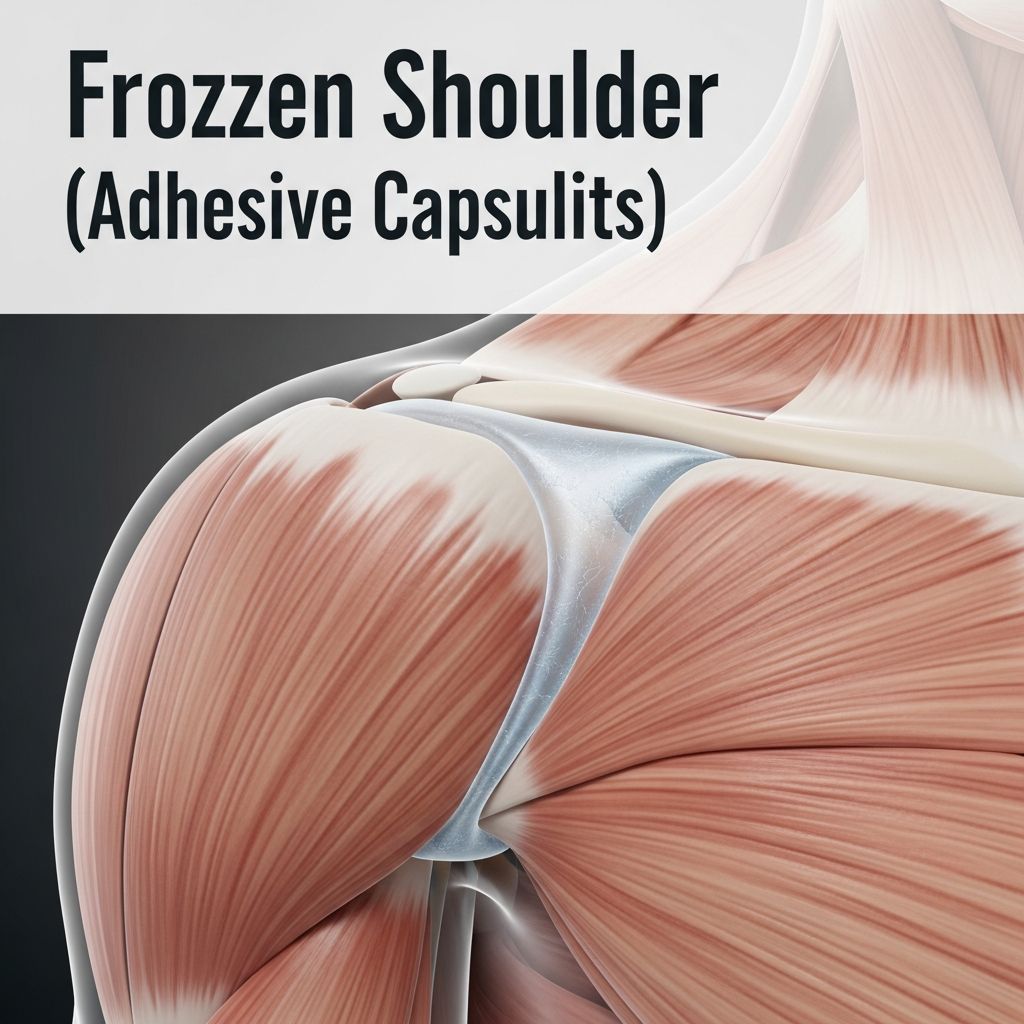
Frozen shoulder, medically known as adhesive capsulitis, is a progressive condition characterized by pain and stiffness in the shoulder joint that significantly impacts daily functioning and quality of life. The condition gets its colloquial name because as pain increases, people tend to use their shoulder less, which paradoxically causes the shoulder capsule to thicken and tighten further, essentially “freezing” the joint in place. While the exact mechanisms remain incompletely understood, researchers have identified inflammation as a central factor in the condition’s development.
What Is Frozen Shoulder?
Frozen shoulder occurs when the protective capsule surrounding the shoulder joint becomes inflamed, thickens, and contracts. The synovial membrane, which normally provides lubrication and protection for the joint, swells and thickens, leading to the formation of scar tissue called adhesions. Additionally, there is typically less synovial fluid available in the joint, further compromising the shoulder’s ability to move smoothly and rotate properly.
In healthy shoulders, the joint capsule allows for smooth movement across multiple planes of motion. However, in frozen shoulder, thick bands of connective tissue develop, restricting movement significantly. The shoulder becomes progressively more immobile, and what started as discomfort can evolve into a debilitating condition that prevents basic daily activities such as dressing, reaching overhead, or sleeping comfortably.
Causes and Risk Factors
Researchers have not identified a single definitive cause for frozen shoulder, and in many cases, the condition develops without an obvious precipitating event. However, medical professionals recognize two primary categories of frozen shoulder: primary and secondary forms.
Primary Adhesive Capsulitis
Primary frozen shoulder occurs without an apparent external cause and is often considered idiopathic. It is thought to arise from intrinsic inflammation leading to fibrotic changes within the shoulder capsule. Notably, primary frozen shoulder is frequently associated with systemic conditions, suggesting an underlying systemic inflammatory or autoimmune component. Conditions commonly linked to frozen shoulder include diabetes mellitus and thyroid disorders, indicating that metabolic and endocrine factors may play significant roles in the condition’s development.
Secondary Adhesive Capsulitis
Secondary frozen shoulder results from an external event or condition directly affecting shoulder mobility and function. Common causes include:
- Trauma: Significant shoulder injuries that lead to immobilization can precipitate adhesive capsulitis.
- Surgery: Postoperative complications following shoulder or chest wall surgeries frequently lead to frozen shoulder development.
- Prolonged immobilization: Extended periods of immobility after injury or surgery cause the joint capsule to stiffen progressively.
Understanding whether frozen shoulder is primary or secondary helps guide treatment approaches and provides insight into underlying health conditions that may require management.
Understanding the Pathophysiology
The development of frozen shoulder involves a complex interplay between inflammation and fibrosis. Initially, an inflammatory response triggers pain and begins limiting motion. Subsequently, fibrotic changes occur within the joint capsule, particularly in the rotator interval region, leading to thickening of the coracohumeral ligament and contraction of the overall joint capsule.
At the microscopic level, adhesive capsulitis is characterized by synovial hyperplasia (excessive tissue growth), angiogenesis (new blood vessel formation), and eventual joint capsule fibrosis. The fibrotic process is mediated by various cytokines and growth factors that promote fibroblast proliferation and excessive collagen deposition, further restricting shoulder mobility. Imaging studies typically demonstrate reduced joint capsule volume and thickening of the synovial lining, providing visual evidence of these pathological changes.
Related Stories



Three Stages of Frozen Shoulder
Frozen shoulder progresses through three distinct stages, each with characteristic symptoms and timelines. Understanding these stages helps patients anticipate changes and healthcare providers tailor treatment strategies appropriately.
Stage 1: Freezing Phase
The freezing stage represents the initial phase and typically lasts from 2 to 9 months, though duration varies among individuals. During this phase:
- Diffuse, disabling shoulder pain develops gradually and intensifies over time
- Pain worsens significantly at night, often disrupting sleep
- Range of motion begins to decrease progressively
- Overhead and backward movements become increasingly difficult
- Daily activities such as dressing and reaching become uncomfortable
Pain is the dominant complaint during the freezing phase, though patients often report that stiffness begins developing concurrently. The pain may initially be mild but typically worsens, impacting quality of life and functional capacity.
Stage 2: Frozen Phase
The frozen stage generally lasts between 4 to 12 months and is characterized by reduced pain intensity coupled with persistent stiffness. Key features include:
- Pain diminishes but remains present as a dull, constant ache
- Stiffness emerges as the primary concern and functional limitation
- Capsular rigidity progressively restricts shoulder movement across all planes
- Daily activities remain significantly impacted by restricted mobility
- Both active and passive range of motion remain severely limited
During this stage, the transition from pain-dominant symptoms to stiffness-dominant symptoms represents an important clinical marker. While patients may experience some pain relief, the loss of mobility can actually worsen functional impairment.
Stage 3: Thawing Phase
The thawing phase marks gradual improvement and recovery, though its duration varies considerably among individuals. Characteristics include:
- Progressive pain reduction
- Gradual restoration of shoulder mobility
- Increasing range of motion across multiple planes
- Functional capacity improves as movement becomes easier
The entire frozen shoulder condition typically persists from several months to 2 to 3 years, though some individuals experience longer recovery periods. The thawing phase can extend considerably, with full recovery sometimes taking up to two years from initial onset.
Symptoms and Clinical Presentation
Frozen shoulder manifests with distinct symptoms that evolve as the condition progresses. Understanding these presentations helps with early recognition and appropriate management.
Pain Characteristics
Pain from frozen shoulder typically exhibits specific characteristics:
- Usually dull or aching in quality
- Worse early in the disease course and when moving the arm
- Typically located over the outer shoulder area and sometimes the upper arm
- May intensify with sudden movements or when reaching extremes of motion
- Often worsens at night, disrupting sleep quality
Movement Restrictions
The hallmark trait of adhesive capsulitis is significant loss of both passive and active range of motion, especially shoulder external rotation. Patients experience difficulty with:
- Flexion (raising the arm forward)
- Abduction (raising the arm out to the side)
- External rotation (rotating the shoulder outward)
- Internal rotation (rotating the shoulder inward)
The typical pattern of range of motion loss begins with external rotation loss, followed sequentially by abduction, internal rotation, and flexion limitations. This restriction in movement is frequently accompanied by pain, which may prevent thorough clinical examination in early stages.
Diagnosis and Evaluation
Diagnosis of frozen shoulder is primarily based on clinical evaluation and detailed patient history rather than imaging studies. Healthcare providers assess the condition through physical examination, evaluating the extent of passive and active range of motion restrictions.
Clinical Assessment
The history typically involves a gradual onset of shoulder pain that intensifies and restricts motion over weeks to months. Patients often describe initial pain that gradually worsens, progressing to stiffness as the primary complaint. The timing of symptom onset, progression rate, and relationship to potential precipitating events (such as surgery or injury) all inform the clinical diagnosis.
Imaging Studies
While imaging studies are not indicated specifically for diagnosing adhesive capsulitis, a shoulder X-ray or magnetic resonance imaging (MRI) may be used to rule out other shoulder pathology or structural abnormalities. Imaging can help exclude conditions such as rotator cuff tears, arthritis, or other structural damage that might require different management approaches.
Treatment Options
Treatment for frozen shoulder focuses on pain management and restoring shoulder mobility. Approaches vary depending on the stage of the condition and individual patient factors.
Conservative Management
Initial treatment typically emphasizes conservative approaches, including physical therapy, medications, and activity modification. Physical therapy is central to treatment, focusing on gentle stretching and progressive range of motion exercises to prevent further stiffening and gradually restore mobility.
Medication Options
Nonsteroidal anti-inflammatory drugs (NSAIDs) may help reduce pain and inflammation during the freezing stage. In some cases, corticosteroid injections into the joint capsule can reduce inflammation and improve pain control, potentially enhancing the effectiveness of physical therapy.
Surgical Interventions
For cases that do not respond adequately to conservative treatment, surgical options may be considered. Arthroscopic capsular release involves surgical division of adhesions and thickened capsular tissue to restore joint mobility. This procedure is typically reserved for resistant cases after conservative treatment has been exhausted.
Recovery Timeline and Prognosis
Recovery from frozen shoulder is highly variable among individuals. While some people experience significant improvement within months, others require extended recovery periods extending to two years or longer. Most patients experience gradual improvement through the thawing phase, though the pace of recovery depends on multiple factors including age, overall health, treatment adherence, and underlying conditions.
Consistent participation in physical therapy exercises and following healthcare provider recommendations significantly impact recovery outcomes. Early recognition and appropriate management during the freezing stage may help prevent progression to severe stiffness and reduce overall recovery time.
Frequently Asked Questions (FAQs)
Q: What is the difference between frozen shoulder and other shoulder conditions?
A: Frozen shoulder specifically involves inflammation and thickening of the joint capsule with characteristic loss of range of motion in multiple directions, distinguishing it from rotator cuff tears or shoulder arthritis, which present with different pain patterns and functional limitations.
Q: Can frozen shoulder occur in both shoulders?
A: Yes, while frozen shoulder typically affects one shoulder, approximately 10-20% of patients develop the condition in the opposite shoulder at some point, particularly those with underlying systemic conditions like diabetes.
Q: How long does it take to recover from frozen shoulder?
A: Recovery timelines vary considerably, ranging from several months to 2-3 years. Consistent physical therapy participation and appropriate medical management can significantly influence recovery speed and outcomes.
Q: Is surgery always necessary for frozen shoulder?
A: No, most cases of frozen shoulder respond well to conservative treatment with physical therapy, medications, and activity modification. Surgery is typically reserved for cases that fail to improve with conservative management after 6-12 months.
Q: Can frozen shoulder be prevented?
A: While primary frozen shoulder cannot always be prevented, secondary frozen shoulder risk may be reduced through gentle early mobilization after shoulder surgery or injury, management of underlying systemic conditions, and maintaining shoulder activity when medically appropriate.
Q: Does physical therapy help frozen shoulder?
A: Yes, physical therapy is a cornerstone of frozen shoulder treatment, focusing on gentle stretching and progressive range of motion exercises to prevent further stiffening and gradually restore shoulder mobility throughout all three stages.
References
- Adhesive Capsulitis (Frozen Shoulder) — National Center for Biotechnology Information, StatPearls. 2024. https://www.ncbi.nlm.nih.gov/books/NBK532955/
- Frozen Shoulder – Adhesive Capsulitis — American Academy of Orthopaedic Surgeons (AAOS), OrthoInfo. 2024. https://orthoinfo.aaos.org/en/diseases–conditions/frozen-shoulder
- Demystifying Frozen Shoulder: Causes, Symptoms, and Treatments — Academy of Orthopaedics. 2024. https://www.academyorthopedics.com/blog/demystifying-frozen-shoulder-causes-symptoms-and-treatments/
- Frozen Shoulder (Adhesive Capsulitis): Symptoms & Treatment — Cleveland Clinic. 2024. https://my.clevelandclinic.org/health/diseases/frozen-shoulder-adhesive-capsulitis
- Frozen Shoulder (Capsulitis) Risk Factors & Treatments — Hospital for Special Surgery (HSS). 2024. https://www.hss.edu/health-library/conditions-and-treatments/list/frozen-shoulder
Similar Articles








Read full bio of medha deb