Genetics Of Basal Cell Carcinoma: Key Pathways & Syndromes
Unraveling the genetic basis of basal cell carcinoma: Hedgehog pathway mutations, inherited syndromes, and targeted therapies.
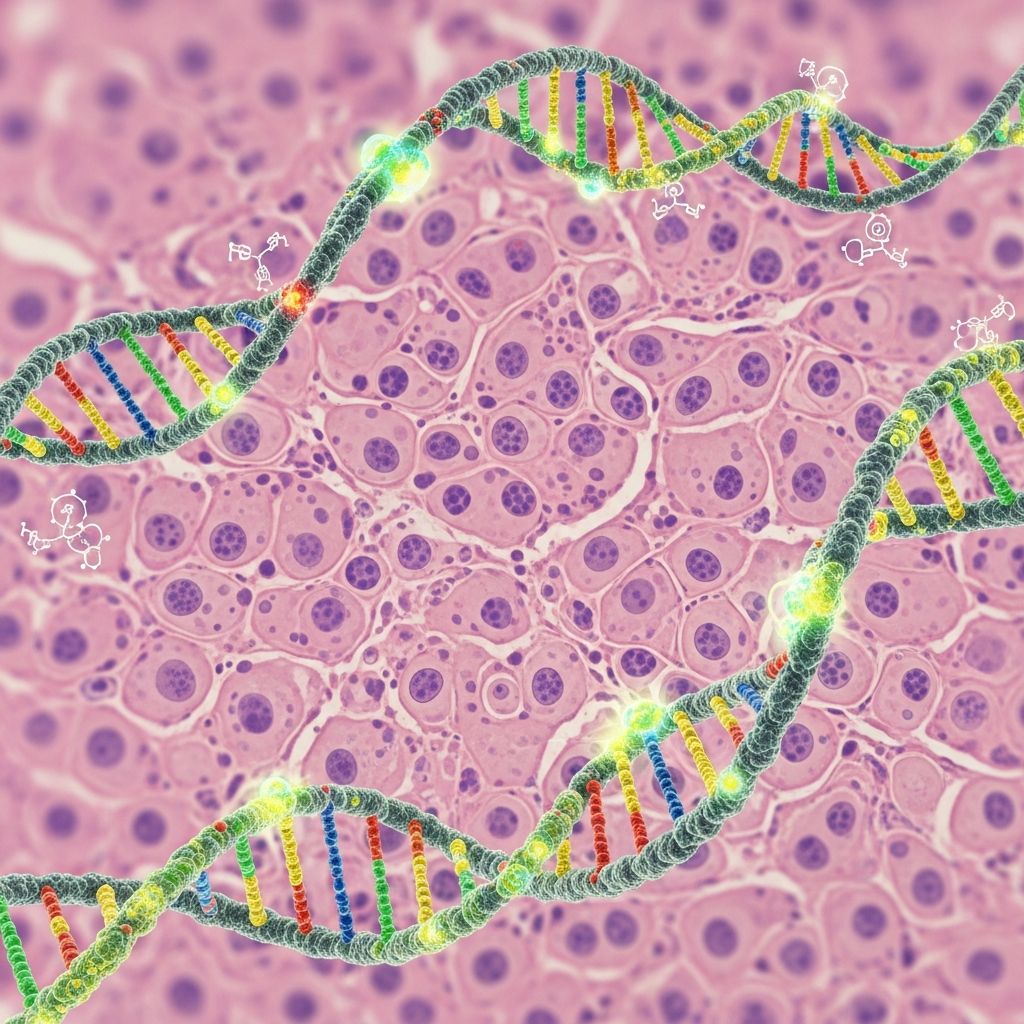
Basal cell carcinoma (BCC) is the most common malignancy in people of European descent, particularly prevalent in Australia and New Zealand due to high UV exposure. While environmental factors like ultraviolet (UV) radiation play a major role, genetic predispositions significantly influence BCC development in both inherited and sporadic cases.
What is the hedgehog signalling pathway?
The hedgehog (HH) signalling pathway is essential for tissue differentiation during fetal development and regulates cell growth and differentiation in adults. In humans, malfunction of this pathway is linked to malignancies, especially BCC.
The pathway involves the hedgehog gene encoding the sonic hedgehog (SHH) protein, an extracellular ligand that binds to a receptor complex on cell membranes, including Patched (PTCH) and Smoothened (SMO). Normally, PTCH inhibits SMO; SHH binding relieves this inhibition, activating downstream transcription factors like GLI that promote cell proliferation.
How does the hedgehog pathway malfunction in basal cell carcinoma?
In BCC, mutations disrupt HH pathway regulation, leading to constitutive activation and uncontrolled basal cell proliferation. Key mechanisms include:
- Loss-of-function mutations in PTCH1 or PTCH2, preventing inhibition of SMO.
- Gain-of-function mutations in SMO, causing ligand-independent activation.
- Mutations in SUFU, a negative regulator of GLI transcription factors.
These alterations result in unregulated SMO signaling, driving Gli-mediated transcription and tumorigenesis. UV radiation exacerbates this by inducing secondary mutations in the remaining wild-type allele (two-hit hypothesis).
Basal cell naevus syndrome
Basal cell naevus syndrome (BCNS), also known as Gorlin syndrome, is a rare autosomal dominant disorder caused by germline mutations in PTCH1 (chromosome 9q22.3), with rarer involvement of PTCH2 or SUFU. Affected individuals inherit one mutated allele, making them prone to a ‘second hit’ from somatic mutations, often UV-induced, leading to early-onset, multiple BCCs.
Prevalence estimates range from 1/57,000 to 1/256,000, with high penetrance but variable expressivity. BCCs develop in 80-90% of pale-skinned patients, often before age 20, and appear as numerous small lesions on the face, trunk, and limbs. Darker-skinned individuals may develop fewer BCCs.
BCNS features extend beyond skin:
- Multiple odontogenic keratocysts (70-80% by age 20)
- Jaw cysts, palmar/plantar pits (70-80%)
- Skeletal abnormalities (e.g., bifid ribs, scoliosis)
- Intracranial calcifications, medulloblastoma risk (2-5% in children)
Diagnosis uses clinical criteria (e.g., two major or one major + two minor features) or genetic testing.
Other inherited syndromes predisposing to basal cell carcinoma
Several genodermatoses increase BCC risk through DNA repair defects or signaling aberrations:
| Syndrome | Inheritance | Key Genes | BCC Features |
|---|---|---|---|
| Xeroderma pigmentosum (XP) | Autosomal recessive | NER genes (e.g., XPA-XPG) | Early, multiple BCCs on sun-exposed sites; extreme UV sensitivity |
| Bazex-Dupré-Christol syndrome | X-linked dominant | Unknown (chromosome Xq24-27.1) | Follicular atrophoderma, hypotrichosis, early BCCs |
| Rombo syndrome | Autosomal dominant | Unknown | Atrophoderma vermiculatum, milia, BCCs |
| Muir-Torre syndrome | Autosomal dominant | Mismatch repair genes (MLH1, MSH2) | BCCs with internal malignancies (e.g., colorectal) |
Related Stories



These syndromes highlight diverse genetic pathways converging on BCC pathogenesis.
Sporadic basal cell carcinoma
Over 90% of BCCs are sporadic, arising from somatic mutations in sun-exposed skin. UV radiation is the primary trigger, causing C>T or CC>TT transitions, especially in PTCH1 and TP53.
Key genetic alterations in sporadic BCC:
- PTCH1 mutations: 30-50% of cases
- TP53 mutations: 44-65%
- SMO mutations: ~10%
- CDKN2A mutations: Variable, less common
Predisposing germline variants include MC1R (red hair, fair skin) and others modulating UV sensitivity. Risk factors for multiple BCCs: young age at first diagnosis, superficial subtype, trunk location, male gender.
Other genes predisposing to basal cell carcinoma
Beyond HH pathway, mutations in:
- TP53: Tumor suppressor; UV-signature mutations common
- MC1R: Melanocortin-1 receptor; linked to pigmentation and DNA repair
- MYCL1, TERT: Telomerase regulation
- Genes involved in pigmentation (e.g., fair skin, freckling increase risk)
Genome-wide association studies identify SNPs in pigmentary and DNA repair genes.
Hedgehog pathway inhibitors
Targeted therapies inhibit aberrant HH signaling in advanced/metastatic BCC:
- Vismodegib (Erivedge™): SMO antagonist, FDA-approved 2012; response rates 30-50% in locally advanced BCC
- Sonidegib (Odomzo™): Approved 2015; similar efficacy
Indications: Metastatic BCC or locally advanced unresectable cases. Side effects: Muscle spasms, alopecia, taste disturbance, weight loss. Resistance via SMO mutations possible; ongoing trials explore combinations.
Frequently Asked Questions
What causes basal cell carcinoma genetically?
Primarily hedgehog pathway dysregulation via PTCH1, SMO mutations, combined with UV-induced TP53 changes.
Who is at risk for Gorlin syndrome?
Individuals with family history or early multiple BCCs; autosomal dominant inheritance.
Can BCC be prevented if genetically predisposed?
Yes, via rigorous sun protection, regular screening, and early lesion excision.
Are hedgehog inhibitors curative?
No, they control advanced disease but do not cure; used when surgery fails.
Does skin color affect BCC genetics?
Yes, fair skin (low melanin) heightens UV damage risk, amplifying genetic susceptibility.
References
- Genetics of basal cell carcinoma — DermNet NZ. 2023. https://dermnetnz.org/topics/genetics-of-basal-cell-carcinoma
- Basal cell naevus syndrome — DermNet NZ. 2023. https://dermnetnz.org/topics/basal-cell-naevus-syndrome
- Basal Cell Carcinoma – StatPearls — NCBI Bookshelf. 2023-09-04. https://www.ncbi.nlm.nih.gov/books/NBK482439/
- Fact Sheet on Basal Cell Carcinoma — Cancer Association of South Africa. 2021-01. https://cansa.org.za/files/2021/01/Fact-Sheet-on-Basal-Cell-Carcinoma-NCR-2017-web-January-2021.pdf
- Understanding Basal Cell Carcinoma — Skin Institute NZ. 2023. https://skintel.co.nz/articles/basal-cell-carcinoma/
- Basal cell naevus syndrome image credit — Dermatol Online J. 2019-11. https://www.ncbi.nlm.nih.gov/pubmed/33098258
Similar Articles








Read full bio of medha deb