Giant Cell Fibroblastoma: Pathology Guide For Clinicians
Detailed pathology of giant cell fibroblastoma: rare childhood soft tissue tumor with unique histological features and benign behavior.
Giant cell fibroblastoma is a rare, locally recurrent fibroblastic tumour that typically arises in the dermis or subcutis of children and young adults. It is considered a morphological variant of dermatofibrosarcoma protuberans (DFSP) due to shared genetic abnormalities involving COL1A1–PDGFB gene fusion.
Introduction
Giant cell fibroblastoma (GCF) represents a distinctive entity in the spectrum of superficial soft tissue tumours, first described in 1987. This tumour is characterized by its occurrence predominantly in the paediatric population, with a marked male predominance. Clinically, it manifests as a slow-growing, painless subcutaneous mass, often on the trunk or extremities. Although histologically benign-appearing, GCF has a notable tendency for local recurrence following incomplete excision, necessitating wide surgical margins for management.
The pathological diagnosis hinges on recognition of hallmark features: pseudoangiomatous spaces lined by multinucleated giant cells, bland spindle cells in a fibromyxoid stroma, and consistent CD34 immunoreactivity. Genetic confirmation via detection of the COL1A1–PDGFB fusion further solidifies the diagnosis, distinguishing it from mimics.
Clinical features
Giant cell fibroblastoma typically presents in boys under 10 years of age as a painless, slow-growing dermal or subcutaneous nodule or plaque. Common sites include the trunk (chest, back, abdomen), proximal extremities (arms, thighs), groin, and axilla; head and neck involvement is less frequent. Lesions measure 1–5 cm at diagnosis, often with a protuberant or polypoid appearance, and may be multinodular.
- Age: Median 3 years (range: birth to adulthood, 90% <30 years)
- Sex: Male predominance (M:F ≈ 2–9:1)
- Duration: Months to years; slow growth
- Symptoms: Asymptomatic; rarely tender or ulcerated
- Recurrence: 50–80% if incompletely excised
Clinical differentials include lipoma, pilomatricoma, fibrous hamartoma of infancy, and juvenile DFSP. Imaging (ultrasound/MRI) shows a well-circumscribed, heterogeneous subcutaneous mass without bone involvement.
Histopathology
Microscopic features
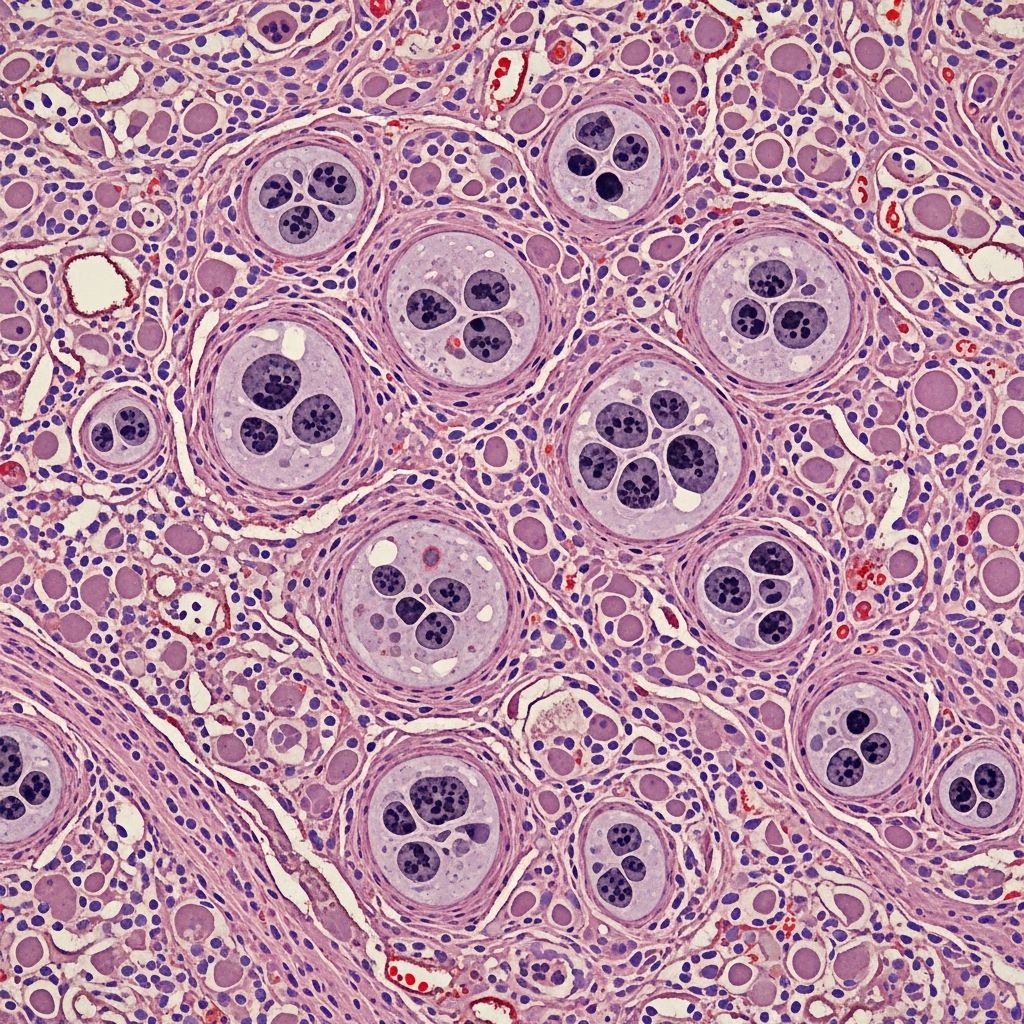
GCF exhibits a biphasic pattern: short fascicles of bland, uniform spindle cells arranged in a storiform or honeycomb pattern intermixed with scattered floret-like multinucleated giant cells. The stroma is variably collagenous, myxoid, or hyalinized. The defining feature is irregular, dilated pseudovascular (angiectoid) spaces mimicking vascular channels, lined by multinucleated giant cells rather than endothelium.
Additional findings include:
- Perivascular onion-skin lymphocytic cuffing
- Intraliesional haemorrhage and haemosiderin deposition
- Entrapment of subcutaneous fat (infiltrative growth)
- Occasional smooth muscle nodules or myxoid pools
- Absence of mitoses, atypia, or necrosis (benign cytology)
Low-power view reveals a nodular, poorly circumscribed tumour dissecting through collagen and fat. Giant cells vary in size, with wreath-like or pseudoinclusion nuclei. Spindle cells have scant eosinophilic cytoplasm, wavy nuclei, and inconspicuous nucleoli.
Cytology
Fine needle aspiration yields hypocellular smears with oval/spindle cells in metachromatic myxoid matrix; rare floret giant cells. Not diagnostic; biopsy required.
Histopathology images
(Note: In a full article, high-resolution photomicrographs would illustrate: low-power tumour architecture, pseudovascular spaces with giant cell lining, spindle cell fascicles, onion-skin lymphocytes, and CD34 stain.)
Immunohistochemistry
GCF shows a characteristic immunoprofile:
| Antibody | Staining Pattern |
|---|---|
| CD34 | Diffuse, strong (+ in spindle and giant cells) |
| Vimentin | Diffuse (+) |
| Factor XIIIa | Focal (+) |
| CD31/CD34 distinction | CD34+/CD31- (non-endothelial) |
| S100, SMA, desmin, ALK | Negative |
CD34 positivity encircles fat cells (“honeycomb” pattern), akin to DFSP. Giant cells are highlighted. This profile excludes vascular tumours (CD31+), neural lesions (S100+), and myogenic tumours.
Genetics
The molecular hallmark is COL1A1–PDGFB fusion due to supernumerary ring chromosomes or translocation t(17;22)(q22;q13), identical to DFSP. Fusion transcripts drive PDGFB overexpression, promoting tumorigenesis. Detected by FISH (break-apart PDGFB probe), RT-PCR, or NGS in 90–100% cases. Absence argues against GCF.
Differential diagnosis
Related Stories



| Diagnosis | Key Distinguishing Features |
|---|---|
| Dermatofibrosarcoma protuberans (DFSP) | Lacks giant cells/pseudovascular spaces; uniform storiform spindle cells; honeycomb fat infiltration; same genetics |
| Angiomatoid fibrous histiocytoma | Lymphoid cuffing, haemorrhage pools; desmin+; EWSR1–CREB1 fusion |
| Cellular fibrous histiocytoma | |
| Plexiform fibrous histiocytoma | Plexiform growth; lipid-laden histiocytes; female predominance |
| Myofibroma | Biphasic (primitive/angiomatous); SMA+; infancy |
GCF–DFSP continuum: GCF may progress to DFSP; hybrids exist.
Management
Complete surgical excision with 1–2 cm margins is curative in most cases. Mohs micrographic surgery or imatinib (for PDGFB-driven tumours) for recurrences/unresectable disease. No role for chemotherapy/radiation given low metastatic risk (none reported). Long-term follow-up due to 50–80% local recurrence rate if margins positive.
Prognosis
Excellent; behaves as low-grade despite recurrences. No metastases documented. Adverse factors: incomplete excision, young age (<5 years), larger size (>4 cm).
Frequently asked questions
Q: Is giant cell fibroblastoma cancerous?
No, it is a benign fibroblastic tumour with local recurrence potential but no metastatic capacity.
Q: What is the most common site for GCF?
Trunk (back, chest, shoulder) in young boys.
Q: How is GCF diagnosed definitively?
Histopathology showing pseudovascular spaces with giant cells + CD34+ + COL1A1–PDGFB fusion.
Q: Does GCF turn into DFSP?
Possible; represents a morphological spectrum with identical genetics.
Q: What is the treatment of choice?
Wide local excision; Mohs for recurrent cases.
References
- Giant cell fibroblastoma — Wikipedia. 2023-10-15. https://en.wikipedia.org/wiki/Giant-cell_fibroblastoma
- Giant Cell Fibroblastoma: A Case Report — PMC (National Library of Medicine). 2017-11-01. https://pmc.ncbi.nlm.nih.gov/articles/PMC5685331/
- Giant Cell Fibroblastoma — Sarcoma Foundation of America. 2024-01-12. https://curesarcoma.org/sarcoma-subtypes/giant-cell-fibroblastoma/
- Giant Cell Fibroblastoma — Massive Bio. 2023-05-20. https://massivebio.com/giant-cell-fibroblastoma-bio/
Similar Articles








Read full bio of medha deb