Giant Cell Fibroma: Complete Guide To Diagnosis & Treatment
Explore the clinicopathological features, diagnosis, and management of giant cell fibroma, a rare benign oral fibrous lesion.
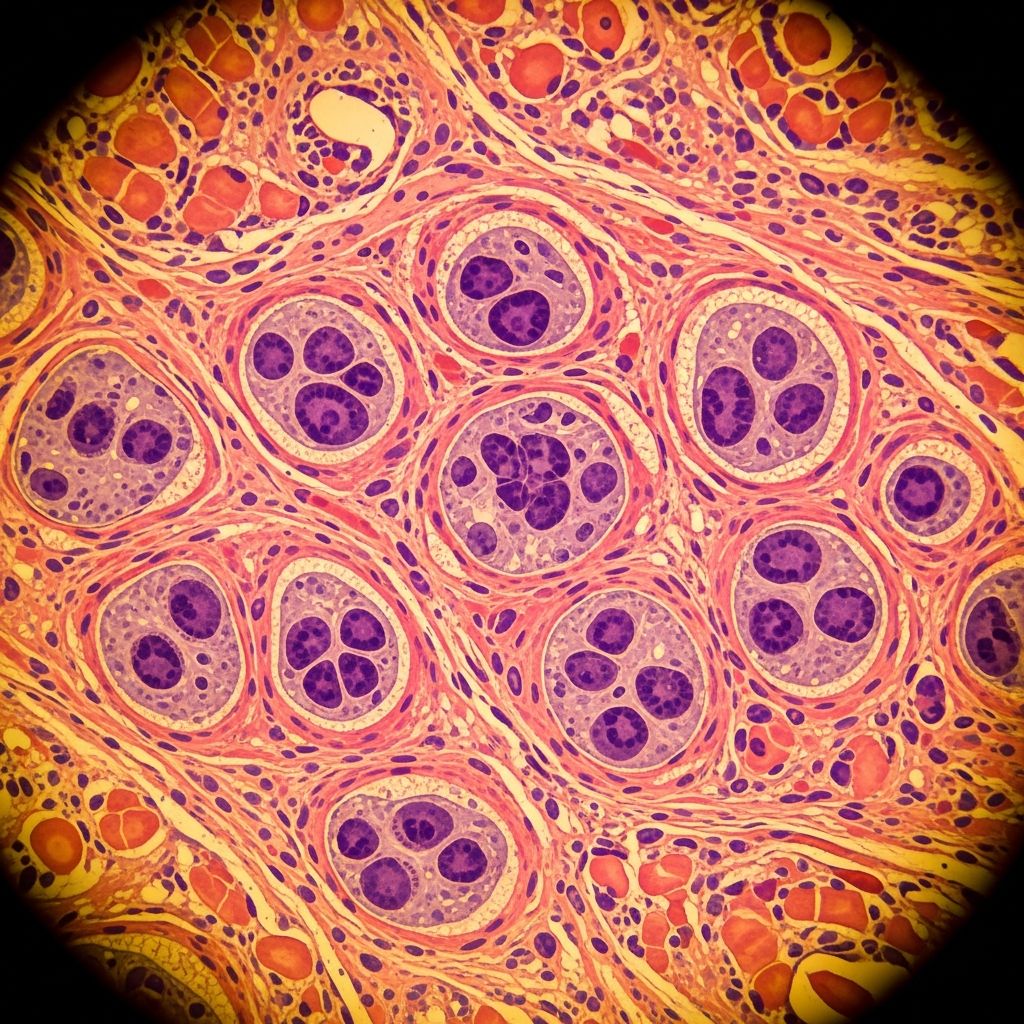
What is giant cell fibroma?
Giant cell fibroma (GCF) is a rare benign fibrous hyperplastic lesion of the oral cavity. It is characterized by the presence of large stellate and multinucleated giant cells within a collagenous stroma, visible distinctly on histopathological examination. First described in 1974 by Weathers et al., GCF typically presents as a small, pedunculated or sessile mass, most commonly on the gingiva, and is often misdiagnosed clinically as a fibroma or papilloma.
Unlike common irritation fibromas, GCF requires microscopic confirmation due to its pathognomonic giant cells. It affects a wide age range, from children to adults, with no strong gender predilection, though some studies note slight female predominance. The lesion is asymptomatic, firm, and measures 0.5–2 cm, with a pebbly or papillary surface.
Who gets giant cell fibroma?
Giant cell fibroma occurs across all age groups, with a mean patient age of approximately 39 years, ranging from 6 to 67 years. It is uncommon in children but reported in mandibular canine regions as small pink papules up to 5 mm, sometimes bilateral and developmental-like. Adults are most frequently affected, with lesions arising due to chronic irritation or unknown factors.
- Prevalence: Rare; fewer than 500 cases reported globally, with limited data from specific populations like the Indian subcontinent.
- Sex: Roughly equal distribution, slight female bias in some series.
- Age: Bimodal peaks in young adults and middle age; rare under 10 years.
- Risk factors: Possible chronic trauma or irritation, though etiology remains unclear; no viral link confirmed.
What causes giant cell fibroma?
The exact cause of giant cell fibroma is unknown. It is considered a reactive fibrous hyperplasia, potentially triggered by chronic irritation from dental appliances, trauma, or plaque accumulation. Some speculate functional changes in fibroblasts or a virus-induced proliferation, but evidence is lacking. Immunohistochemistry shows giant cells positive for vimentin and prolyl-4-hydroxylase, negative for cytokeratin, CD68, S100, and others, suggesting fibroblastic origin rather than macrophage or neural.
Melanin pigmentation in some cases indicates stromal cells engulfing granules, with CD68 focal positivity in inflammatory areas. GCF stroma features mature collagen patterns (radiating or reticular), distinguishing it from immature fibrous lesions. No malignant potential or hereditary factors identified.
What are the clinical features of giant cell fibroma?
GCF appears as a painless, slow-growing, firm nodule of normal mucosal colour (pink), unless ulcerated from trauma. Size ranges 4–17 mm, typically 0.5–1 cm.
- Surface: Pebbly, bossellated, papillary, or smooth/lobulated; numerous papules mimic papilloma.
- Base: Pedunculated (common) or sessile/broad.
- Symptoms: Asymptomatic; rare ulceration causes tenderness.
| Location | Frequency |
|---|---|
| Gingiva (mandibular > maxillary) | 60–70% |
| Tongue | 15–20% |
| Buccal mucosa | 10% |
| Palate, lip, retromolar pad | Rare |
In children, often near mandibular canines as retrocuspid papillae, not requiring biopsy if typical. Provisional clinical diagnoses include fibroma, papilloma, or pyogenic granuloma.
Diagnosis
Clinical diagnosis is unreliable; histopathology is essential. Biopsy reveals:
Related Stories



- Dense, haphazard collagen bundles in avascular stroma.
- Hallmark: Large stellate giant cells (1–2 nuclei, short dendrites, hyperchromatic) beneath epithelium; occasional multinucleated.
- Artifactual spaces around giant cells.
- Hyperplastic, keratinized epithelium with elongated rete ridges.
- Occasional melanin granules in stroma.
Immunostains: Vimentin+, others negative, confirming fibroblastic nature.
Differential diagnosis
GCF mimics other oral fibrous lesions:
| Lesion | Key Features | Distinction from GCF |
|---|---|---|
| Irritation fibroma | Smooth, firm, trauma-related | Lacks stellate giant cells; more mature stroma |
| Papilloma | Papillary surface | Epithelial hyperplasia dominant; no giant cells |
| Pyogenic granuloma | Vascular, red, friable | Granulation tissue, inflammation; no giant fibroblasts |
| Peripheral ossifying fibroma | Gingival, mineralized | Ossification/calcification absent in GCF |
| Peripheral giant cell granuloma | Purple, vascular | Multinucleated osteoclast-like giants, not stellate |
What is the treatment for giant cell fibroma?
Complete surgical excision is curative; no recurrence in most series if fully removed.
- Adults: Scalpel excision with narrow margins.
- Children: Electrosurgery (hemostasis, no sutures, quick) or laser (precise, less scarring).
- Follow-up: Rare recurrence (2/464 cases); due to incomplete excision.
No conservative management; excision prevents growth and confirms diagnosis.
Prevention
Impossible due to unclear etiology. Minimize oral irritation via good hygiene, well-fitting dentures. Regular dental check-ups aid early detection.
Further reading and references
- Case reports emphasize histopathology’s role.
- Immunohistochemical studies clarify cell origin.
Frequently Asked Questions (FAQs)
Q: Is giant cell fibroma cancerous?
A: No, it is a benign reactive lesion with no malignant potential.
Q: Does giant cell fibroma recur?
A: Recurrence is rare (<1%), usually from incomplete excision.
Q: Can giant cell fibroma be diagnosed without biopsy?
A: No, histopathology with stellate giant cells is required for confirmation.
Q: What is the most common site for giant cell fibroma?
A: Gingiva, especially mandibular.
Q: Is laser treatment effective for giant cell fibroma?
A: Yes, particularly in children for precision and reduced bleeding.
References
- Giant cell fibroma: A clinicopathological study — PMC – NIH. 2012-11-15. https://pmc.ncbi.nlm.nih.gov/articles/PMC3519210/
- Giant-cell fibroma — Wikipedia. 2023-01-01. https://en.wikipedia.org/wiki/Giant-cell_fibroma
- Giant Cell Fibroma Of Oral Mucosa — College of Dentistry, University of Baghdad. 2023-12-01. https://codental.uobaghdad.edu.iq/wp-content/uploads/sites/14/2023/12/Aya-Kais.pdf
- Giant Cell Fibroma- A Case Report — Quest Journals. 2020-09-01. https://questjournals.org/jmdsr/papers/vol8-issue9/Ser-1/M08098385.pdf
Similar Articles








Read full bio of Sneha Tete