Giant Cell Tumour of Tendon Sheath Pathology
Detailed histopathological analysis of giant cell tumour of tendon sheath, a benign fibrohistiocytic lesion of tendon sheaths.
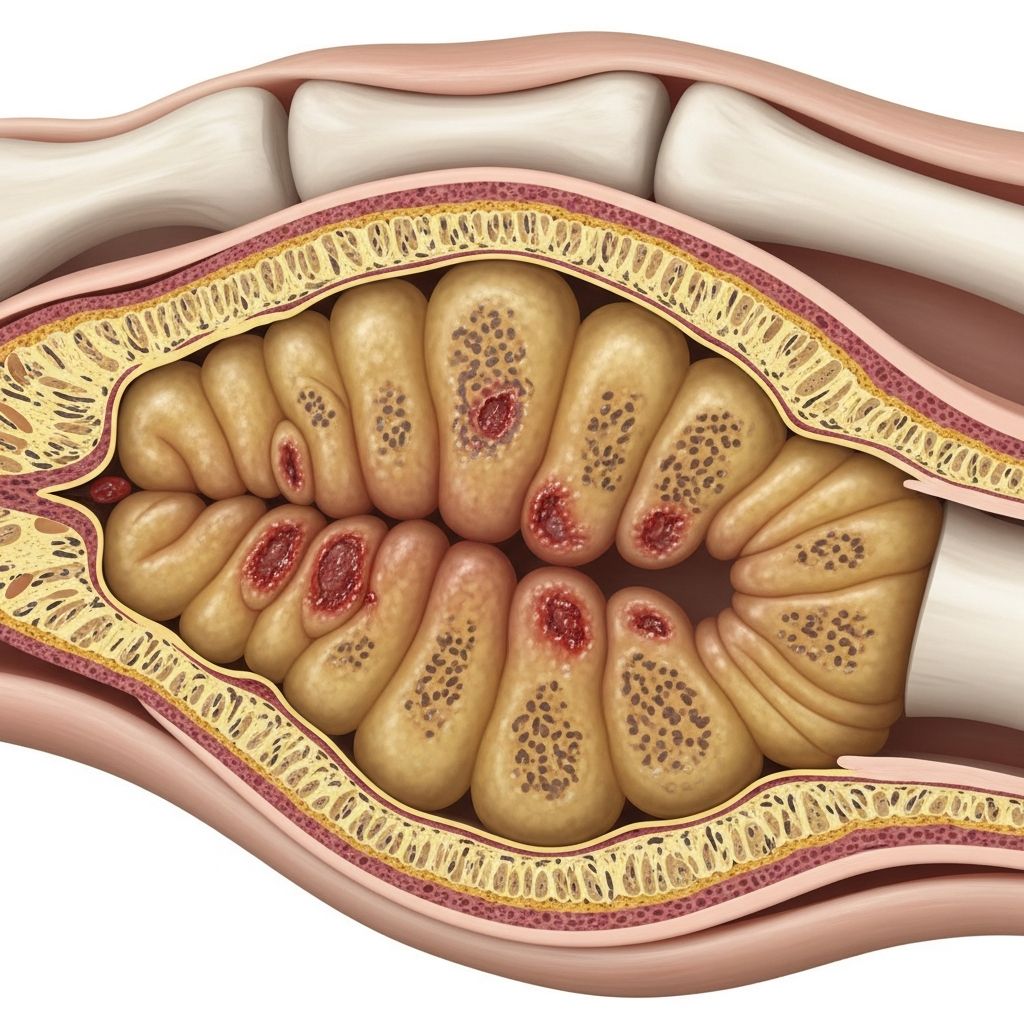
Giant cell tumour of tendon sheath (GCTTS) is a benign fibrohistiocytic proliferation arising from the synovium of tendon sheaths, representing the second most common solid mass in the hand after ganglion cysts. It typically presents as a slow-growing, painless nodule on the fingers, particularly in adults aged 30-50 years, with a slight female predominance.
Clinical Features
GCTTS manifests as a firm, well-circumscribed subcutaneous nodule, most frequently on the flexor aspects of the fingers, especially the index and middle fingers. Lesions are usually 1-3 cm in size, mobile relative to the skin but fixed to the underlying tendon sheath. Patients often report a painless mass present for months to years, though tenderness or restricted joint motion may occur with larger tumours.
While hands are affected in 85-90% of cases, involvement of feet, wrists, ankles, or knees is less common but documented, particularly in atypical presentations like the big toe where it may mimic gout or cause bone erosion. Radiographs typically show soft tissue swelling without calcification, though MRI reveals low-signal intensity masses due to hemosiderin deposits, aiding preoperative planning.
Histopathology
Scanning power view reveals a well-circumscribed tumour nodule in the deep dermis or subcutis, often with attached tendon sheath fragments. The lesion appears multinodular, lobulated, with a fibrous capsule.
At low power, the tumour comprises sheets of uniform oval to spindle-shaped mononuclear cells within a delicate eosinophilic fibrous stroma. Scattered multinucleated giant cells (osteoclast-like) are interspersed, along with small clusters of lipid-laden (xanthoma) cells and hemosiderin deposits imparting a golden-brown pigmentation.
- Oval mononuclear cells: plump, with abundant eosinophilic cytoplasm and eccentric nuclei showing pale chromatin and small nucleoli.
- Multinucleated giant cells: 5-50 nuclei, fused from mononuclear cells.
- Stroma: collagenous, myxoid in areas, with prominent vascularity.
- Other cells: foamy histiocytes, siderophages, occasional plasma cells.
Higher magnification highlights discohesive pools of lesional cells, slit-like spaces, and pseudoinclusions of collagen within giant cells. Mitotic figures are rare and atypical forms absent, confirming benignity.
Cytology
Fine needle aspiration shows dispersed mononuclear cells with grooved nuclei, admixed giant cells, and stromal fragments. Hemosiderin-laden macrophages and foamy cells support the diagnosis, though core biopsy is preferred for architectural assessment.
Histological Variants
- Proximal type: Larger, more aggressive, with bone invasion (5-10% cases).
- Diffuse type (PVNS-like): Infiltrative, intra-articular, higher recurrence.
Immunohistochemistry
Tumour cells express CD68 (histiocytic marker) diffusely in mononuclear and giant cells, vimentin (fibroblastic), and variably CD163. Negative for S100, desmin, actin, and ALK. Proliferative index (Ki67) is low (<5%). These features indicate fibrohistiocytic differentiation.
Electron Microscopy
Ultrastructurally, mononuclear cells show villous processes, confirming synovial origin. Giant cells display multiple nuclei and phagocytosis.
Related Stories



Genetics
CSF1 gene rearrangements drive neoplastic mononuclear cell proliferation, recruiting non-neoplastic giant cells via paracrine signalling. Targeted therapies like CSF1R inhibitors (e.g., pexidartinib) show promise for unresectable cases.
Differential Diagnosis
| Feature | GCTTS | Giant Cell Tumour of Soft Tissue | PVNS | Fibroma of Tendon Sheath |
|---|---|---|---|---|
| Location | Tendon sheath, digits | Deep soft tissue | Intra-articular | Tendon sheath |
| Size | Small, nodular | Large, multinodular | Diffuse | Slit-like |
| Giant cells | Few, scattered | Numerous | Numerous | Rare/absent |
| Stroma | Delicate fibrous | Collagenized, bone | Myxoid, hemosiderin | Thick collagen |
| Recurrence | 10-20% | Low | High | Low |
GCTTS differs from soft tissue giant cell tumour by lacking metaplastic bone and SMA positivity. Fibroma of tendon sheath has paucicellular collagenous stroma without giant cells. Malignancy (rare <1%) shows pleomorphism, high mitoses, necrosis.
Management
Surgical excision is curative in 80-90% cases, with marginal excision sufficient for localized lesions. Recurrence risk (10-44%) correlates with incomplete resection, satellite nodules, or proximal type. Mohs micrographic surgery reduces recurrence in digits. Radiation or CSF1R inhibitors for unresectable/recurrent disease.
Postoperative monitoring includes clinical exam and MRI for high-risk cases. Physiotherapy optimizes function.
Frequently Asked Questions
What is giant cell tumour of tendon sheath?
A benign tumour arising from tendon sheath synovium, composed of mononuclear cells, giant cells, and stroma.
Is it cancerous?
No, benign, though locally recurrent. Malignant transformation is exceedingly rare.
How is it diagnosed?
By histopathology showing characteristic cells; MRI aids preoperative extent.
What is the treatment?
Complete surgical excision; follow-up for recurrence.
Does it recur?
Yes, 10-20% after excision, higher if incomplete.
Prognosis
Excellent with complete excision; functional impairment rare. Long-term follow-up recommended for digits.
References
- Giant cell tumour of tendon sheath pathology — DermNet NZ. 2023. https://dermnetnz.org/topics/giant-cell-tumour-of-tendon-sheath-pathology
- Giant Cell Tumor of the Tendon Sheath: A Rare Case of Big Toe Involvement — NIH/PMC. 2024-10-15. https://pmc.ncbi.nlm.nih.gov/articles/PMC12046614/
- Giant cell tumor of tendon sheath 101 pathology — YouTube (Pathology Transcript). 2023. https://www.youtube.com/watch?v=K3KCK4WaA_s
- Giant Cell Tumor of Tendon Sheath — Orthobullets. 2025-01-15. https://www.orthobullets.com/hand/6092/giant-cell-tumor-of-tendon-sheath
- Giant cell tumor of tendon sheath — VisualDx. 2024. https://www.visualdx.com/visualdx/diagnosis/giant+cell+tumor+of+tendon+sheath?diagnosisId=51609&moduleId=101
Similar Articles








Read full bio of medha deb