Glandular Cheilitis: Complete Guide To Diagnosis And Treatment
Understanding glandular cheilitis: causes, symptoms, diagnosis, and management of this rare lip condition affecting salivary glands.
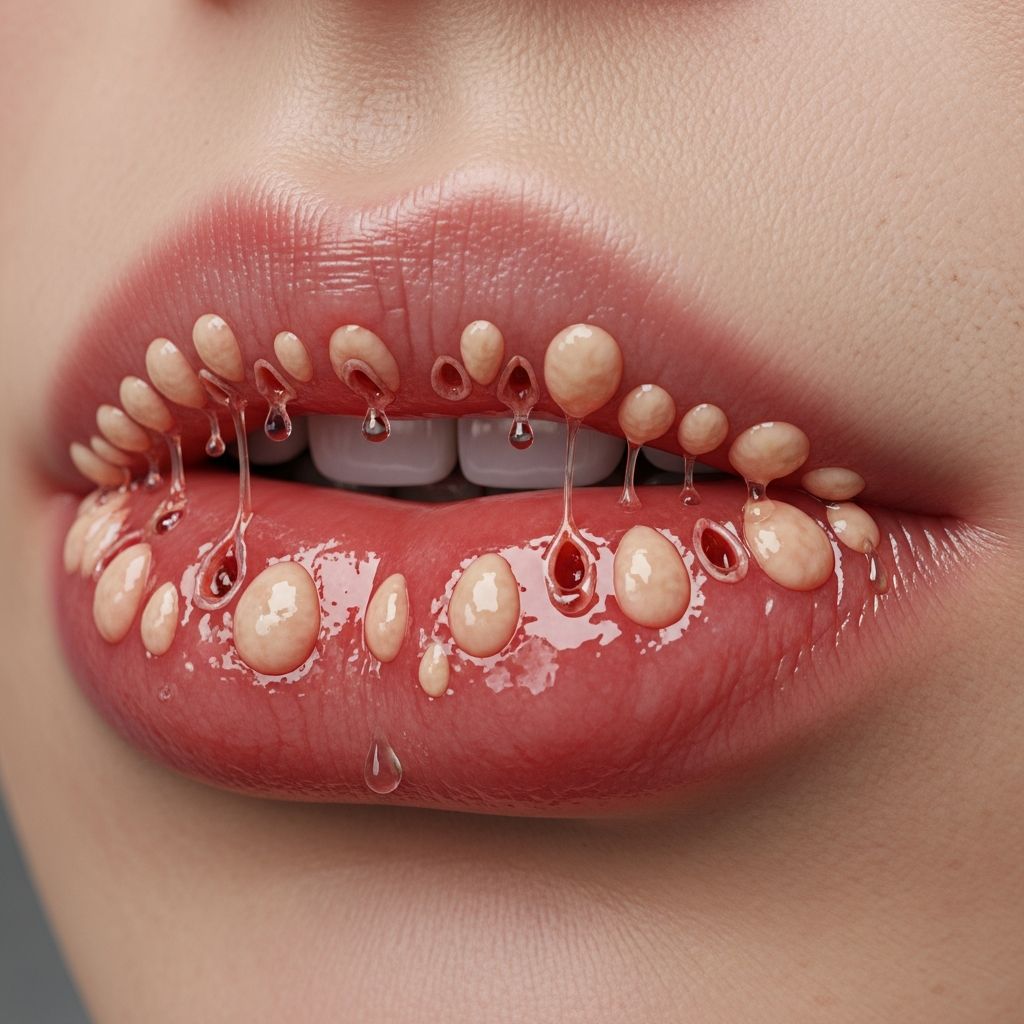
Glandular cheilitis, also known as cheilitis glandularis, is a rare chronic inflammatory condition primarily affecting the lower lip. It involves swelling (macrocheilia) due to hyperplasia and inflammation of the minor salivary glands in the vermilion border of the lip. Patients often notice dilated openings of these glands, from which thick, mucoid saliva can be expressed manually. This condition predominantly impacts adults, particularly those with fair skin, and may predispose to secondary complications like actinic damage or malignancy.
What is glandular cheilitis?
Glandular cheilitis represents an uncommon disorder characterized by persistent labial swelling accompanied by glandular hyperplasia. The minor salivary glands become prominent, with red, dilated ostia visible on the lip’s vermilion surface. Expressing these glands yields a viscous, sticky mucus that adheres to the lip, causing discomfort. While the lower lip is most commonly affected, the upper lip can occasionally be involved. Hardening of tissues and suppuration may occur in advanced cases, termed cheilitis apostematosa profunda.
The condition arises from fibrosis surrounding the salivary glands, often with dense chronic inflammatory infiltrates. Although salivary gland function may appear normal histologically in some cases, the clinical presentation suggests a reactive process to chronic irritation. Globally rare, it falls under skin and endocrine diseases, with higher incidence in fair-skinned or albino individuals due to sun exposure.
Who gets glandular cheilitis?
Glandular cheilitis primarily affects adults, with no strong gender predilection reported, though some sources note a slight male predominance. It is more prevalent in fair-skinned Caucasians and albino patients, likely due to increased susceptibility to ultraviolet (UV) radiation on the everted vermilion. Chronic sun exposure exacerbates the condition, leading to greater vermilion exposure and potential actinic changes.
- Risk factors: Fair skin phototypes, albinism, outdoor occupations with UV exposure.
- Age: Typically middle-aged adults.
- Associations: Possible links to mechanical trauma or actinic damage, though etiology remains idiopathic in most cases.
What causes glandular cheilitis?
The precise etiology of glandular cheilitis remains unknown. Hypotheses include it as a primary inflammatory glandular disease or a nonspecific reaction pattern to external insults such as mechanical trauma, chronic actinic exposure, or smoking. Recent studies have identified alterations in immunohistochemical expression of aquaporins (water channels) in affected glands, suggesting impaired fluid dynamics.
Unlike granulomatous cheilitis (associated with Melkersson-Rosenthal syndrome or Crohn’s disease), glandular cheilitis lacks granuloma formation and is not typically linked to systemic granulomatous disorders. Fibrosis and chronic inflammation around salivary glands drive the swelling, independent of infection in most instances. No definitive genetic cause is established, though susceptibility factors play a role.
What are the clinical features of glandular cheilitis?
Clinical manifestations vary by subtype but center on lower lip macrocheilia with prominent salivary gland features.
Simple form
The most common presentation involves moderate lip thickening with multiple dilated, red glandular orifices on the vermilion. Gentle pressure expresses clear, thick mucus, which dries and crusts, causing irritation.
Deep form
More severe, with indurated swelling extending into deeper tissues. Glands may harden, and suppuration can lead to purulent discharge.
Superficial suppurative form
Features crusting, erosion, and secondary infection at gland openings.
Common symptoms include cosmetic concerns from swelling, discomfort from mucus adhesion, dryness, and fissuring. Long-term eversion increases UV exposure risk, potentially leading to actinic cheilitis or squamous cell carcinoma (SCC), especially in high-risk patients.
Related Stories



| Subtype | Key Features | Complications |
|---|---|---|
| Simple | Dilated ostia, mucus secretion | Cosmetic deformity |
| Deep | Induration, suppuration | Purulent discharge |
| Superficial suppurative | Crusting, erosion | Secondary infection |
Diagnosis of glandular cheilitis
Diagnosis is primarily clinical, based on characteristic lip swelling and expressible glandular mucus. Differential diagnoses include granulomatous cheilitis, actinic cheilitis, angular cheilitis, melanoma, or SCC. Biopsy confirms glandular hyperplasia, fibrosis, and chronic inflammation without granulomas.
- Clinical exam: Inspect for dilated ostia and express mucus.
- Biopsy: Essential if malignancy suspected; shows ductal ectasia and periductal fibrosis.
- Imaging: Rarely needed; ultrasound may assess deeper involvement.
Rule out systemic associations like Crohn’s or sarcoidosis via history and labs if indicated.
Treatment of glandular cheilitis
Treatment is often unnecessary for mild, asymptomatic cases. Symptomatic management focuses on reducing inflammation and addressing complications. No medical therapy reliably reverses glandular changes.
- Conservative: Sun protection (SPF lip balm), emollients, hygiene to prevent crusting.
- Medical: Intralesional or topical corticosteroids for swelling; antibiotics if suppurative. Often ineffective long-term.
- Surgical: Vermilionectomy with salivary gland dissection is curative for severe/symptomatic cases, especially in albinos or SCC-risk patients. Removes affected vermilion and glands.
In granulomatous variants, systemic steroids or immunosuppressants may be trialed, but glandular cheilitis responds best to excision. Long-term follow-up monitors for SCC.
What is the prognosis for glandular cheilitis?
Benign but chronic; mild cases stabilize without intervention. Surgical treatment offers excellent cosmetic and functional outcomes. Untreated severe cases risk erosion, infection, and malignant transformation (rare but higher in fair-skinned patients). Regular surveillance is advised.
Related topics
- Actinic cheilitis
- Granulomatous cheilitis
- Cheilitis overview
- Squamous cell carcinoma of the lip
Frequently Asked Questions
Is glandular cheilitis cancerous?
Not inherently, but chronic eversion increases SCC risk, necessitating biopsy and follow-up in high-risk groups.
Can glandular cheilitis be cured?
Mild cases require no treatment; curative surgery (vermilionectomy) is effective for severe disease.
What does glandular cheilitis look like?
Swollen lower lip with red dilated gland openings; mucus exudes on pressure.
How is glandular cheilitis treated?
Conservative measures first; surgery for refractory cases.
Who is at risk for glandular cheilitis?
Fair-skinned adults with sun exposure.
References
- Granulomatous Cheilitis: Causes, Symptoms & Treatment — Cleveland Clinic. 2023-10-15. https://my.clevelandclinic.org/health/diseases/23161-granulomatous-cheilitis
- Cheilitis glandularis – Orphanet — Orphanet. 2024-01-01. https://www.orpha.net/en/disease/detail/1221
- Cheilitis – StatPearls — NCBI Bookshelf / NIH. 2023-07-17. https://www.ncbi.nlm.nih.gov/books/NBK470592/
- Cheilitis Glandularis — MalaCards. 2024-05-20. https://www.malacards.org/card/cheilitis_glandularis
- Cheilitis glandularis | About the Disease | GARD — NIH Genetic and Rare Diseases Information Center. 2023-11-10. https://rarediseases.info.nih.gov/diseases/412/cheilitis-glandularis
Similar Articles








Read full bio of medha deb