Glasgow Coma Scale (GCS): Assessment & Interpretation
Understand the Glasgow Coma Scale: A clinical tool measuring consciousness levels and brain injury severity.
What Is the Glasgow Coma Scale (GCS)?
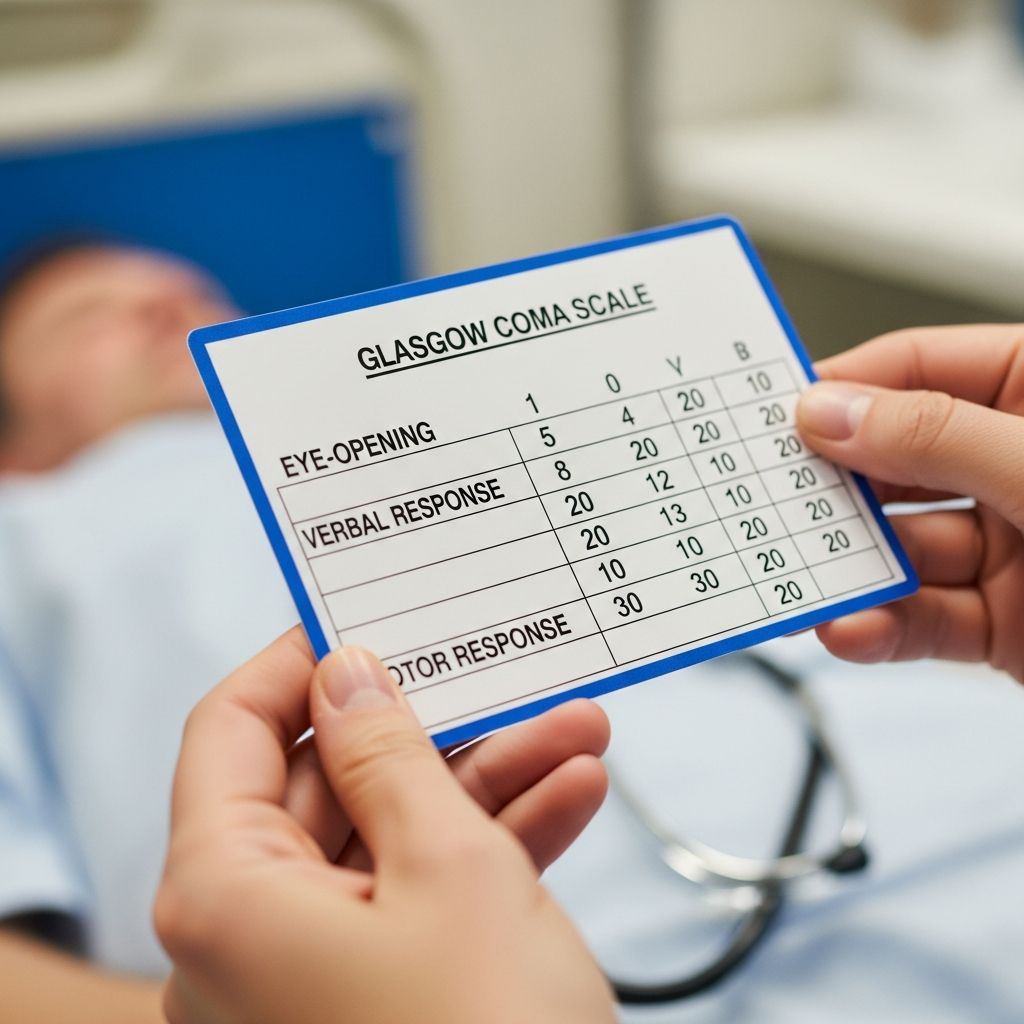
The Glasgow Coma Scale (GCS) is a clinical diagnostic tool used to measure and assess the level of consciousness in individuals who have experienced brain injury, trauma, or neurological events. Developed in the 1970s by Graham Teasdale and Bryan Jennett, the GCS provides healthcare professionals with a standardized method to evaluate how awake, alert, and responsive a person is following a potentially serious medical incident. The scale generates a numerical score that helps clinicians determine the severity of brain damage and guides immediate medical decision-making in emergency situations.
The GCS works by scoring three independent behavioral responses: eye opening, verbal response, and motor response. Each component is evaluated separately, and then the individual scores are combined to produce a total GCS score ranging from 3 to 15. Lower scores indicate more severe impairment of consciousness, while higher scores suggest better neurological function and awareness. This scoring system has become the gold standard in emergency medicine, neurology, and critical care settings worldwide.
How Does the Glasgow Coma Scale Work?
The GCS evaluates three specific parameters of responsiveness that provide insight into different aspects of brain function. By assessing these three components independently, clinicians can create a more comprehensive picture of a patient’s neurological status and track changes over time. Each component reveals different information about how well the brain is functioning.
The Three Components of GCS
Understanding each component is essential for both healthcare providers administering the test and patients or families seeking to comprehend assessment results.
Eye Opening Response (E)
The eye opening component assesses whether the arousal mechanisms in the brainstem are functioning properly. This is one of the most basic indicators of consciousness and wakefulness. Eye opening can be spontaneous, occurring without external stimulation, or it may require verbal stimulation or physical pressure to trigger the response. The eye opening response is scored on a scale of 1 to 4, with 4 being the best possible response (spontaneous eye opening) and 1 indicating no eye opening whatsoever.
Verbal Response (V)
The verbal response component is often considered the most common indicator of recovery from coma and the restoration of consciousness. This assessment evaluates the patient’s ability to speak and communicate coherently. The verbal response can range from complete absence of sounds to fully oriented conversation where the patient can answer questions appropriately about their identity, location, and current circumstances. Verbal response is scored on a scale of 1 to 5, with special notations for patients who are intubated and cannot speak.
Motor Response (M)
The motor response component evaluates how the central nervous system controls muscle movement and the patient’s ability to follow commands or respond to stimuli. This assessment tests nerve and spinal cord connections to the brain as well as the brain’s capacity to direct intentional movement. Motor response is scored on a scale of 1 to 6, with the highest score indicating the ability to follow commands and the lowest indicating no movement whatsoever. Different types of abnormal responses, such as decerebrate (rigid extension) or decorticate (flexion) posturing, can provide information about the severity and location of brain injury.
Understanding GCS Scoring
Related Stories



The GCS scoring system combines three separate numerical ratings to create a comprehensive assessment of consciousness level. Each component is scored independently based on the best response observed, meaning clinicians record the highest level of function demonstrated in any situation during the examination.
Eye Opening Scores
Eye opening is scored from 1 to 4:
- Score 4: Spontaneous eye opening without any stimulation
- Score 3: Eye opening in response to verbal command or request
- Score 2: Eye opening only in response to physical pressure or painful stimuli
- Score 1: No eye opening despite any level of stimulation
Verbal Response Scores
Verbal response is scored from 1 to 5:
- Score 5: Fully oriented patient who can answer questions coherently about personal information, location, date, and circumstances
- Score 4: Confused patient who responds to questions but with some disorientation or confusion in answers
- Score 3: Inappropriate words—random or exclamatory speech without meaningful conversation
- Score 2: Incomprehensible sounds such as moaning but no discernible words
- Score 1: Complete absence of verbal response or sound production
For patients who are intubated and cannot speak due to having a breathing tube, the verbal component is marked as “V intubated” rather than receiving a numerical score.
Motor Response Scores
Motor response is scored from 1 to 6:
- Score 6: Obeys commands—patient can follow instructions for how and when to move
- Score 5: Localizes to pain—patient intentionally moves toward and localizes the source of painful or pressure stimuli
- Score 4: Withdrawal from pain—patient moves away from painful stimuli as a reflex action
- Score 3: Abnormal flexion (decorticate response)—arms flex or bend inward on the chest with hands clenched into fists
- Score 2: Abnormal extension (decerebrate response)—rigid adduction and extension of arms and legs with downward pointing toes
- Score 1: No motor response despite any level of stimulation
Total GCS Score Calculation
The total GCS score is calculated by adding the individual scores from each of the three components: E + V + M. The resulting score ranges from a minimum of 3 to a maximum of 15. This combined score is typically expressed in a specific format for clarity. For example, a patient might be described as having a GCS of 12 with component scores written as GCS 12 = E3 V4 M5, indicating a score of 3 for eye opening, 4 for verbal response, and 5 for motor response.
The total score provides a quick numerical reference for severity, while the individual component scores offer more detailed information about specific areas of neurological function. When a component cannot be tested, it is marked as “NT” (not testable), and the total combined score should not be calculated in such cases.
Interpreting Your GCS Score
GCS scores fall into three main categories that correspond to injury severity and help guide clinical management decisions.
| Score Range | Classification | Description |
|---|---|---|
| 13-15 | Minor Head Injury | Patient shows good neurological function with minimal consciousness impairment |
| 9-12 | Moderate Head Injury | Patient shows moderate impairment with some responsiveness to stimuli |
| 8 or less | Severe Head Injury (Coma) | Patient is in coma or deep unconsciousness with severe neurological impairment |
A score of 3 represents the lowest possible score, indicating deep coma or death, with no response to any stimulation across all three components. A score of 15 indicates a fully awake, alert, and appropriately responsive individual with intact consciousness.
Clinical Applications
The Glasgow Coma Scale is used across multiple clinical situations and patient populations. It is particularly valuable in emergency departments where rapid assessment guides immediate treatment decisions. The GCS can be applied to patients with traumatic brain injury from accidents, falls, or assaults, as well as those experiencing stroke, non-traumatic coma, cardiac arrest, toxic ingestions, or other neurological emergencies.
Beyond initial assessment, the GCS is used for serial monitoring of hospitalized patients to track neurological changes and recovery progress. A patient’s GCS score upon arrival at the hospital serves as a baseline that clinicians compare to subsequent measurements to determine whether the patient is improving, declining, or remaining stable. This trending information helps guide ongoing treatment decisions and informs family members about the patient’s neurological status.
Special Considerations and Notation
Certain clinical situations require special notation when assessing GCS. Patients with endotracheal intubation (breathing tubes) cannot undergo verbal assessment, so the score is marked as “V intubated” rather than receiving a numerical value. Similarly, physical limitations such as paralysis from stroke or spinal injury may prevent accurate motor assessment, in which case the motor component is marked as “NT” (not testable). When any component cannot be properly assessed, the total combined GCS score should not be reported, as it would not accurately represent the patient’s true consciousness level.
Modern clinical practice has also refined terminology used during GCS assessment. Newer guidelines prefer the term “pressure” rather than “pain” when describing the stimuli used to test certain reflexes, as this terminology is more accurate and avoids unnecessary harm to the patient. This change in language reflects an evolution in how clinicians approach neurological assessment while maintaining the scale’s clinical validity.
GCS and Pupil Response
Advanced GCS assessment sometimes incorporates pupil response as an additional indicator of brain function. The GCS-P score combines the standard GCS with pupil reactivity scoring. A GCS score of 3 combined with a pupil score of 2 (indicating no pupil reaction in both eyes) results in a GCS-P score of 1, signifying very deep coma with severe neurological compromise.
Limitations and Pediatric Considerations
While the Glasgow Coma Scale is valuable across most patient populations, it has limited applicability in very young children, particularly those under 36 months of age. At this developmental stage, even healthy children would be expected to have poor verbal performance, making standard GCS scores difficult to interpret accurately in this age group. Consequently, the Pediatric Glasgow Coma Scale was developed specifically for assessing younger children, using age-appropriate behavioral indicators.
Frequently Asked Questions About GCS
What does a GCS score of 8 or lower mean?
A GCS score of 8 or lower typically indicates severe head injury and coma. Patients with such low scores require intensive medical monitoring and may need mechanical ventilation and specialized neurological care. This score range suggests significant impairment of consciousness and brain function.
Can the GCS score change over time?
Yes, GCS scores frequently change as patients recover from brain injury or experience decline. Serial GCS assessments help clinicians track neurological changes and adjust treatment plans accordingly. Improving scores generally indicate recovery, while declining scores may indicate complications.
Is GCS used only for traumatic brain injury?
No, the GCS can be used for any condition affecting consciousness, including stroke, cardiac arrest, toxic ingestions, metabolic disturbances, and infections. It provides a universal language for describing consciousness level across different types of neurological emergencies.
What should I do if I’m concerned about someone’s consciousness level?
If you believe someone has experienced a head injury or shows signs of altered consciousness such as confusion, difficulty waking, or unusual behavior, seek emergency medical care immediately. Emergency physicians can perform a proper GCS assessment and determine appropriate treatment.
How long does a GCS assessment take?
A GCS assessment typically takes just a few minutes to complete, making it practical for use in emergency settings where rapid decision-making is critical. The simplicity and speed of the assessment contribute to its widespread adoption in emergency medicine.
References
- Glasgow Coma Scale: What It Is, Interpretation & Chart — Cleveland Clinic. 2024. https://my.clevelandclinic.org/health/diagnostics/24848-glasgow-coma-scale-gcs
- Glasgow Coma Scale — StatPearls, National Center for Biotechnology Information (NCBI). 2024. https://www.ncbi.nlm.nih.gov/books/NBK513298/
- Glasgow Coma Scale (GCS) — Stroke Engine. 2024. https://strokengine.ca/en/assessments/glasgow-coma-scale-gcs/
- Glasgow Coma Scale — Official Glasgow Coma Scale. 2024. https://www.glasgowcomascale.org
Similar Articles








Read full bio of medha deb