Glaucoma Diagnosis: What To Expect And Key Tests
Learn how glaucoma is diagnosed, from comprehensive eye exams to advanced imaging tests that detect this silent vision thief early.
Glaucoma diagnosis involves a series of specialized eye tests to detect optic nerve damage and elevated intraocular pressure (IOP), often before symptoms appear, as this “silent thief of sight” progresses without early warning signs. Early detection through comprehensive exams is crucial since damage is irreversible but vision loss can be halted with timely intervention.
What Is Glaucoma?
Glaucoma refers to a group of eye disorders characterized by progressive deterioration of the optic nerve head and retinal nerve fiber layer, primarily due to elevated IOP, leading to potential vision loss or blindness if untreated. The most common type, primary open-angle glaucoma (POAG), features gradual blockage in the eye’s drainage system, while acute angle-closure glaucoma causes sudden pressure spikes. Risk factors include advanced age, African heritage, family history, and elevated IOP.
In POAG, patients are often asymptomatic until significant peripheral vision loss occurs, making routine screening vital, especially starting at age 40. Unlike other vision issues, central vision remains intact until late stages, emphasizing the need for specialized diagnostic tools.
Who Is at Risk for Glaucoma?
Individuals over 60, those with African American, Hispanic, or Asian heritage, family history of glaucoma, high IOP, thin corneas, diabetes, or severe nearsightedness face higher risks. Elevated IOP above 21 mm Hg is a key indicator, though normal-tension glaucoma exists where damage occurs despite normal pressure. Early screening is recommended for those 40 and older, particularly with risk factors, to catch subtle changes before irreversible damage.
- Age: Risk doubles every decade after 60.
- Ethnicity: Higher prevalence in African Americans and Hispanics.
- Family history: Genetic predisposition increases likelihood.
- Other factors: Diabetes, hypertension, and corticosteroid use.
Glaucoma Symptoms
Open-angle glaucoma typically presents no early symptoms, with patchy blind spots developing in peripheral vision as nerve fibers die; central vision loss occurs late. Acute angle-closure glaucoma, however, causes sudden severe eye pain, headache, nausea, blurred vision, halos around lights, and red eyes due to rapid IOP rise. Chronic cases may mimic aging-related vision decline, underscoring diagnostic importance.
Visual field defects start peripherally, advancing centrally; patients may not notice until 50% of retinal ganglion cells are lost. Regular exams detect these before subjective symptoms emerge.
Glaucoma Diagnosis
Diagnosing glaucoma requires an eye specialist, as early findings are subtle; a single exam is often insufficient, necessitating serial observations. A comprehensive evaluation includes dilated retinal exam, tonometry, gonioscopy, slit-lamp biomicroscopy, pachymetry, and visual field testing. Persistent cup-to-disc ratio 63 30, rising IOP, retinal nerve fiber layer thinning on OCT, and reproducible field defects confirm diagnosis.
Glaucoma suspects have suspicious optic nerves or elevated IOP but normal fields; monitoring is key. Tools like ophthalmoscopy, tonometry, and perimetry are standard.
Tonometry
Tonometry measures IOP by gauging corneal resistance to indentation or flattening, typically 10-21 mm Hg normal range; values >21 mm Hg raise suspicion despite diurnal variations. Applanation tonometry via slit-lamp is gold standard post-anesthetic numbing. Elevated IOP is a risk but not definitive, as some glaucomatous eyes have normal pressure. Accurate measurement guides management.
Related Stories



Ophthalmoscopy
Ophthalmoscopy examines the optic nerve head through a dilated pupil, revealing enlarged cup-to-disc ratio (>0.3 suspicious), disc hemorrhages, nerve fiber layer defects, or asymmetry between eyes. Large cups overlap normal variations, so serial imaging is essential. This direct visualization detects early structural changes before functional loss.
Perimetry (Visual Field Test)
Perimetry maps visual field sensitivity, detecting defects from peripheral scotomas to advanced loss; early glaucoma shows subtle nasal steps or arcuate defects. Humphrey 24-2 is common, but defects appear after 50% ganglion cell loss, limiting early sensitivity. Reproducible defects confirm progression; used in staging like AGIS or CIGTS.
Gonioscopy
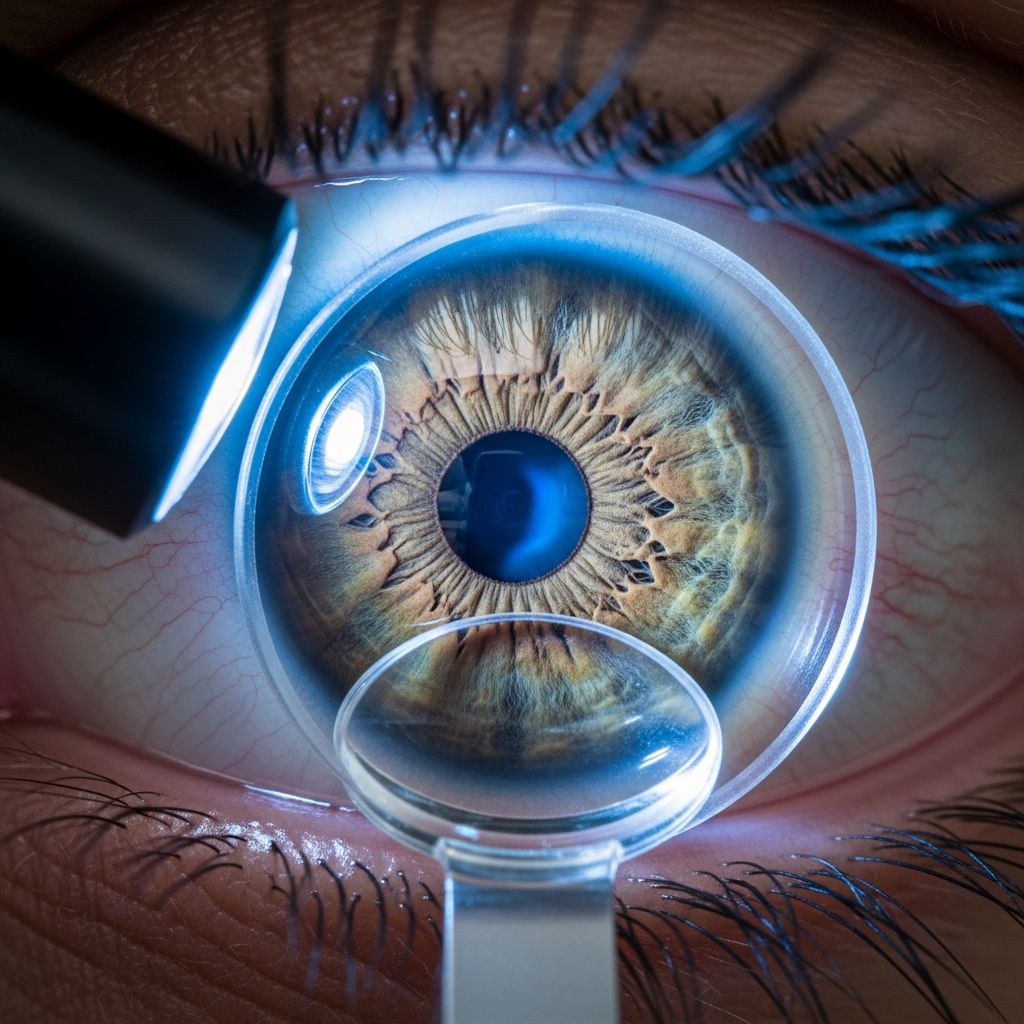
Gonioscopy inspects the drainage angle using a mirrored lens, distinguishing open-angle (wide angle) from angle-closure (narrow/narrowed). Essential for classifying glaucoma type; acute closure shows blocked trabecular meshwork. Performed post-dilation to assess risk.
Optical Coherence Tomography (OCT)
OCT provides high-resolution retinal nerve fiber layer (RNFL) and ganglion cell complex imaging; serial thinning precedes field loss, enabling early detection. Quantifies optic nerve head parameters like rim area and cup volume; characteristic progression substantiates diagnosis. Superior to exam alone for monitoring.
Pachymetry
Pachymetry measures corneal thickness ultrasonically; thin corneas (<555 μm) underestimate IOP, increasing true risk. Central thickness adjusts readings; thick corneas overestimate. Routine in evaluation for accurate risk assessment.
What Happens During a Glaucoma Exam?
A glaucoma exam starts with medical history, followed by vision acuity, refraction, slit-lamp anterior segment check, tonometry, gonioscopy, dilated fundus exam via ophthalmoscopy, perimetry, and OCT/pachymetry. Takes 1-2 hours; drops cause temporary blur/sting. Baseline establishes norms; follow-ups track changes.
Expect questions on family history, symptoms; numbing drops for pressure; mirror lens for angle; bowl perimeter for fields.
Glaucoma Severity Stages
Glaucoma severity is staged using visual field indices like mean deviation (MD), pattern standard deviation (PSD), and hemifield tests via scales such as Hodapp-Parrish-Anderson (HPA), AGIS, CIGTS, or Glaucoma Severity Scale (GSS). GSS categorizes stages 0-V: normal to end-stage blindness, incorporating visual acuity for late stages.
Early: Mild MD loss, no defects; Moderate: Arcuate scotomas; Advanced/Severe: Hemifield loss; End-stage: Field <5° or poor acuity. Enables standardized progression tracking.
| Stage | MD (dB) | Key Features |
|---|---|---|
| 0 (Normal) | > -2 | No defects |
| I (Early) | -2 to -6 | Mild PSD elevation |
| II (Moderate) | -6 to -12 | PSD > stage I, hemifield normal |
| III (Advanced) | < -12 | PSD any, hemifield abnormal |
| IV (Severe) | < -12 | Both hemifields abnormal |
| V (End-stage) | N/A | Untestable fields, VA <20/200 |
Adapted from GSS criteria.
Glaucoma FAQs
How is glaucoma diagnosed?
Through comprehensive eye exams including tonometry for IOP, ophthalmoscopy for optic nerve, perimetry for fields, gonioscopy for angle, OCT for RNFL, and pachymetry.
Can glaucoma be diagnosed in one visit?
Often presumptive initially; confirmation requires serial exams showing progression.
Is glaucoma painful?
Open-angle usually painless; acute angle-closure causes severe pain.
Who should get screened for glaucoma?
Adults 40+, those with risk factors like family history or diabetes.
Can glaucoma be cured?
No, but early diagnosis prevents vision loss via treatments lowering IOP.
References
- Glaucoma in Adults-diagnosis, Management, and Prediagnosis to … 12 PMC/NCBI. 2023-02-14. https://pmc.ncbi.nlm.nih.gov/articles/PMC9905872/
- Glaucoma: Diagnosis and Management – AAFP 12 American Academy of Family Physicians. 2023-03-01. https://www.aafp.org/pubs/afp/issues/2023/0300/glaucoma.pdf
- Glaucoma – Symptoms and causes – Mayo Clinic 12 Mayo Clinic. 2023-10-01. https://www.mayoclinic.org/diseases-conditions/glaucoma/symptoms-causes/syc-20372839
- Glaucoma Facts And Stats 12 Glaucoma Research Foundation. 2024-01-15. https://glaucoma.org/articles/glaucoma-facts-and-stats
Similar Articles








Read full bio of medha deb