Glomangioma Pathology: Comprehensive Guide For Clinicians
Detailed histopathological analysis of glomangioma, distinguishing it from glomus tumors and venous malformations.
Glomangiomas, also known as glomuvenous malformations, represent a distinct vascular lesion characterized by dilated venous channels lined by clusters of glomus cells. Unlike classic glomus tumors, glomangiomas typically manifest in childhood or adolescence, are often multifocal, and lack the intense pain associated with subungual glomus tumors.
Clinical Features
Glomangiomas differ clinically from typical glomus tumors in several key aspects. They usually appear during childhood and adolescence, are generally asymptomatic, and do not show a predilection for the subungual region. These lesions often present as multifocal pink-to-blue nodules or plaque-like formations that may darken with age.
- Age of onset: Infancy to adolescence, contrasting with glomus tumors in young adults.
- Symptoms: Typically painless initially, though tenderness may develop later; not the excruciating pain of glomus tumors.
- Distribution: Can occur anywhere on the skin, rarely mucous membranes; multiple lesions in about 10% of cases.
- Appearance: Soft, compressible pink, red, or blue nodules or coalescing plaques that thicken and darken over time.
- Inheritance: May be sporadic or familial with autosomal dominant pattern linked to chromosome 1p21-22 mutations in glomulin gene.
Multiple disseminated glomangiomas, as reported in case studies, present as asymptomatic bluish nodules from childhood, highlighting their benign nature.
Histopathology
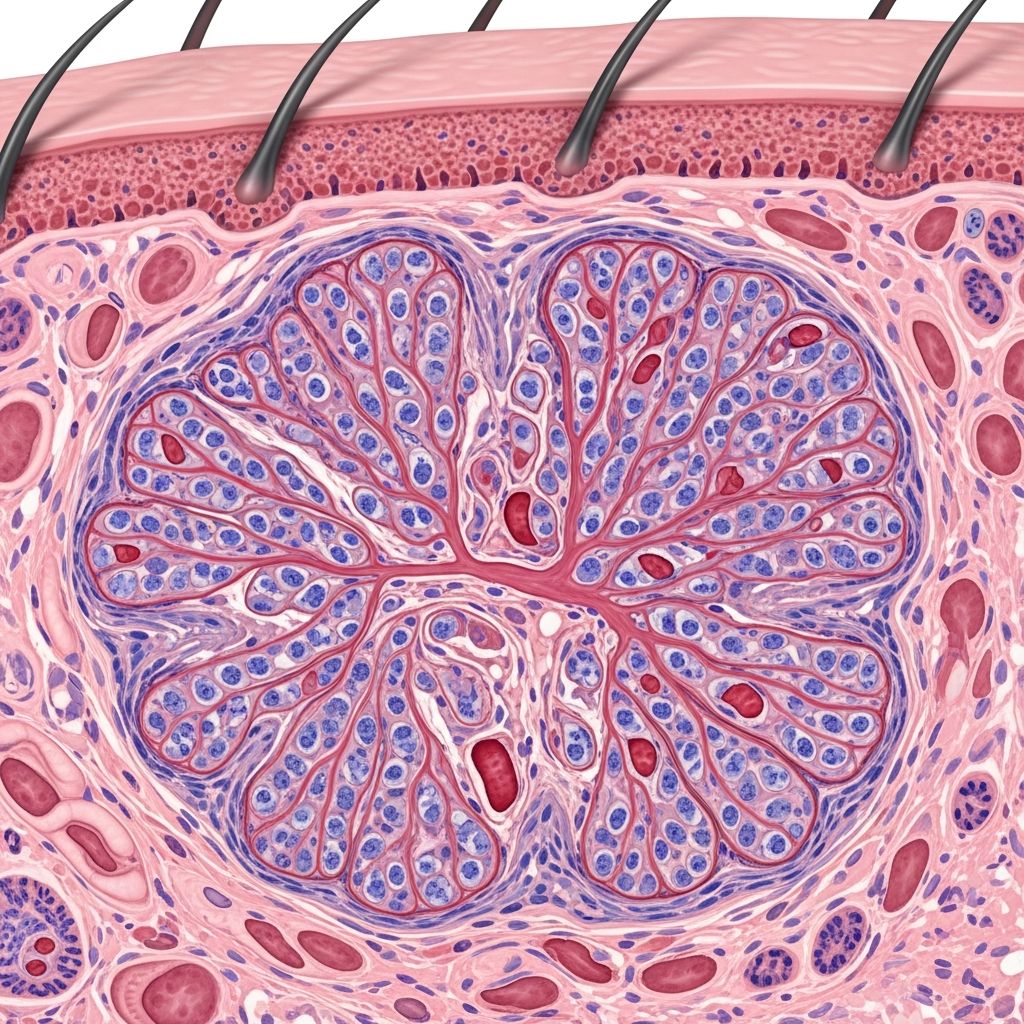
The defining histopathological feature of glomangioma is the presence of dilated venous channels resembling venous malformations, but distinguished by surrounding layers of cuboidal glomus cells. These vascular spaces are lined by single to multiple rows of glomus cells, creating a characteristic architecture.
- Low-power view: Large, dilated thin-walled veins in dermis and subcutaneous tissue, forming nodular or plaque-like patterns.
- Glomus cells: Uniform cuboidal to round cells with bland round/oval nuclei, eosinophilic cytoplasm, and distinct cell borders; arranged in clusters around vessels.
- Vascular component: Prominent with dilated vessels; may show thrombosis or phlebolith formation, more evident than in solid glomus tumors.
- Depth: Confined to dermis and subcutis, well-circumscribed, without prominent mitoses or pleomorphism.
- Special features: Glomus cells form nodules around vascular spaces, differing from the solid sheets in classic glomus tumors.
Under microscopy, glomangiomas appear as collections of purplish cells in the deep dermis abutting fat, with cells clustering around vessels in a perivascular growth pattern.
Immunohistochemistry
Immunohistochemical profiling is crucial for confirming glomus cell identity and distinguishing glomangioma from mimics.
| Marker | Staining in Glomus Cells | Notes |
|---|---|---|
| α-smooth muscle actin (SMA) | Positive | Strong, uniform; confirms smooth muscle origin. |
| Vimentin | Positive | Consistent with mesenchymal differentiation. |
| Desmin | Negative | Distinguishes from true smooth muscle tumors. |
| von Willebrand factor | Negative | Endothelial cells positive; glomus cells negative. |
| S-100 | Negative | Rules out neural differentiation. |
| CD34/CD31 | Negative in glomus cells; positive in endothelium | Highlights vascular component. |
| Type IV collagen | Surrounds tumor cells | Basement membrane network. |
Glomus cells in glomangioma show no staining differences from other glomus tumor variants, reinforcing their shared origin as modified perivascular smooth muscle cells.
Differential Diagnosis
Several entities enter the differential due to overlapping vascular or cellular features. Key discriminators include vascular prominence, cell arrangement, and IHC profile.
- Glomus tumor (solid type): More solid sheets of glomus cells, less prominent vascular dilation, painful subungual location.
- Venous malformation: Lacks glomus cells; purely dilated irregular veins without perivascular cell clusters.
- Eccrine spiradenoma: Two cell populations, epithelial markers (keratin+), ductal differentiation.
- Intradermal nevus: S-100 and Melan-A positive; lacks vascular component.
- Hemangioendothelioma or other vascular tumors: Endothelial markers positive in tumor cells.
- Neuroendocrine tumors: May mimic round cell morphology but positive for synaptophysin/chromogranin.
Related Stories



Rarely, glomangiomas occur extracutaneously (e.g., nasal cavity), but maintain similar histology.
Pathogenesis
Glomangiomas arise from glomus cells, specialized perivascular smooth muscle cells in the Sucquet-Hoyer canal of the glomus body, which regulates skin temperature via arteriolar contraction/dilation. Familial cases involve glomulin gene mutations on chromosome 1p21-22, leading to loss of function and abnormal vascular proliferation.
These lesions are benign proliferations, with rare malignant potential characterized by mitoses, atypia, or invasion—uncommon in typical glomangioma.
Diagnosis
Clinical suspicion arises from multifocal, non-painful vascular lesions in children. Confirmation requires biopsy showing characteristic venous channels with glomus cell lining. Imaging (ultrasound/Doppler) may assess extent in segmental cases.
Treatment
Asymptomatic lesions require observation. For painful, disfiguring, or functional lesions:
- Sclerotherapy: Effective for multifocal disease.
- Laser therapy: Pulsed dye laser for superficial plaques.
- Surgical excision: For solitary symptomatic nodules, though recurrence possible in familial forms.
- Pain management: NSAIDs if tenderness develops.
Frequently Asked Questions (FAQs)
Q: How does glomangioma differ from a classic glomus tumor?
A: Glomangiomas occur in children, are multifocal and painless, with prominent vascular channels; glomus tumors are solitary, painful subungual nodules in adults with solid glomus cell sheets.
Q: Are glomangiomas hereditary?
A: Up to 50% of cases are familial with autosomal dominant inheritance due to glomulin mutations.
Q: What is the hallmark histological feature?
A: Dilated veins lined by 1-3 layers of cuboidal glomus cells, positive for SMA and vimentin.
Q: Can glomangiomas become malignant?
A: Extremely rare; most are benign. Malignancy shows mitoses, atypia, and deep invasion.
Q: Is biopsy always necessary?
A: Yes for definitive diagnosis, especially to rule out mimics like venous malformations.
References
- Glomuvenous malformation — DermNet NZ. 2008 (updated). https://dermnetnz.org/topics/glomuvenous-malformation
- Multiple disseminated glomus tumors (glomangioma) — PubMed (Acta Derm Venereol). 1993-09-01. https://pubmed.ncbi.nlm.nih.gov/8396077/
- Glomangioma pathology — DermNet NZ. Accessed 2026. https://dermnetnz.org/topics/glomangioma-pathology
- Glomus tumour pathology — DermNet NZ. Accessed 2026. https://dermnetnz.org/topics/glomus-tumour-pathology
- Glomus tumours — DermNet NZ. 2008 (updated). https://dermnetnz.org/topics/glomus-tumour
- Glomus tumor under the microscope (pathology) — YouTube (transcript). Accessed 2026. https://www.youtube.com/watch?v=Hfe4cAr2n60
Similar Articles








Read full bio of Sneha Tete