Glomeruloid Haemangioma Pathology: Diagnosis And POEMS Link
Detailed pathology of glomeruloid haemangioma, a rare vascular lesion linked to POEMS syndrome and its diagnostic features.
Glomeruloid haemangioma is a rare benign cutaneous vascular proliferation that typically arises in patients with a history of
POEMS syndrome
.Introduction
Glomeruloid haemangioma, first described in 1990 by Chan et al., represents a histologically distinctive benign vascular tumour. It is strongly associated with polyneuropathy, organomegaly, endocrinopathy, monoclonal gammopathy, and skin changes (**POEMS syndrome**), a paraneoplastic syndrome linked to plasma cell dyscrasias and often Castleman disease. While predominantly seen in POEMS patients, rare cases occur in individuals without this syndrome, highlighting its diagnostic specificity when present.
Clinically, these lesions manifest as small, firm, red-to-violaceous dome-shaped papules, papulonodules, subcutaneous bluish compressible tumours, wine-red sessile or pedunculated papules, or cerebriform papules. They measure from a few millimetres to centimetres in diameter, primarily on the trunk and proximal limbs, though facial involvement is reported rarely. Lesions often appear eruptively over days to weeks, aiding association with POEMS.
POEMS syndrome encompasses multisystem features: demyelinating polyneuropathy, hepatosplenomegaly or lymphadenopathy (organomegaly), endocrine abnormalities (e.g., diabetes, hypogonadism), monoclonal protein (M-protein), and skin changes like hyperpigmentation, hypertrichosis, sclerodermoid thickening, acrocyanosis, and vascular proliferations. Cutaneous vascular lesions occur in up to one-third of cases, with glomeruloid haemangioma being the most specific. Early recognition can prompt POEMS screening, enabling multidisciplinary management to prevent complications like thrombosis or effusions.
Histology
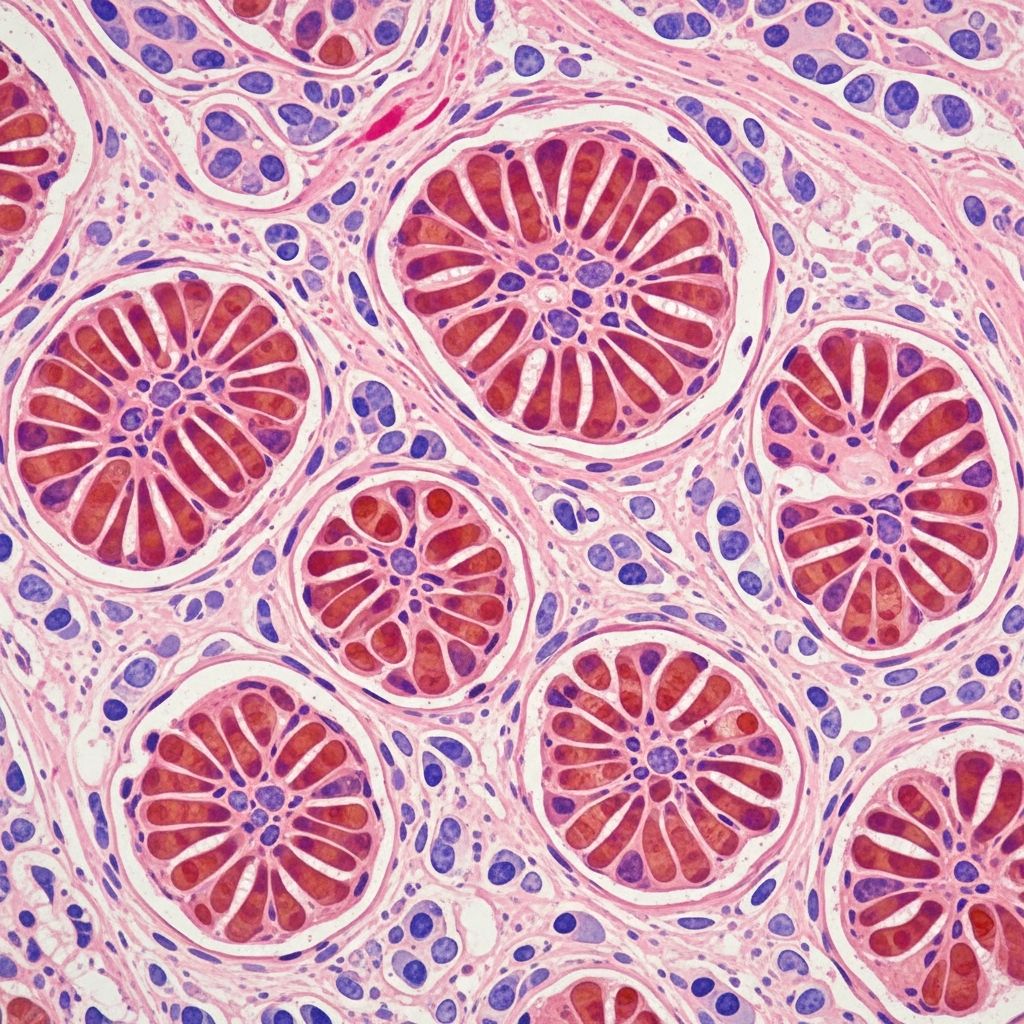
The hallmark histopathology features numerous dermal ectatic vascular spaces lined by flat endothelial cells. Within these dilated spaces, conglomerations of capillaries lined by plump, swollen endothelial cells protrude into the lumina, filled with red blood cells, closely resembling renal glomeruli (figures 1–4 in original).
Key microscopic findings include:
- Scattered, well-defined dermal structures of varying sizes mimicking glomeruli: a central dilated sinusoidal vessel surrounded by peripheral capillary loops.
- Proliferation of coiled or glomeruloid capillary tufts within larger vascular channels.
- Variable-sized, homogeneous, eosinophilic, periodic acid-Schiff (PAS)-positive, diastase-resistant globules in endothelial and stromal cells.
- Endothelial cells with hobnail appearance in some cases; no significant atypia or mitoses, confirming benignity.
Low-power views show dermal nodules or clusters of irregular vascular spaces; high-power reveals the diagnostic glomerular architecture. Associated changes in POEMS may include sclerodermiform thickening or hyperpigmentation, but the vascular pattern is pathognomonic.
Special Studies
Immunohistochemistry supports the diagnosis:
- Endothelial cells strongly positive for CD31, CD34, and factor VIII-related antigen.
- PAS-positive hyaline globules in endothelial cells, diastase-resistant.
- Negative for HHV-8 in most cases, distinguishing from Kaposi sarcoma.
Electron microscopy (rarely needed) shows Weibel-Palade bodies in endothelium and hyaline globules with microfibrillar structure. These studies confirm vascular origin and exclude mimics. In POEMS context, serum VEGF levels are elevated, correlating with vascular proliferation, though not specific to histology.
| Feature | Description |
|---|---|
| Vascular Architecture | Dilated spaces with intraluminal glomerular capillary clusters |
| Endothelial Cells | Plump, swollen; CD31+, CD34+; hobnail forms |
| Inclusions | PAS+ diastase-resistant eosinophilic globules |
| Other | RBC-filled capillaries; no atypia/mitoses |
Related Stories



Differential Diagnoses
Glomeruloid haemangioma’s unique glomerular pattern distinguishes it from other vascular proliferations:
- Acquired tufted angioma: Cannonball distribution of tufts in dermis/subcutis; lacks true glomerular spaces.
- Kaposi sarcoma: Slit-like spaces, spindle cells, HHV-8+; lymphoplasmacytic infiltrate.
- Angiosarcoma: Anastomosing channels, atypia, mitoses; malignant.
- Pyogenic granuloma (lobular capillary haemangioma): Lobular pattern, epidermal collarette; surface ulceration.
- Microvenular haemangioma: Uniform small venules; no glomerular tufts.
- Involuting haemangioma: Similar tufts but with involutional changes.
In non-POEMS cases, rule out coagulopathies or isolated vascular anomalies. Dermoscopy shows milky-red areas, reddish dots/lines, aiding biopsy site selection.
Clinical Features and Associations
Beyond pathology, understanding clinical context is crucial. Lesions are often multiple and eruptive, prompting POEMS evaluation: nerve conduction studies, serum protein electrophoresis, VEGF assay, and imaging for organomegaly/Castleman. Rare isolated cases exist, but POEMS association exceeds 90%.
Management
Benign; no treatment needed unless symptomatic. Address underlying POEMS: chemotherapy, radiation for Castleman, autologous stem cell transplant. Lesion excision for diagnosis or cosmesis; laser therapy reported anecdotally.
Frequently Asked Questions (FAQs)
What is glomeruloid haemangioma?
A rare benign skin vascular tumour resembling renal glomeruli histologically, linked to POEMS syndrome.
Is glomeruloid haemangioma always associated with POEMS?
Typically yes (>90%), but rare isolated cases occur.
How is it diagnosed?
By biopsy showing glomerular vascular clusters; immunohistochemistry (CD31/CD34+).
What does it look like clinically?
Red-violaceous papules/nodules on trunk/limbs; eruptive.
What are POEMS syndrome symptoms?
Polyneuropathy, organomegaly, endocrinopathy, M-protein, skin changes (e.g., hyperpigmentation).
Prognosis
Excellent for isolated lesions; follows POEMS course, which varies with plasma cell dyscrasia treatment response.
References
- Glomeruloid haemangioma pathology — DermNet NZ. 2023. https://dermnetnz.org/topics/glomeruloid-haemangioma-pathology
- Glomeruloid Hemangioma in Normal Individuals — PMC (Indian J Dermatol). 2013-05-15. https://pmc.ncbi.nlm.nih.gov/articles/PMC3657245/
- Glomeruloid Hemangioma and POEMS Syndrome — Actas Dermo-Sifiliográficas. 2017. https://www.actasdermo.org/en-glomeruloid-hemangioma-poems-syndrome-articulo-S1578219016303468
- Glomeruloid hemangioma — Wikipedia (informed by primary sources). 2023. https://en.wikipedia.org/wiki/Glomeruloid_hemangioma
- Glomeruloid Hemangioma as a Marker for the Early Diagnosis — PMC (Ann Dermatol). 2017-02-27. https://pmc.ncbi.nlm.nih.gov/articles/PMC5383761/
- Hemangioma glomeruloide e a síndrome POEMS — SciELO (An Bras Dermatol). 2014. https://www.scielo.br/j/abd/a/spXc4xndNYD7hZD5bZndS6h/?lang=en
Similar Articles








Read full bio of Sneha Tete