Gonadotropin-Releasing Hormone: Function & Effects
Understand GnRH: The crucial hormone regulating reproductive health and sexuality.
What Is Gonadotropin-Releasing Hormone (GnRH)?
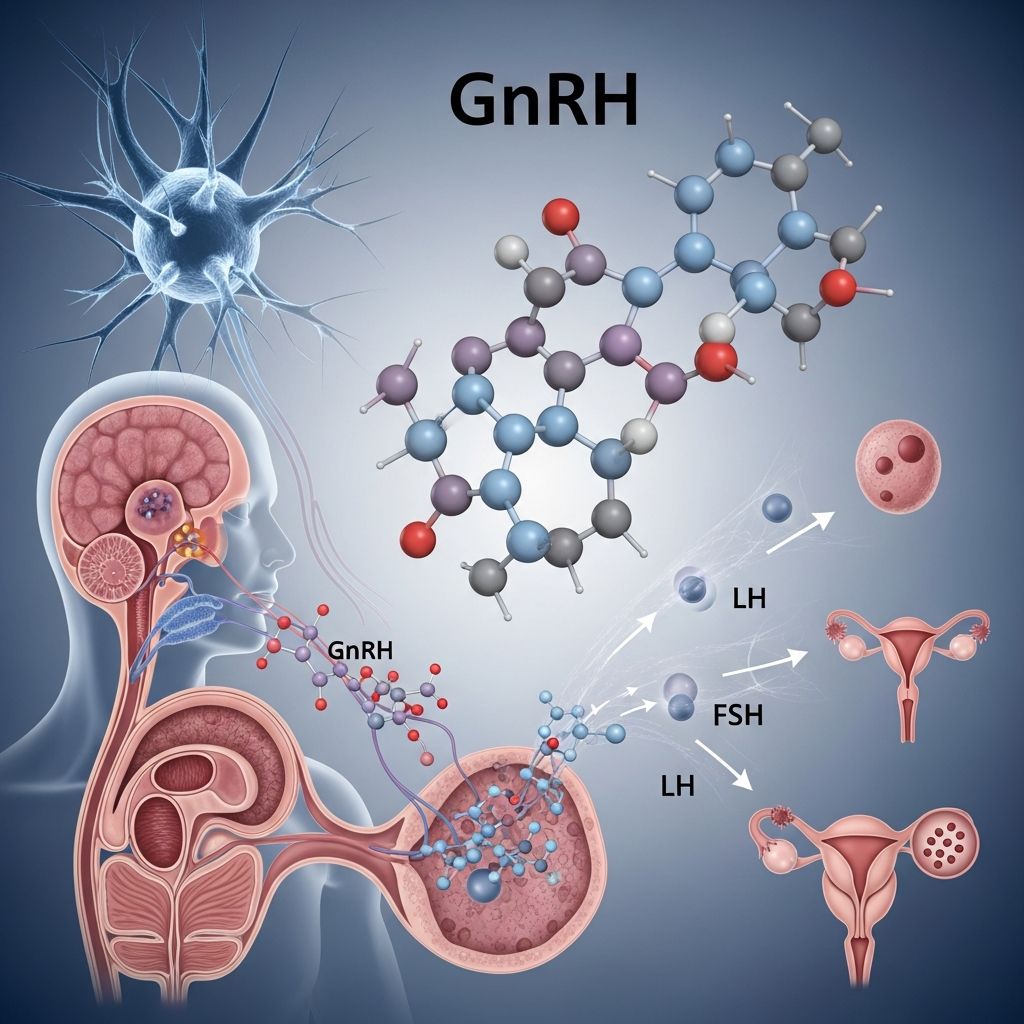
Gonadotropin-releasing hormone, commonly known as GnRH, is a critical hormone produced by your hypothalamus, a small but powerful gland located at the base of your brain. This hormone plays a fundamental role in orchestrating your reproductive system and sexual development throughout your lifetime. GnRH acts as a chemical messenger that initiates a cascade of hormonal signals essential for reproduction, fertility, and the development of secondary sexual characteristics during puberty.
The hypothalamus releases GnRH in specialized patterns, typically in pulses or short bursts rather than as a continuous flow. These pulsatile releases are crucial for proper hormonal function—the frequency and intensity of these pulses actually determine which reproductive hormones your body produces in greater abundance. This elegant system represents one of the body’s most sophisticated regulatory mechanisms, ensuring that reproductive hormones remain in delicate balance.
How Does GnRH Work?
GnRH operates through a complex feedback system known as the hypothalamic-pituitary-gonadal (HPG) axis. Understanding this system is essential to appreciating how your reproductive health is maintained. When your hypothalamus releases GnRH, this hormone travels a short distance through specialized blood vessels to reach your pituitary gland, another small but crucial endocrine gland located beneath your brain.
Once GnRH reaches the pituitary gland, it binds to specific receptors and stimulates the release of two important gonadotropins: follicle-stimulating hormone (FSH) and luteinizing hormone (LH). The pattern of GnRH pulses determines the ratio of FSH to LH production. Low-frequency pulses of GnRH preferentially stimulate FSH release, while high-frequency pulses trigger greater LH production. This nuanced control allows your body to fine-tune reproductive processes depending on your life stage and physiological needs.
FSH and LH then travel through your bloodstream to your gonads—the testes in males and ovaries in females. In males, LH stimulates testosterone production, while FSH promotes sperm development. In females, FSH stimulates follicle development and estrogen production, while LH triggers ovulation and corpus luteum formation that produces progesterone. This interconnected system creates a self-regulating loop where the hormones produced by your gonads ultimately feed back to suppress or enhance GnRH production, maintaining hormonal equilibrium.
GnRH’s Role in Puberty and Sexual Development
One of GnRH’s most dramatic functions occurs during puberty, when this hormone reactivates after remaining relatively quiet during childhood. The timing of puberty is largely controlled by GnRH secretion, which increases in frequency and magnitude during this developmental period. This hormonal surge triggers the physical and emotional changes that characterize adolescence.
During puberty, elevated GnRH stimulates increased production of FSH and LH, which in turn drive the development of secondary sexual characteristics. In males, this includes testicular enlargement, penis growth, increased muscle mass, deepening of the voice, and the development of facial and body hair. In females, the puberty-driven GnRH surge stimulates breast development, growth of the uterus and ovaries, distribution of body fat in characteristic patterns, and the onset of menstruation. GnRH essentially orchestrates the transformation of the juvenile body into that of a reproductively mature adult.
GnRH and the Menstrual Cycle
In individuals with ovaries, GnRH plays a central role in regulating the menstrual cycle, which typically spans approximately 28 days. The cycle begins when GnRH pulses stimulate FSH release, which prompts your ovaries to develop follicles containing eggs. As follicles grow, they produce increasing amounts of estrogen. Low levels of estrogen provide negative feedback to suppress more GnRH and FSH production, while rising estrogen levels—particularly just before ovulation—trigger positive feedback that causes a dramatic surge in GnRH, FSH, and LH. This LH surge is the immediate trigger for ovulation, when a mature egg is released from the ovary.
Related Stories



After ovulation, the remnants of the follicle transform into the corpus luteum, which produces progesterone. This progesterone exerts negative feedback effects, slowing the frequency of GnRH pulses from the hypothalamus. If the egg is not fertilized, progesterone production declines, GnRH pulses increase again, and FSH levels begin to rise, initiating the next menstrual cycle. This elegant feedback system maintains the rhythmic nature of the menstrual cycle and ensures reproductive readiness.
GnRH and Testosterone Regulation in Males
In males, GnRH maintains steady testosterone production through a similar feedback mechanism. The hypothalamus releases GnRH in regular pulses, stimulating the pituitary to release LH, which signals the testes to produce and release testosterone. As testosterone levels in the blood increase, they provide negative feedback to suppress further GnRH production, creating a self-regulating system that maintains testosterone within an optimal range. This feedback loop ensures that testosterone levels remain relatively stable throughout the day and across seasons, supporting male sexual function, muscle development, bone health, and overall vitality.
Conditions Affecting GnRH Production and Function
Kallmann Syndrome
Kallmann syndrome is an inherited genetic condition in which the hypothalamus fails to produce sufficient GnRH. Without adequate GnRH signaling, affected individuals experience low levels of FSH and LH, resulting in insufficient sex hormone production. Without treatment, individuals with Kallmann syndrome typically do not enter puberty and may face infertility challenges. However, with appropriate hormone replacement therapy, puberty can be induced and fertility may be achieved.
Hypogonadism and GnRH Deficiency
Various conditions can impair GnRH production or function, leading to hypogonadism—abnormally low sex hormone levels. GnRH deficiency can result from hypothalamic damage due to tumors, head trauma, infections, or certain medications. When GnRH levels are inadequate, FSH and LH production declines, causing insufficient testosterone production in males and disrupted ovulation and estrogen production in females. This condition can manifest as delayed puberty, reduced fertility, decreased sexual function, or loss of menstruation.
Primary Hypogonadism (Hypergonadotropic-Hypogonadism)
When the gonads themselves are damaged and cannot produce adequate sex hormones, the feedback system responds by increasing GnRH, FSH, and LH production in an attempt to stimulate more hormone output. This results in elevated gonadotropin levels despite low sex hormone levels—a condition called primary hypogonadism or hypergonadotropic-hypogonadism. This pattern is associated with conditions like primary ovarian insufficiency (POI) or testicular failure.
GnRH and Fertility
GnRH is essential for normal fertility in both males and females. The pulsatile pattern of GnRH release is particularly important—continuous GnRH exposure actually suppresses fertility, while the natural pulsatile pattern promotes it. This discovery has led to important medical applications. GnRH agonists—medications that provide continuous GnRH stimulation—can suppress sex hormone production and are used to treat endometriosis, fibroids, and certain cancers. Conversely, GnRH antagonists block GnRH signaling and are used in assisted reproductive technologies to prevent premature ovulation during fertility treatments.
Research has also demonstrated that GnRH agonists administered during chemotherapy can help preserve ovarian function in premenopausal women undergoing cancer treatment. Studies show that women who received GnRH agonists during chemotherapy had a premature ovarian insufficiency rate of only 14.1%, compared to 30.9% in the control group. This protective effect represents an important advancement in preserving fertility options for women facing cancer treatment.
GnRH Testing and Diagnosis
When healthcare providers suspect abnormalities in GnRH function or sex hormone levels, they may order various tests. Blood tests measuring FSH, LH, testosterone (in males), or estrogen and progesterone (in females) provide indirect information about GnRH function. In some cases, providers may administer GnRH directly to assess how the pituitary gland responds, helping to determine whether GnRH deficiency originates in the hypothalamus or reflects pituitary dysfunction.
The GnRH stimulation test involves administering synthetic GnRH and then measuring the subsequent rise in FSH and LH. A normal response indicates that the pituitary can produce gonadotropins appropriately, suggesting that hypothalamic GnRH production may be the problem. A blunted response may indicate pituitary disease. These diagnostic approaches help clinicians pinpoint the cause of reproductive or sexual development problems.
Medical Applications of GnRH Therapy
Synthetic GnRH and its analogues have become important therapeutic tools. GnRH agonists, which initially stimulate the pituitary before causing prolonged suppression, are used to treat conditions including endometriosis, uterine fibroids, precocious puberty (early puberty), and certain cancers. GnRH antagonists, which block GnRH signaling, are used in fertility treatments and to manage hormone-sensitive cancers. Pulsatile GnRH replacement therapy can restore fertility in individuals with GnRH deficiency.
Factors That Influence GnRH Secretion
Multiple factors influence how much and how frequently your hypothalamus releases GnRH. Stress, nutrition, body weight, exercise intensity, and sleep patterns all affect GnRH secretion. Significant weight loss, excessive exercise, or chronic stress can suppress GnRH and subsequently reduce sex hormone production, potentially causing irregular periods or erectile dysfunction. Conversely, recovery of normal body weight, reduced stress, and improved sleep often restore normal GnRH pulsatility and reproductive function.
Frequently Asked Questions About GnRH
Q: What does GnRH stand for?
A: GnRH stands for gonadotropin-releasing hormone. It is a hormone produced by the hypothalamus that controls the release of reproductive hormones.
Q: Where is GnRH produced?
A: GnRH is produced in the hypothalamus, a small gland located at the base of your brain just above the pituitary gland.
Q: How does GnRH affect male fertility?
A: GnRH stimulates LH production, which signals the testes to produce testosterone and support sperm development. Normal GnRH pulsatility is essential for male fertility.
Q: Can GnRH levels be tested?
A: While GnRH itself is difficult to measure in blood, healthcare providers assess GnRH function by measuring FSH and LH levels or through GnRH stimulation tests.
Q: What happens if GnRH production is too low?
A: Low GnRH production results in reduced FSH and LH, leading to low sex hormone levels, delayed puberty, irregular periods, erectile dysfunction, or infertility.
Q: Can GnRH be used as a treatment?
A: Yes. GnRH agonists and antagonists are used to treat various conditions, including endometriosis, fibroids, some cancers, and to manage fertility treatments.
Q: How does stress affect GnRH?
A: Chronic stress can suppress GnRH secretion, potentially causing irregular periods, reduced testosterone, and decreased fertility.
References
- Testosterone: What It Is, Function & Levels — Cleveland Clinic. 2024. https://my.clevelandclinic.org/health/articles/24101-testosterone
- Follicle-Stimulating Hormone (FSH): What It Is & Function — Cleveland Clinic. 2024. https://my.clevelandclinic.org/health/articles/24638-follicle-stimulating-hormone-fsh
- Ovulation: Calculating, Timeline, Pain & Other Symptoms — Cleveland Clinic. 2024. https://my.clevelandclinic.org/health/articles/23439-ovulation
- A Systematic Review and Meta-Analysis of Individual Patient–Level Data from Five Randomized Trials Evaluating Gonadotropin-Releasing Hormone Agonists During Chemotherapy for Preservation of Ovarian Function and Fertility in Premenopausal Patients with Early Breast Cancer — National Center for Biotechnology Information (NCBI). 2019. https://pmc.ncbi.nlm.nih.gov/articles/PMC6804855/
- Conception: Fertilization, Process & When It Happens — Cleveland Clinic. 2024. https://my.clevelandclinic.org/health/articles/11585-conception
Similar Articles








Read full bio of Sneha Tete