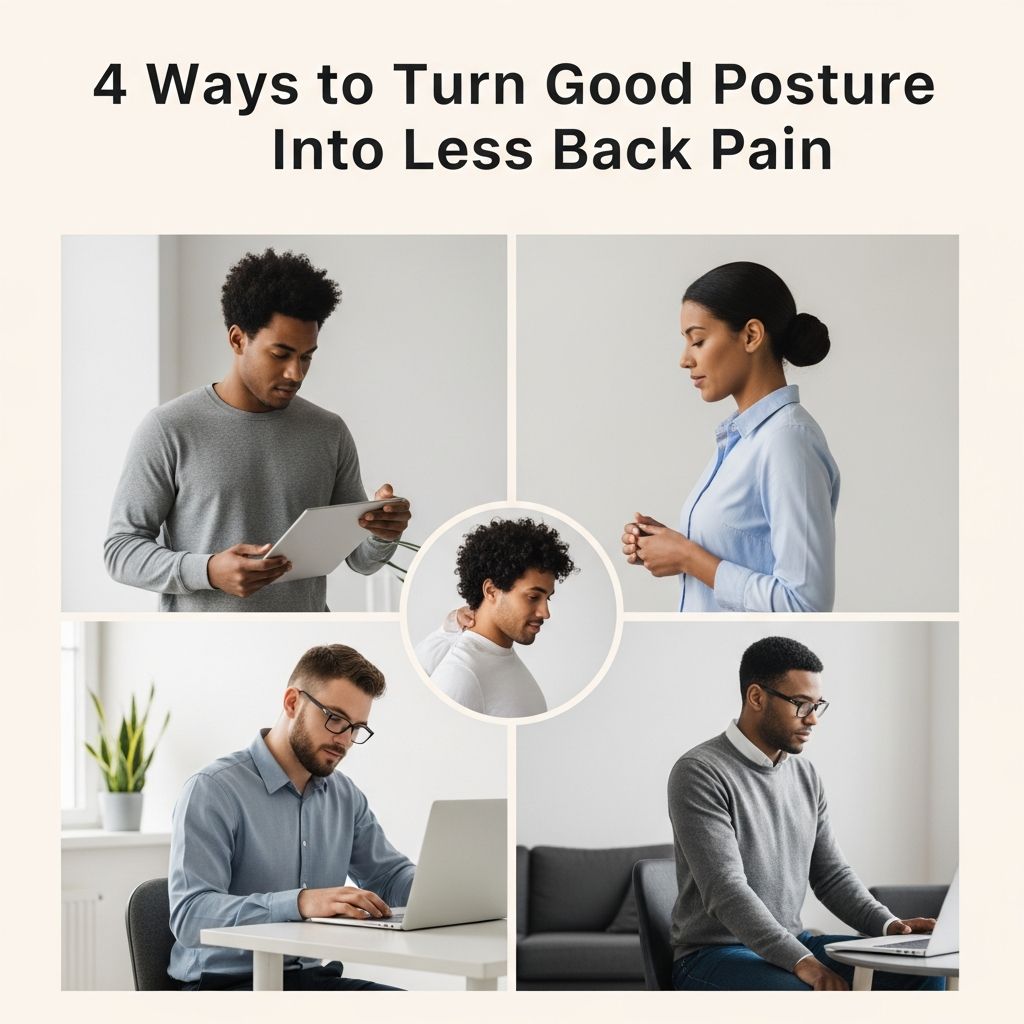
4 Ways to Turn Good Posture Into Less Back Pain
Master posture techniques to reduce back pain and improve spinal health naturally.
Back pain affects millions of people worldwide, significantly impacting quality of life and productivity. While numerous factors contribute to back discomfort, one of the most overlooked yet powerful solutions lies in maintaining proper posture. Good posture is not merely about standing tall or looking professional; it fundamentally affects how your spine functions, how your muscles support your skeletal structure, and ultimately, whether you experience chronic pain or relief.
The relationship between posture and back pain is well-established in medical research. When your body is properly aligned, the forces acting on your spine are distributed evenly across the vertebrae and discs. Conversely, poor posture places abnormal stress on your spine, leading to muscle strain, disc compression, and inflammatory responses that manifest as pain. The good news is that by adopting strategic approaches to posture correction, you can substantially reduce or even eliminate back pain.
Understanding the Posture-Pain Connection
Before diving into specific strategies, it’s important to understand why posture matters so much for spinal health. Your spine consists of 33 vertebrae separated by intervertebral discs that act as shock absorbers. Surrounding these structures are muscles, ligaments, and tendons that provide support and enable movement. When you maintain proper posture, all these components work together harmoniously. However, when you slouch, hunch forward, or misalign your body, you create mechanical stress that accumulates over time.
The muscles and ligaments surrounding your spine can weaken with age or from injury, which can make movements like twisting, stretching, lifting, and bending difficult. When core muscles are weak, the lower back often has to compensate for this lack of mobility, which places greater stress and burden on its muscles. A strong core can stabilize your spine to help keep your lower back healthy and pain-free, allowing your muscles to work efficiently rather than strain under excessive load.
Strategy 1: Master the Fundamentals of Proper Posture
The foundation of reducing back pain through posture begins with understanding what proper alignment looks like. Correct posture means positioning your body so that your ears, shoulders, hips, knees, and ankles form a straight vertical line when viewed from the side. Your head should sit directly above your shoulders, not jutting forward, and your shoulders should be relaxed and rolled back slightly.
When sitting, your feet should be flat on the floor or a footrest, with your knees at approximately 90 degrees. Your lower back should maintain its natural curve—you can use a lumbar support pillow to help maintain this position if needed. Your computer screen should be at eye level to prevent you from looking down, which creates forward head posture, one of the most common causes of neck and upper back pain.
Key postural checkpoints:
- Your head should be balanced on top of your spine, not protruding forward
- Your shoulders should be relaxed, not hunched up toward your ears
- Your chest should be open and slightly expanded
- Your core muscles should be gently engaged without rigidity
- Your lower back should maintain its natural curve, not be excessively arched or flattened
- Your weight should be distributed evenly across both feet when standing
Related Stories



Strategy 2: Strengthen Your Core Through Targeted Exercises
A stable spine is also more flexible, so it can support a full range of natural movements. Healthier movements reduce pressure on the low back and lower the risk of pain and injury. Spine stability is achieved with a balanced approach to your entire core musculature, which means you engage all the core muscles at once—from the abdominals to the whole back.
One of the most effective approaches to core strengthening comes from research by Dr. Stuart McGill, an expert in spine biomechanics. Dr. McGill developed the “big three” exercises, which are scientifically designed to build core stability without excessive stress on the spine. These exercises should be performed two or three days a week before your regular workout, and after a while, you can perform them daily.
The Big Three Core Exercises
1. Curl-up
The curl-up exercise targets your abdominal muscles while maintaining spinal stability. Here’s how to perform it correctly:
- Lie on your back with one leg extended straight on the floor
- Bend the knee of your other leg so your foot is flat on the floor
- Place your hands under your lower back to maintain the natural arch of your spine
- On an exhalation, lift your head, shoulders, and chest off the floor as though they were all connected, coming off the floor just enough to feel tension
- Avoid bending your lower back, tucking your chin, or letting your head tilt back
- Hold for 10 seconds and then slowly lower yourself down
- Complete five reps, then switch leg positions and repeat
2. Side Plank
The side plank strengthens the lateral core muscles that support your spine from the sides. Follow these steps:
- Lie on your side with your upper body propped up on your arm, forearm on the floor and elbow underneath your shoulder
- Place your free hand on top of your hip
- Pull your feet back so your knees are at a 90-degree angle
- Lift your hips off the floor so they are in line with the rest of your body
- Hold for up to 10 seconds, maintaining a straight line from your head to your knees
- Slowly lower your hips back down to the floor
- Repeat five times, then flip to your other side and repeat
- For a challenge, straighten your legs instead of bending them
3. Bird-Dog
The bird-dog exercise improves balance, coordination, and core stability throughout your entire trunk. Perform it as follows:
- Get down on the floor on your hands and knees
- Raise your left arm and extend it forward as far as possible while simultaneously lifting your right leg and extending it straight behind your body
- Keep both the raised arm and leg parallel to the floor
- Ensure your hips are aligned with your torso and not tilted to one side
- Hold for 10 seconds and then return to the starting position
- Repeat five times, then switch to the other arm and leg and repeat
Progression Strategy
Start with five repetitions of each exercise using a pyramid sequence: perform five reps of each exercise, then three reps of each, and finish with one rep of each. As you get more comfortable with the routine, you can increase the number of reps you start with for each exercise, but continue to follow the descending pattern. This progressive approach allows your body to adapt safely while building endurance and strength.
Strategy 3: Develop Daily Postural Awareness and Habits
Even the best exercises won’t help if you spend eight hours a day slouching at your desk. Developing consistent awareness of your posture throughout daily activities is crucial for long-term pain relief. This means actively monitoring and correcting your posture during work, meals, driving, and leisure activities.
Many people experience fear-avoidance behavior after developing back pain, where they avoid movement thinking it will worsen their condition. However, people with back pain often fear movement, which can make their back stiff and their pain even worse. A stable and well-supported spine actually enables a full range of natural movements, making gentle activity and conscious posture maintenance essential for recovery.
Postural Habits Throughout Your Day
| Activity | Posture Strategy |
|---|---|
| Sitting at Desk | Maintain 90-degree angles at elbows, hips, and knees; position monitor at eye level; take breaks every 30 minutes to stand and stretch |
| Using Your Phone | Bring the phone up to eye level instead of looking down; avoid prolonged forward head posture |
| Driving | Adjust seat so you’re not reaching for the steering wheel; use lumbar support; take frequent breaks on long drives |
| Standing | Distribute weight evenly across both feet; avoid locking knees; engage core gently |
| Lifting Objects | Bend at knees and hips, keep back straight; hold objects close to your body; avoid twisting while holding weight |
| Sleeping | Sleep on your side or back (not stomach); use a pillow that maintains neck alignment; place pillow between knees if side sleeping |
Strategy 4: Incorporate Ergonomic Modifications and Support
Your environment plays a significant role in maintaining good posture. Whether you work at a desk, in a warehouse, or at home, ergonomic adjustments can dramatically reduce strain on your spine and support better postural habits naturally.
Workspace Optimization
Your desk setup should minimize forward head posture and excessive spinal flexion. Position your monitor so the top of the screen is at or slightly below eye level, approximately 20-26 inches away from your eyes. Your keyboard and mouse should be positioned so your elbows are at 90 degrees and your wrists are neutral, not bent upward or downward.
Consider using a standing desk converter that allows you to alternate between sitting and standing throughout the day. Extended periods in any single position stress your spine, but frequent changes in position distribute forces across different structures and muscles. If you sit for extended periods, a supportive chair with lumbar support and armrests significantly reduces lower back strain.
Supportive Equipment
Lumbar support pillows, ergonomic seat cushions, and back braces can provide temporary support while your core strengthens. However, these should be viewed as temporary aids rather than permanent solutions. Your body’s own musculature is ultimately the most effective support system. Additionally, proper footwear with appropriate arch support helps maintain spinal alignment from the ground up, preventing compensatory posture adjustments.
The Role of Movement and Flexibility
Good posture isn’t static; it’s dynamic. Your body needs flexibility and mobility to maintain proper alignment during movement. Tight hip flexors, hamstrings, and chest muscles can pull your body out of alignment and contribute to poor posture. Incorporating stretching and mobility work into your routine helps maintain the flexibility necessary for maintaining good posture during all activities.
Practices like yoga, Pilates, and tai chi specifically address postural alignment and core strength while improving flexibility. These activities train your body to move with awareness and control, which translates into better posture throughout your daily life. Even 15 minutes daily of gentle stretching and mobility work can substantially improve your postural capacity.
When to Seek Professional Help
While posture correction and core strengthening resolve most cases of postural back pain, some situations require professional evaluation. If you experience persistent pain despite implementing these strategies, have pain that radiates down your leg, experience numbness or tingling, or have a history of spinal injury, consult with a healthcare provider. Physical therapists can provide personalized exercise programs, while chiropractors can assess your spinal alignment and provide adjustments if needed.
Chiropractors aim to do more than just address immediate pain; many work with patients to improve posture, teach exercises, and adjust daily habits to prevent recurrence. A healthcare professional can determine whether your pain stems from postural dysfunction or indicates a more serious structural issue requiring different treatment approaches.
Frequently Asked Questions
Q: How long does it take to see improvement in back pain from better posture?
A: Many people notice improvement within 2-4 weeks of consistently practicing good posture and core exercises. However, significant long-term improvement typically develops over 8-12 weeks as your muscles adapt and strengthen. The key is consistency—making postural changes a daily habit rather than an occasional effort.
Q: Can poor posture cause permanent damage to my spine?
A: Chronic poor posture can accelerate disc degeneration and contribute to conditions like arthritis, but most damage is reversible through improved posture and core strengthening. Even if some structural changes have occurred, better alignment reduces symptoms and prevents further deterioration.
Q: Do I need special equipment to strengthen my core?
A: No. The big three exercises require no equipment—just your bodyweight and enough space to lie down and move. This makes them accessible to most people regardless of fitness level or available resources.
Q: Is it normal to feel muscle soreness when starting core exercises?
A: Mild muscle soreness is normal when beginning any new exercise routine as your muscles adapt. However, sharp or severe pain suggests improper form or an underlying condition. Start conservatively and progress gradually, ensuring you maintain proper form throughout each exercise.
Q: Can posture correction help with other health issues besides back pain?
A: Yes. Proper posture improves breathing capacity, enhances digestion, boosts confidence, and reduces fatigue. It also decreases tension headaches, improves circulation, and promotes overall spinal health beyond just pain relief.
Q: How often should I perform the big three exercises?
A: Begin with two to three days per week before your regular workout. As you become more comfortable and notice improvements, you can progress to performing them daily. Even daily performance remains safe when done with proper form.
Conclusion
Transforming good posture into less back pain is achievable through a multifaceted approach combining postural awareness, targeted core strengthening, ergonomic optimization, and consistent daily habits. The four strategies outlined—mastering proper posture fundamentals, performing core strengthening exercises like the big three, developing postural awareness throughout your day, and optimizing your environment through ergonomic modifications—work synergistically to reduce pain and improve spinal health.
The most important factor is consistency. Small, sustainable changes practiced daily are more effective than intensive sporadic efforts. By implementing these evidence-based strategies, you can significantly reduce back pain, improve your quality of life, and develop habits that support lifelong spinal health and wellness.
References
- Harvard Men’s Health Watch: Three Moves for Better Spine Health — Harvard Medical School. August 2020. https://www.health.harvard.edu/
- McGill, Stuart. Ultimate Back Fitness and Performance — Backfitpro Inc. 2014. Academic research on spine biomechanics and core stability exercises
- Posture and Its Impact on Musculoskeletal Health — American Physical Therapy Association. https://www.apta.org/
- Ergonomics and Workplace Health Guidelines — Occupational Safety and Health Administration (OSHA). U.S. Department of Labor. https://www.osha.gov/
Similar Articles








Read full bio of Sneha Tete