Granulomatosis With Polyangiitis: What You Need To Know
Rare autoimmune vasculitis causing granulomas and inflammation in respiratory tract, kidneys, and skin.
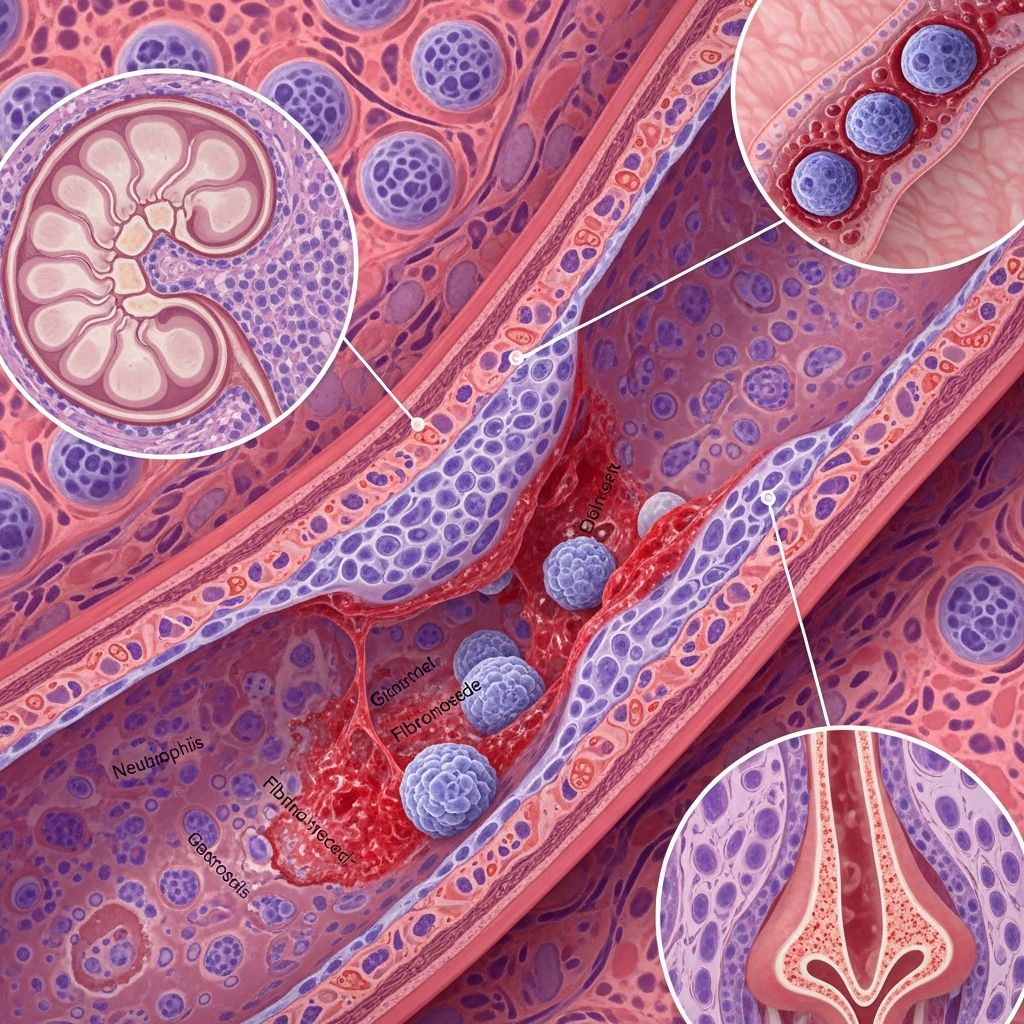
Granulomatosis with polyangiitis (GPA), formerly known as Wegener granulomatosis, is a rare multisystem autoimmune disease characterized by necrotizing granulomatous inflammation and vasculitis primarily affecting small to medium-sized blood vessels. It belongs to the ANCA-associated vasculitides and predominantly involves the upper and lower respiratory tracts, kidneys, and skin, though any organ can be affected.
What is granulomatosis with polyangiitis?
Granulomatosis with polyangiitis (GPA) is a systemic vasculitis marked by the formation of granulomas—clumps of immune cells—and inflammation of blood vessels (vasculitis). This leads to narrowing of vessels, reduced blood flow, and tissue damage in affected organs. The disease often presents in a limited form confined to the upper respiratory tract or a systemic form involving lungs, kidneys, and other organs.
The hallmark is the presence of antineutrophil cytoplasmic antibodies (ANCA), particularly c-ANCA targeting proteinase 3 (PR3), found in over 90% of active generalized cases. GPA can rapidly progress to organ failure if untreated, but modern therapies have improved survival rates dramatically.
Who gets granulomatosis with polyangiitis?
GPA typically affects adults aged 40–60 years, with equal prevalence in males and females. It is rare in children and extremely uncommon before age 10. Incidence is approximately 10–20 cases per million population annually in Europe and North America.
- Peak age: 45–60 years
- Sex ratio: Equal (M:F ≈ 1:1)
- Race: More common in Caucasians
- Risk factors: Possible genetic predisposition (HLA-DPB1 alleles), environmental triggers like silica exposure, smoking
What causes granulomatosis with polyangiitis?
The exact cause remains unknown, but GPA arises from a complex interplay of genetic susceptibility, environmental triggers, and dysregulated immune response. Infections may trigger the autoimmune process, though no specific pathogen has been identified.
Key pathophysiological mechanisms include:
- Autoantibodies (PR3-ANCA) activate neutrophils, causing vessel wall damage
- Formation of granulomas with giant cells and necrosis
- T-cell mediated inflammation
- Complement activation and endothelial injury
Genetic factors such as HLA-DPB1*0401/0402 alleles increase susceptibility. Environmental exposures (silica dust, farming, solvents) and smoking are associated risks.
What are the clinical features of granulomatosis with polyangiitis?
Upper respiratory tract (most common initial site, 70–90%)
- Chronic sinusitis, nasal congestion, crusting, epistaxis
- Saddle nose deformity from cartilage destruction
- Middle ear involvement: otitis media, hearing loss
- Oral ulcers, strawberry gingivitis
Lower respiratory tract (50–80%)
- Cough, haemoptysis, dyspnoea
- Pulmonary nodules, infiltrates, cavities on imaging
- Alveolar haemorrhage (life-threatening)
Renal involvement (70–80% in systemic disease)
- Rapidly progressive glomerulonephritis
- Haematuria, proteinuria, renal failure
- Hypertension, oedema
Cutaneous manifestations (30–50%)
- Palpable purpura, petechiae, ecchymoses
- Necrotizing ulcers, subcutaneous nodules
- Livedo reticularis, digital infarcts
Other organ involvement
- Eye: Scleritis, uveitis, orbital pseudotumour (proptosis)
- Nervous system: Mononeuritis multiplex, cranial neuropathies
- Musculoskeletal: Arthralgias/arthritis (60%)
- Constitutional: Fever, weight loss, fatigue
Related Stories



How is granulomatosis with polyangiitis diagnosed?
Diagnosis relies on clinical features, serology, imaging, and histopathology. No single test is diagnostic; a combination is required.
Laboratory tests
- ANCA: c-ANCA/PR3 positive in 90% generalized GPA, 60% limited disease
- ESR/CRP: Elevated inflammatory markers
- Urinalysis: Active sediment (RBC casts, proteinuria)
- Anaemia, thrombocytosis, renal impairment
Imaging
- CT sinuses: mucosal thickening, bone erosion
- Chest CT: nodules, cavities, ground-glass opacities
Biopsy (gold standard)
Preferred sites: lung, kidney, upper respiratory tract, skin
- Findings: necrotizing granulomatous vasculitis, giant cells
| Diagnostic Criteria | EULAR/ACR 2022 |
|---|---|
| Score ≥5 points | Definite GPA |
| ANCA positivity | +5 |
| Granulomatous pathology | +3 |
| Upper airway involvement | +2 |
What is the treatment for granulomatosis with polyangiitis?
Treatment is divided into remission induction (3–6 months) and maintenance (18–24 months minimum). Multidisciplinary care involving rheumatology, nephrology, ENT, pulmonology is essential.
Remission induction
- Severe organ-threatening disease: High-dose glucocorticoids (methylprednisolone 1g IV x3 days) + rituximab (preferred) or cyclophosphamide
- Non-severe: Glucocorticoids + methotrexate or mycophenolate
Maintenance therapy
- Rituximab infusions every 6 months
- Azathioprine or methotrexate
- Slow glucocorticoid taper
Adjunctive therapies
- Plasma exchange for alveolar haemorrhage or severe renal disease
- Avacopan (C5a inhibitor) to reduce steroid dependence
- Prophylaxis: trimethoprim-sulfamethoxazole for Pneumocystis pneumonia
| Regimen | Indication | Duration |
|---|---|---|
| Rituximab + steroids | Relapsing/severe GPA | Induction: 4–6 doses |
| Cyclophosphamide + steroids | Fertility-preserving alternative | 3–6 months |
| Azathioprine | Maintenance | ≥18 months |
Monitoring and complications
- Regular ANCA titres, renal function, imaging
- Watch for infections, osteoporosis, diabetes from steroids
- Cyclophosphamide risks: infertility, bladder cancer
What is the prognosis for granulomatosis with polyangiitis?
Untreated GPA is fatal within months due to renal or pulmonary failure. With modern therapy, 1-year survival exceeds 90%, 5-year ~80%. Relapses occur in 50% within 5 years.
- Favourable prognostic factors: Early diagnosis, limited disease, ANCA negativity
- Poor prognostic factors: Severe renal failure (creatinine >5.7 mg/dL), alveolar haemorrhage, age >65
Long-term sequelae include chronic sinusitis, hearing loss, nasal deformity, end-stage renal disease (requiring dialysis/transplant).
Frequently asked questions
Is granulomatosis with polyangiitis curable?
GPA is not curable but can achieve prolonged remission with treatment. Lifelong monitoring is required due to relapse risk.
Can GPA be fatal?
Yes, without treatment, but early intervention improves survival to over 90% at 1 year.
What triggers GPA flares?
Infections, medication non-adherence, or spontaneous. Prompt treatment prevents organ damage.
Does GPA affect pregnancy?
Remission preferred before conception. Rituximab safe in pregnancy for refractory cases.
How is GPA different from microscopic polyangiitis?
GPA features granulomas and upper respiratory involvement; MPA lacks granulomas, often MPO-ANCA positive.
References
- Granulomatosis with Polyangiitis — NORD (rarediseases.org). 2023. https://rarediseases.org/rare-diseases/granulomatosis-with-polyangiitis/
- Granulomatosis With Polyangiitis — StatPearls, NCBI Bookshelf. 2023-11-03. https://www.ncbi.nlm.nih.gov/books/NBK557827/
- Granulomatosis with polyangiitis – Diagnosis and treatment — Mayo Clinic. 2024. https://www.mayoclinic.org/diseases-conditions/granulomatosis-with-polyangiitis/diagnosis-treatment/drc-20351093
- Granulomatosis with Polyangiitis (GPA, formerly Wegener’s) — Vasculitis Foundation. 2023. https://vasculitisfoundation.org/education/vasculitis-types/granulomatosis-with-polyangiitis/
- Granulomatosis with polyangiitis – Symptoms and causes — Mayo Clinic. 2024. https://www.mayoclinic.org/diseases-conditions/granulomatosis-with-polyangiitis/symptoms-causes/syc-20351088
Similar Articles








Read full bio of Sneha Tete