Grenz Ray Therapy
Explore Grenz ray therapy: ultrasoft X-rays for treating refractory inflammatory skin conditions, its mechanism, uses, and safety considerations.
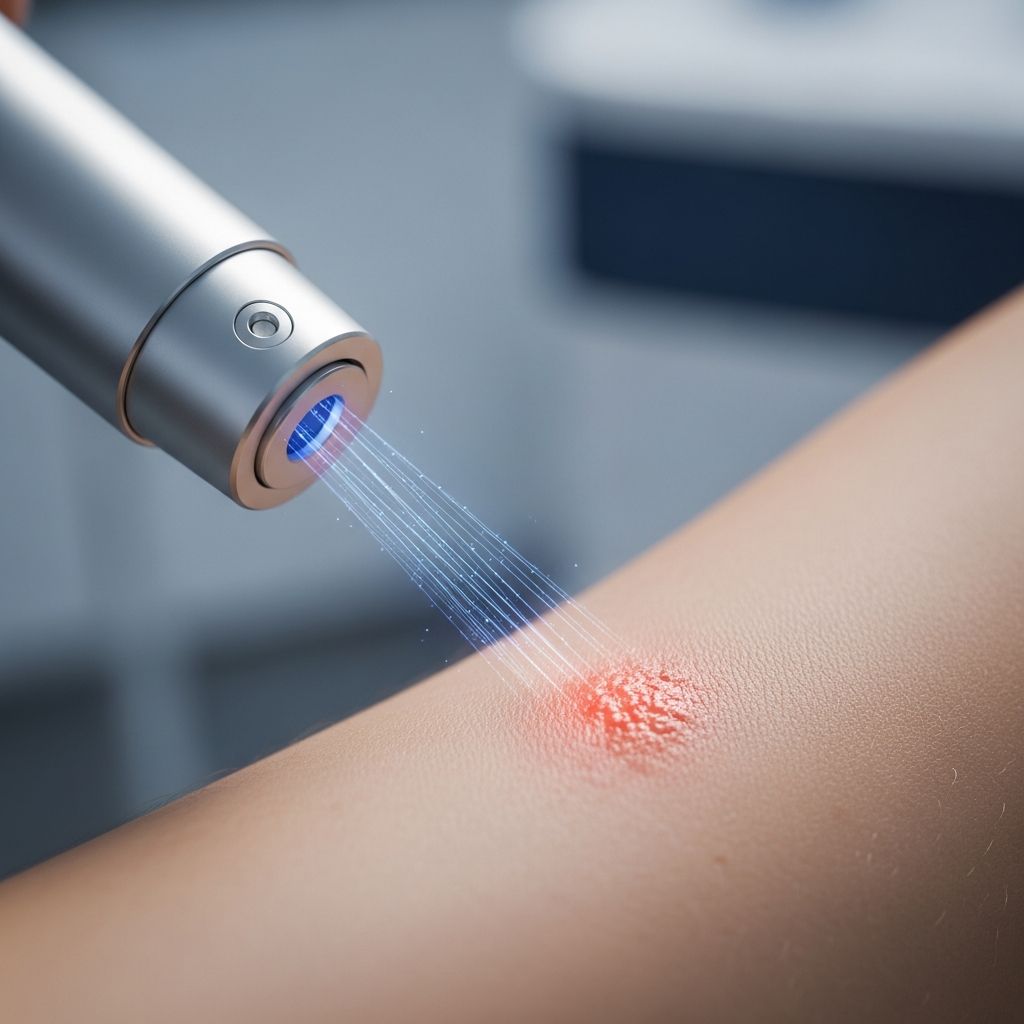
Grenz ray therapy is a form of
ultrasoft X-ray radiation
used to treat benign, inflammatory skin conditions that do not respond to conventional therapies. This treatment delivers low-energy rays absorbed primarily in the superficial skin layers, providing anti-inflammatory effects with minimal penetration.What is grenz ray therapy?
Grenz rays, also known as
border rays
orBucky rays
, are produced at low kilovoltages (typically 10-20 kV), resulting in very low penetration power. Approximately90% of the rays are absorbed within the first 5 mm of skin
, and50% within the first 1 mm
, ensuring they do not reach beyond the dermis. This distinguishes them from higher-energy X-rays or gamma rays used in deeper tissue treatments.Classified as
’ultrasoft’ or ‘soft’ radiation
, grenz rays exert their effect by reducing the number ofLangerhans cells
(dendritic lymphocytes) in the epidermis, which calms inflammation. They are difficult to calibrate precisely due to their soft nature and should not be confused withsuperficial radiation therapy
, which treats malignant skin cancers with higher energies.Historically popular in dermatology from the mid-20th century, grenz ray therapy has become seldom used today due to advances in topical treatments, phototherapy, and biologics. However, it remains an option for
refractory cases
.Who gets grenz ray therapy?
Grenz ray therapy is indicated for patients with
benign, inflammatory dermatoses
unresponsive to standard treatments. Suitable candidates include those with localized conditions where superficial anti-inflammatory effects are beneficial. It is not recommended for malignant lesions, radiation-sensitive individuals, or areas like the head and neck due to long-term cancer risks.- Adults and children with chronic eczema, psoriasis, or lichen planus.
- Patients failing topical steroids, calcineurin inhibitors, or phototherapy.
- Those requiring non-systemic therapy for localized disease.
Contraindications include pregnancy, active skin infections, history of radiation dermatitis, or genetic radiosensitivity syndromes.
What are the treatment aims for grenz ray therapy?
The primary goals are to
reduce inflammation
, alleviate itching and discomfort, and achieve remission in refractory skin conditions. Treatment aims for partial or complete clearing of lesions, with many patients experiencing prolonged symptom relief.- Suppress hyperproliferation and immune activity in the epidermis.
- Provide rapid symptom control where other modalities fail.
- Minimize systemic side effects compared to oral immunosuppressants.
How is grenz ray therapy performed?
Treatment is administered using a specialized
grenz ray machine
with the tube positioned at atarget-skin distance of 10-15 cm
. Sessions are typicallyweekly or twice weekly
, delivering200 Roentgens (R) or rads per session
for a total course of800-1000 R over 3-4 sessions
.Dosing varies by site: lower for sensitive areas like the face, higher for palms/soles. Further courses can be repeated after
4-6 months
if needed, with a cumulative lifetime limit around5000 R
to minimize risks. The procedure is painless, lasting minutes per session, with no anesthesia required.| Treatment Site | Typical Dose per Session | Total Course | Frequency |
|---|---|---|---|
| Trunk/Limbs | 200 R | 800-1000 R | Weekly x 4 |
| Hands/Feet | 200-300 R | 1000-1200 R | Twice weekly x 4 |
| Face/Scalp | 100-150 R | 600-800 R | Weekly x 4 |
Radiation safety protocols must be strictly followed, including shielding non-treated areas and monitoring exposure.
What conditions is grenz ray therapy used to treat?
Grenz rays are effective for a variety of
refractory inflammatory and benign skin disorders
. Common indications include:- Eczema: Atopic, allergic contact, dyshidrotic, lichen simplex chronicus.
- Psoriasis: Localized plaque, palmoplantar pustulosis.
- Lichen planus and lichen nitidus.
- Seborrhoeic dermatitis.
- Pruritus: Ani, vulvae, or other localized itch.
- Other: Granuloma annulare, Hailey-Hailey disease, patch-stage mycosis fungoides (early), keratosis pilaris.
Studies show moderate improvement in
64% of recalcitrant dermatitis cases
, with high patient satisfaction for hand dermatitis. It is often combined with topicals for enhanced efficacy.What are the complications of grenz ray therapy?
Grenz ray therapy is generally well-tolerated with
few acute side effects
. Doses over 200 R may cause mildsunburn-like erythema
, resolving in days. Apersistent dark tan
can last months.Long-term risks include
nonmelanoma skin cancers
(BCC, SCC), particularly in radiosensitive patients or with high cumulative doses. Historical data show a30-35 times higher BCC risk
after 30-50 Gy courses, with cases emerging 20-40 years later.- Acute: Erythema, temporary epilation, pigmentation changes.
- Chronic: Telangiectasia, atrophy, increased skin cancer risk (rare if doses low).
- No melanoma association reported.
Aetna and others deem it
experimental
due to limited high-quality evidence and cancer concerns.Alternatives to this treatment
Modern alternatives have largely replaced grenz rays:
- Topical therapies: Corticosteroids, tacrolimus, crisaborole.
- Phototherapy: UVB, PUVA, excimer laser.
- Systemics: Methotrexate, biologics (e.g., dupilumab for eczema).
- Other: Cryotherapy, laser, PDT for select lesions.
These offer better safety profiles and evidence bases.
Frequently Asked Questions
Is grenz ray therapy safe?
It has a low risk profile for acute effects but carries a small long-term skin cancer risk, especially with repeated courses. Use is limited to refractory cases under specialist supervision.
How many sessions are needed?
Typically 3-4 weekly sessions of 200 R, repeatable after 6 months if required.
Does it cure skin conditions?
No, it induces remission; many experience prolonged relief, but relapse may occur.
Can it cause cancer?
Yes, nonmelanoma skin cancers possible after high cumulative doses, with risk elevated 30x in some studies.
Is it still used today?
Rarely; considered obsolete by many due to safer options, but valid for select chronic dermatoses.
References
- Grenz Ray Therapy — DermNet NZ. 2023. https://dermnetnz.org/topics/grenz-ray-therapy
- Grenz Ray Therapy for Skin Disorders — Aetna Clinical Policy Bulletin. 2024-01-15. https://www.aetna.com/cpb/medical/data/200_299/0231.html
- Recalcitrant Basal Cell Carcinoma after Grenz Ray Therapy — NIH/PMC. 2024. https://pmc.ncbi.nlm.nih.gov/articles/PMC11250693/
- The Effectiveness of Grenz Ray Therapy for Chronic Dermatoses — OHSU Elsevier Pure. 2008. https://ohsu.elsevierpure.com/en/publications/the-effectiveness-of-grenz-ray-therapy-for-chronic-dermatoses-of–2
- Grenz Ray Therapy in the New Millennium — SAGE Journals. 2008. https://journals.sagepub.com/doi/full/10.2310/6620.2008.07078
- Safety of Grenz Ray Therapy — JAMA Dermatology. 1986. https://jamanetwork.com/journals/jamadermatology/fullarticle/551329
- Grenz Rays Therapy for Inflammatory Skin Conditions — NICE Guidance. 2007. https://www.nice.org.uk/guidance/ipg236/documents/grenz-rays-therapy-for-inflammatory-skin-conditions-interventional-procedures-consultation
Similar Articles




Read full bio of medha deb