Habit-Tic Deformity Guide: Causes, Diagnosis, And Recovery
Understanding the causes, diagnosis, and effective treatments for habit-tic nail deformity, a common psychodermatological condition.
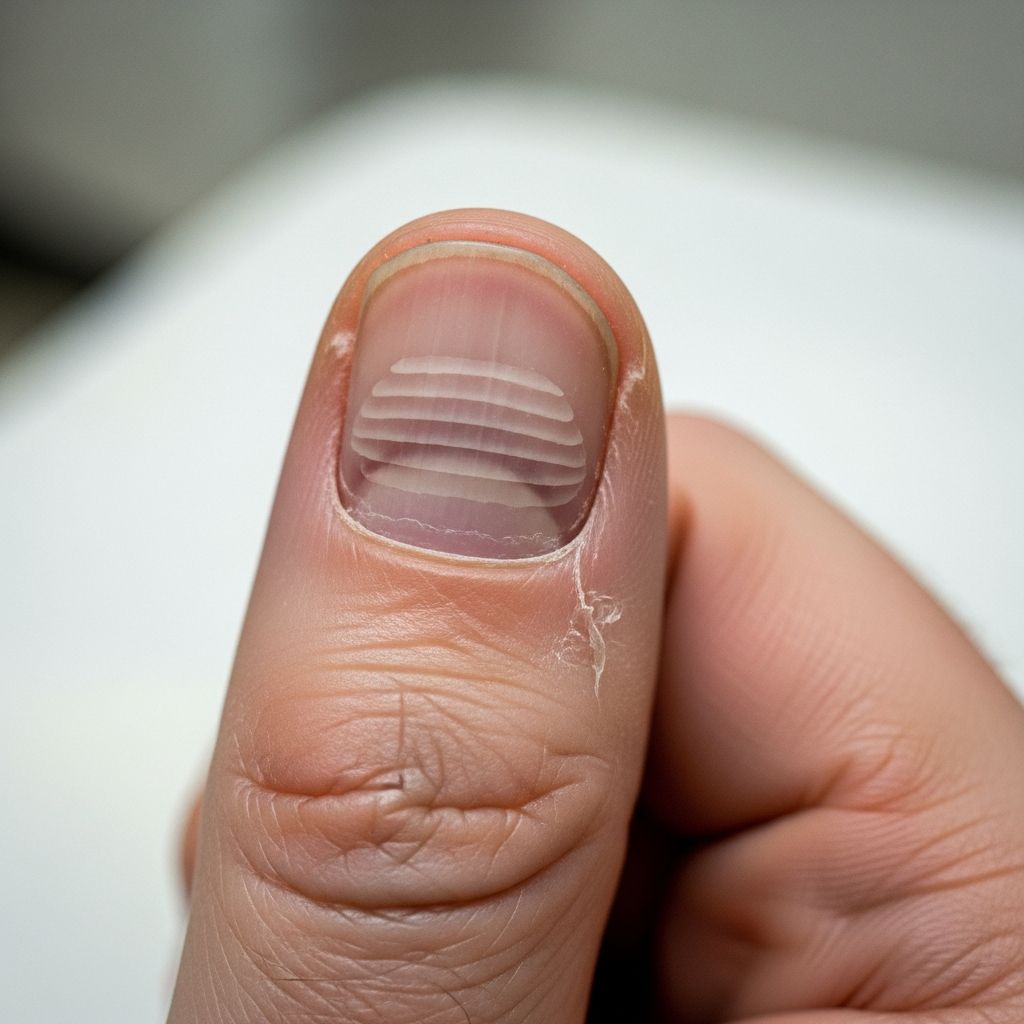
Habit-tic deformity (HTD) is a distinctive type of acquired nail dystrophy classified as a psychodermatosis, primarily affecting the thumbnail but potentially involving other nails. It arises from repetitive, often subconscious manipulation of the proximal nail fold, leading to characteristic transverse ridges and other morphological changes in the nail plate. This condition highlights the interplay between behavioral habits and dermatological pathology, frequently linked to body-focused repetitive behaviors (BFRBs).
What is habit-tic deformity?
Habit-tic deformity manifests as a series of parallel, transverse ridges or grooves across the nail plate, most prominently on the thumbnails. These ridges result from repeated microtrauma to the nail matrix, the germinative area responsible for nail growth. The condition is typically unilateral or more pronounced on the dominant hand’s thumbnail, reflecting the habitual use of an adjacent finger—often the index finger—to pick, rub, or push back the cuticle and proximal nail fold.
Clinically, affected nails exhibit:
- Multiple parallel transverse ridges: These are deep, evenly spaced (approximately 1 mm apart), and run perpendicular to the nail’s growth direction, starting from the proximal nail plate and fading distally.
- Enlarged lunula (macrolunula): The lunula, the white half-moon at the nail base, appears widened and may show a proximal yellow or white discoloration.
- Thinning or washboard-like nail plate: The surface resembles a washboard due to successive waves of ridging from ongoing trauma.
- Absence or damage to the cuticle: Proximal nail fold shows hangnails, punctate hemorrhages, or periungual erythema from chronic irritation.
- Occasional nail plate splitting or onychoschizia: In severe, longstanding cases.
HTD is not painful but can cause cosmetic distress, leading to embarrassment or social withdrawal. Nail growth continues, but new ridges form as the habit persists, perpetuating the deformity. While thumbnails are affected in over 90% of cases, fingernails or even toenails may be involved in bilateral or pediatric presentations.
Who gets habit-tic deformity?
Habit-tic deformity affects individuals across all ages, with a higher prevalence in adults, particularly women, though pediatric cases are increasingly reported. It is often seen in professionals such as healthcare workers who frequently wash hands, exacerbating dryness and irritation that may trigger or worsen the habit. Children as young as 7 years have presented with bilateral thumb and toenail involvement, suggesting early-onset potential.
Risk factors include:
- High-stress occupations or lifestyles promoting subconscious habits.
- Co-existing BFRBs like onychophagia (nail biting), onychotillomania (nail picking), trichotillomania (hair pulling), or excoriation (skin picking).
- Psychiatric comorbidities: Up to 50% of cases link to obsessive-compulsive disorder (OCD), anxiety, depression, or even psychotic features like delusions of infestation.
- Neurological conditions: Insensitivity to pain (e.g., from spinal cord injury or genetic syndromes like Lesch-Nyhan or Smith-Magenis) may contribute by reducing inhibition of self-trauma.
Patients often deny awareness of the habit, describing feelings of relief post-manipulation, akin to compulsive rituals. Family members frequently provide the key history of observed picking.
Causes
The primary cause of habit-tic deformity is repetitive self-inflicted trauma to the nail matrix via picking, rubbing, or pushing back the proximal nail fold using another fingernail. This disrupts keratinocyte proliferation, causing successive Beau lines—transverse depressions that evolve into ridges as the nail grows.
Related Stories



Pathophysiology involves:
- Mechanical disruption: Each picking episode creates a temporary arrest in nail matrix activity, manifesting as a ridge.
- Chronic inflammation: Proximal nail fold irritation leads to cuticle loss and lunular hypertrophy.
- Psychobehavioral drivers: Classified under BFRBs per DSM-5, involving impulse-control issues. Unlike simple habits, these cause distress and resistance to cessation. Anxiety or stress often precedes episodes, though patients may lack insight.
Rarely, secondary onychomycosis (fungal infection) complicates chronic toenail cases due to trauma-induced susceptibility.
Related conditions
Habit-tic deformity overlaps with other nail dystrophies and psychodermatoses:
| Condition | Key Features | Differentiation from HTD |
|---|---|---|
| Onychotillomania | General nail picking disorder | HTD is a subtype with specific ridging pattern |
| Trichotillomania | Hair pulling | Co-occurs frequently; similar BFRB spectrum |
| Onychophagia | Nail biting | Shorter nails, no ridges; often comorbid |
| Psoriasis | Onycholysis, pitting | Pits are irregular; skin plaques aid diagnosis |
| Lichen planus | Longitudinal ridges | Ridges longitudinal, not transverse |
| Alopecia areata | Geometric pits | Pits uniform; no habit history |
Systemic associations include OCD (DSM-5 criteria: recurrent BFRBs causing distress), anxiety/depression (treated with SSRIs like fluoxetine).
Diagnosis
Diagnosis is primarily clinical, based on characteristic morphology and history of habitual manipulation. Key diagnostic steps:
- History: Probe for subconscious picking; involve family for confirmation. Assess for BFRBs, psychiatric symptoms (anxiety, OCD).
- Examination: Confirm transverse ridges, macrolunula, cuticle loss. Dermoscopy reveals regular spacing.
- Differentials exclusion: Nail clippings for KOH/PAS/fungal culture if infection suspected; biopsy rarely for ambiguous cases (shows non-specific matrix disruption).
- Psychiatric referral: Screen for comorbidities using tools like DSM-5 BFRB criteria.
Treatment
Treatment targets habit cessation and nail protection, achieving resolution in 80-90% of cases within 3-6 months as nails grow out (thumbnail: 6 months).
Behavioural interventions
- Habit reversal training (HRT): Awareness training, competing response (e.g., fist clenching). Gold standard for BFRBs.
- Cognitive behavioral therapy (CBT): Addresses underlying anxiety; effective in 70% of comorbid cases.
Physical barriers
- Micropore tape or bandages: Applied over proximal fold for 3 months; prevents access, promotes regrowth.
- Cyanoacrylate glue or bitter-tasting topicals (e.g., benzethonium chloride): Creates artificial cuticle; daily application sustains barrier.
Pharmacological options
- SSRIs (e.g., fluoxetine): For OCD/anxiety; remission in refractory cases.
- N-acetylcysteine: Glutamate modulator; adjunct for BFRBs.
Combined approaches yield best outcomes; monitor for secondary infections.
Outcome
HTD responds excellently to intervention, with full nail normalization in compliant patients. Chronic cases may leave residual dystrophy. Relapse prevention via ongoing therapy is key; patient education on stress management enhances long-term success.
Frequently Asked Questions
Q: Is habit-tic deformity permanent?
A: No, it typically resolves completely within 4-6 months with habit cessation, as nails grow out. Chronic cases may have mild residual changes.
Q: Can children get habit-tic deformity?
A: Yes, bilateral thumb/toenail cases occur in children; early psychological evaluation is crucial.
Q: Does habit-tic deformity indicate a serious mental health issue?
A: Often linked to BFRBs, OCD, or anxiety; psychiatric assessment recommended for comprehensive care.
Q: What is the quickest treatment for habit-tic nails?
A: Barrier methods like micropore tape combined with HRT provide rapid improvement in 3 months.
Q: Can over-the-counter remedies fix it?
A: Bitter nail polishes or bandages help mildly; severe cases need professional behavioral/pharmacologic intervention.
(Word count: 1678)
References
- Habit Tic Deformity: Need for a Comprehensive Approach — Singal A, et al. PMC – NIH. 2019-02-01. https://pmc.ncbi.nlm.nih.gov/articles/PMC6388558/
- A simple cost-effective remedy for habit-tic deformity — Cosmoderma. 2023-01-15. https://cosmoderma.org/a-simple-cost-effective-remedy-for-habit-tic-deformity/
- Longitudinal Depression on the Right Thumbnail — MDedge Dermatology. 2022-05-10. https://blogs.the-hospitalist.org/content/longitudinal-depression-right-thumbnail
- Habit-tic Deformity — DermNet NZ. 2024-08-20. https://dermnetnz.org/topics/habit-tic-deformity
- Dermatologic Clinic: Ridged Nail Dystrophy — Clinical Advisor. 2023-11-05. https://www.clinicaladvisor.com/features/dermatologic-clinic-ridged-nail-dystrophy/
- Inexpensive Solution for Habit-Tic Deformity — JAMA Dermatology. 2000-06-01. https://jamanetwork.com/journals/jamadermatology/fullarticle/422144
- Clinical Pearl: Benzethonium Chloride for Habit-Tic Nail Deformity — MDedge Cutis. 2021-09-15. https://mdedge.com/cutis/article/204312/hair-nails/clinical-pearl-benzethonium-chloride-habit-tic-nail-deformity
Similar Articles








Read full bio of Sneha Tete