Hemolytic Uremic Syndrome: Causes, Symptoms & Treatment Guide
Comprehensive guide to haemolytic uraemic syndrome (HUS): causes, symptoms, diagnosis, management, and prognosis in children and adults.
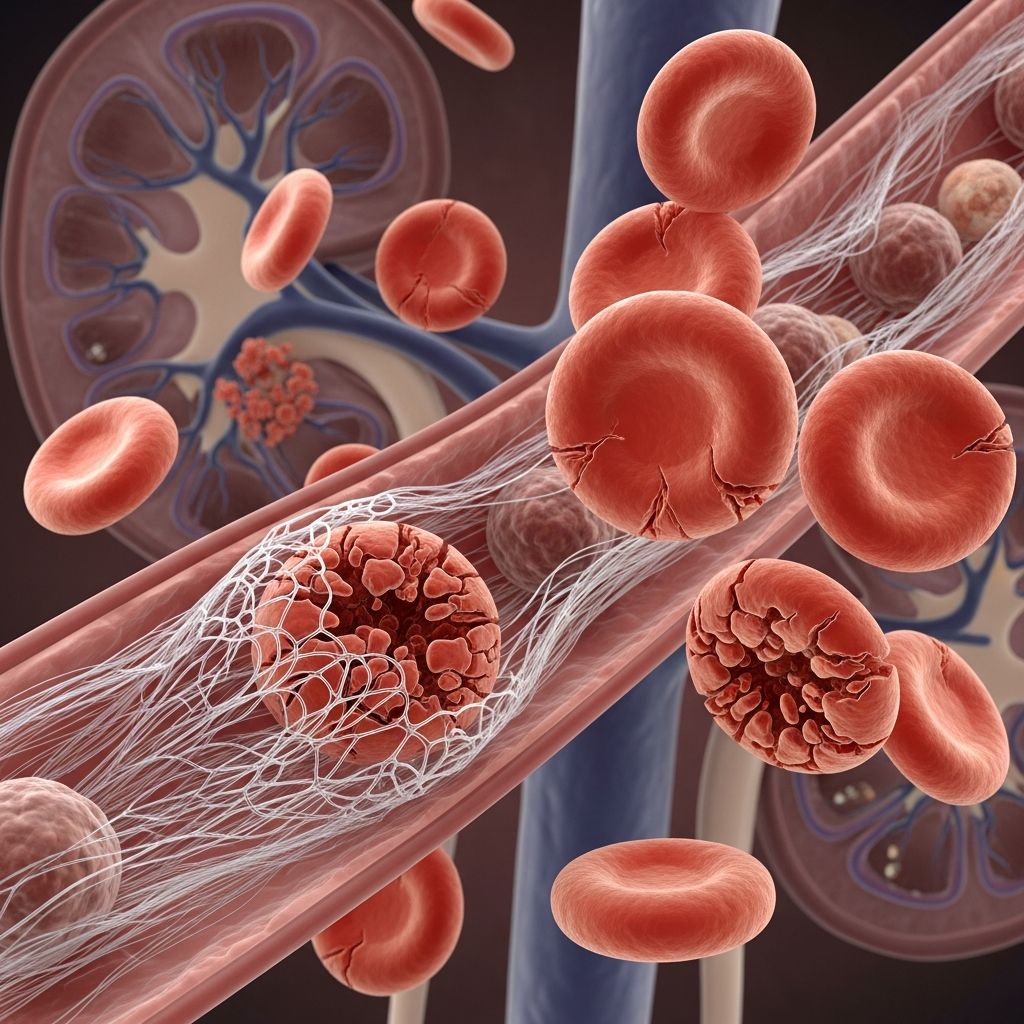
Haemolytic uraemic syndrome (HUS) is a serious illness, usually affecting children, characterized by the triad of microangiopathic haemolytic anaemia, thrombocytopenia and acute kidney injury. HUS is a type of thrombotic microangiopathy (TMA).
What is haemolytic uraemic syndrome?
Haemolytic uraemic syndrome (HUS) involves widespread formation of tiny blood clots (thrombi) throughout the body, usually triggered by infection with Shiga toxin-producing bacteria such as Escherichia coli O157:H7 or Shigella dysenteriae. These toxins damage the lining of small blood vessels, particularly in the kidneys, causing partial obstruction and mechanical shearing of red blood cells as they pass through narrowed vessels, leading to haemolysis. This results in the classic triad: haemolytic anaemia, low platelets due to consumption in clots, and renal failure from glomerular damage.
Most cases (90%) occur in children under 5 years following diarrhoeal illness (D+ HUS), while atypical HUS (aHUS) arises from complement dysregulation or other triggers without preceding diarrhoea.
Who gets haemolytic uraemic syndrome?
HUS predominantly affects young children, with peak incidence between 6 months and 4 years. Incidence is approximately 1-3 per 100,000 children annually in developed countries, higher in outbreaks linked to contaminated food or water. Adults can develop HUS, particularly atypical forms associated with pregnancy, transplantation, or medications.
- Typical (D+ HUS): Children after STEC infection (Shiga toxin-producing E. coli).
- Atypical HUS: Genetic complement mutations (e.g., CFH, CFI), occurring at any age.
- Secondary HUS: Pneumococcal infection, HIV, chemotherapy, or autoimmune diseases.
What causes haemolytic uraemic syndrome?
Typical HUS (diarrhoea-positive)
Caused by Shiga toxin (Stx1/Stx2) from E. coli O157:H7 (most common), O26, O111, or Shigella. Toxin binds globotriaosylceramide (Gb3) on endothelial cells, activating the alternative complement pathway, causing endothelial damage, thrombosis, and inflammation. About 5-10% of STEC gastroenteritis progresses to HUS, with higher risk in children.
Atypical HUS
Results from dysregulation of the alternative complement pathway due to mutations in genes like CFH (complement factor H, 20-30% cases), MCP, CFI, leading to uncontrolled C3 convertase activity and endothelial injury. Triggers include infections, pregnancy, or drugs.
Other causes
- Pneumococcal HUS (neuraminidase exposes Thomsen-Friedenreich antigen).
- Drugs: chemotherapy (gemcitabine), immunosuppressants (ciclosporin).
- Systemic diseases: SLE, malignancy, transplantation.
What are the clinical features of haemolytic uraemic syndrome?
Prodrome: Bloody diarrhoea, abdominal pain, vomiting 3-7 days prior (80-90% cases).
Classic triad develops 5-10 days post-diarrhoea:
- Anaemia: Pallor, fatigue, jaundice from haemolysis (schistocytes on blood film).
- Thrombocytopenia: Bruising, petechiae, bleeding.
- Renal failure: Oliguria/anuria, haematuria, oedema, hypertension.
Other features: Neurological (seizures, confusion, stroke in 25%), cardiac (pericarditis), gastrointestinal (pancreatitis, perforation).
| Symptom | Frequency | Description |
|---|---|---|
| Oliguria | 80-90% | Reduced urine output <0.5 mL/kg/h |
| Hypertension | 50-70% | Due to volume overload/renin |
| Neurological | 20-40% | Irritability, seizures |
| Cardiopulmonary | 10-20% | Heart failure, ARDS |
How is haemolytic uraemic syndrome diagnosed?
Clinical suspicion + laboratory triad:
- Anaemia: Hb <10 g/dL, schistocytes >1%, elevated LDH, low haptoglobin.
- Thrombocytopenia: Platelets <150 x 10^9/L.
- Renal: Elevated creatinine, urea; proteinuria/haematuria.
Stool tests: Culture/PCR for STEC, Shiga toxin assay.
Differentiate from TTP: HUS has severe renal involvement, normal ADAMTS13 (>10%), younger age.
Genetic testing: For aHUS (complement genes).
What is the treatment for haemolytic uraemic syndrome?
Supportive care is mainstay; HUS is medical emergency requiring ICU admission.
- Fluids: Correct hypovolaemia cautiously (risk overload); match insensible losses.
- Hypertension: ACE inhibitors, calcium channel blockers.
- Anaemia: Transfuse if Hb <7 g/dL or symptomatic; avoid over-transfusion.
- Platelets: Only for life-threatening bleeding.
- Dialysis: Peritoneal or haemodialysis for anuria, hyperkalaemia, acidosis (40-50% need it).
- Neurological: Anticonvulsants, hypertension control.
Related Stories



Avoid: Antibiotics (increase toxin release), antimotility drugs, NSAIDs.
Atypical HUS: Eculizumab (anti-C5 monoclonal antibody); plasma exchange initially.
What is the outcome for haemolytic uraemic syndrome?
Mortality 3-5% with modern care (higher in adults/pneumococcal). 50-70% full renal recovery in D+ HUS; 25% chronic kidney disease.
AHUS: 25% end-stage renal disease without eculizumab; better with early treatment.
Long-term: Hypertension, proteinuria in 20-30%; monitor renal function.
Prevention of haemolytic uraemic syndrome
- Food safety: Cook ground beef thoroughly, avoid unpasteurized milk/juice, wash produce.
- Hand hygiene during outbreaks.
- No routine STEC screening in low-risk diarrhoea.
Frequently asked questions
Q: Is haemolytic uraemic syndrome contagious?
A: The STEC infection causing D+ HUS is contagious via faecal-oral route; HUS itself is not.
Q: Should antibiotics be given for E. coli diarrhoea?
A: No, antibiotics may worsen HUS by increasing Shiga toxin release.
Q: How long does recovery take?
A: Acute phase 1-2 weeks; full recovery 1-3 months; some have lifelong sequelae.
Q: Can adults get HUS?
A: Yes, often atypical form linked to pregnancy, drugs, or transplantation.
Q: What foods cause STEC HUS?
A: Undercooked beef, raw milk, contaminated vegetables (spinach, sprouts).
Related topics
- Thrombotic thrombocytopenic purpura
- Shiga toxin-producing E. coli infection
- Acute kidney injury
- Complement-mediated TMA
References
- Haemolytic Uraemic Syndrome — Zero To Finals. 2023. https://zerotofinals.com/medicine/renal/hus/
- Management of hemolytic uremic syndrome — PMC / NCBI. 2014-10-29. https://pmc.ncbi.nlm.nih.gov/articles/PMC4278190/
- Hemolytic uremic syndrome (HUS) – Symptoms and causes — Mayo Clinic. 2023. https://www.mayoclinic.org/diseases-conditions/hemolytic-uremic-syndrome/symptoms-causes/syc-20352399
- Hemolytic uremic syndrome — BMJ Best Practice. 2024. https://bestpractice.bmj.com/topics/en-us/470
- Signs of Hemolytic Uremic Syndrome — CDC. 2023. https://www.cdc.gov/ecoli/signs-symptoms/hus.html
Similar Articles








Read full bio of medha deb