Hair Follicle Tumours: 12 Benign And Malignant Types
Comprehensive guide to benign and malignant hair follicle tumours, their diagnosis, pathology, and management strategies.
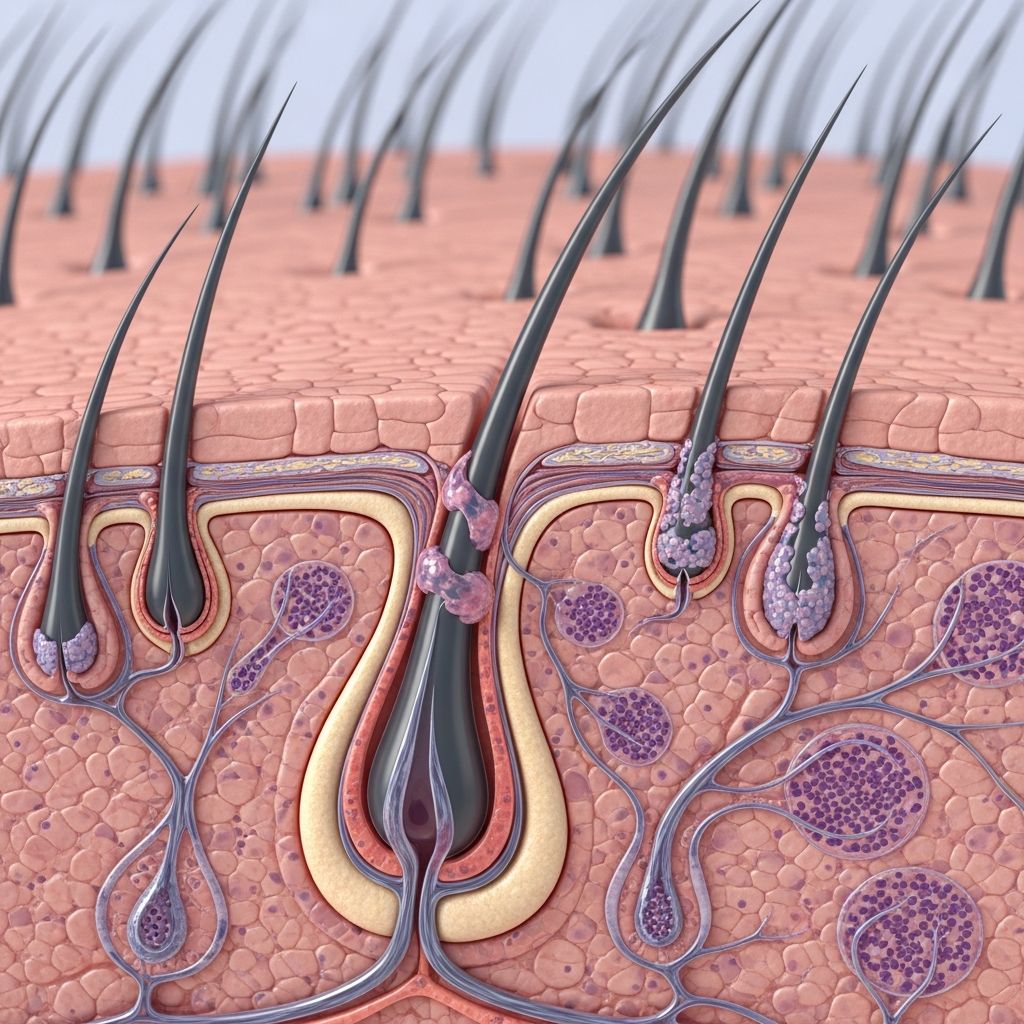
Hair follicle tumours represent a diverse group of skin adnexal neoplasms originating from various components of the hair follicle, including the bulb, shaft, and associated structures. These tumours can be benign or malignant, often presenting as firm nodules or papules on the skin.
What are hair follicle tumours?
The hair follicle comprises the hair bulb in its lower portion and the emerging hair shaft. Sebaceous glands connect to follicles, producing sebum to moisturize hair and skin. Tumours from hair follicles fall under skin adnexal tumours, a broad category of growths from appendageal structures. They range from entirely benign to rare malignant forms with metastatic potential.
Benign variants predominate, but distinguishing them from malignant counterparts or basal cell carcinoma is crucial due to overlapping features. Accurate histopathological evaluation is essential, supported by clinical context.
Benign hair follicle tumours
Benign hair follicle tumours arise from primitive follicular structures or mature differentiation stages. They typically appear as asymptomatic, skin-coloured to yellowish papules or nodules, often on the face, scalp, or trunk.
- Trichofolliculoma: A small papule with a central pore from which fine hairs emerge, resembling a dilated follicle.
- Trichoepithelioma: Multiple small, firm papules on the face, sometimes familial; histologically shows basaloid islands and keratin cysts.
- Trichilemmoma: Warty or smooth papules on the face, linked to Cowden syndrome; features clear cells and thickened glassy basement membrane.
- Trichoblastoma: Larger nodules mimicking basal cell carcinoma; composed of follicular germinative cells with stromal induction.
- Pilomatricoma (pilomatrixoma): Hard, calcified nodules, common in children on head/neck; shows basophilic cells transitioning to shadow cells.
- Dilated pore of Winer: Large comedo-like lesion with a dilated ostium filled with keratin.
- Trichoadenoma: Nodules with cystic spaces and basaloid proliferations.
- Fibrofolliculoma/trichodiscoma: Small papules on face/trunk, associated with Birt-Hogg-Dubé syndrome.
These lesions are usually solitary but can be multiple in syndromic cases. Clinical diagnosis often requires biopsy confirmation.
Malignant hair follicle tumours
Malignant counterparts are rare but aggressive, arising de novo or from benign precursors. They present as rapidly growing, ulcerated nodules.
- Tricholemmocarcinoma: Arises from trichilemmoma; shows infiltrative clear cells.
- Trichoblastic carcinoma: From trichoblastoma; features atypia, necrosis, and mitoses.
- Pilomatrix carcinoma: Rare, from pilomatricoma; highly infiltrative with recurrence risk.
- Spiradenocarcinoma: Malignant eccrine spiradenoma, sometimes follicular differentiation.
These require wide excision and vigilant follow-up due to local invasion and metastasis potential.
| Benign Hair Follicle Tumours | Malignant Hair Follicle Tumours |
|---|---|
| Trichofolliculoma Trichoepithelioma Trichilemmoma Trichoblastoma Pilomatricoma | Tricholemmocarcinoma Trichoblastic carcinoma Pilomatrix carcinoma |
For detailed pathology, refer to individual tumour types.
Syndromes associated with hair follicle tumours
Certain benign hair follicle tumours signal genetic syndromes with internal malignancy risks.
- Cowden syndrome: Multiple facial trichilemmomas, oral papillomas; increased breast, thyroid cancer risk.
- Birt-Hogg-Dubé syndrome: Fibrofolliculomas, trichodiscomas; renal cell carcinoma, lung cysts.
- Rombo syndrome: Follicular atrophoderma, milia, hypotrichosis; basocellular carcinomas.
- Muir-Torre syndrome: Sebaceous tumours with keratoacanthomas; visceral malignancies.
Syndromic patients need systemic evaluation and genetic counselling.
Diagnosis of hair follicle tumours
Diagnosis combines clinical examination and histopathology. Provide dermatopathologist with:
- Lesion location and duration.
- Size, shape, colour, surface.
- Patient age, sex, family/syndrome history.
- Clinical photographs.
Related Stories



Avoid superficial biopsies; prefer excisional biopsy with margins for accurate subtyping and completeness assessment.
Management of hair follicle tumours
Most are benign, treated by complete surgical excision. Confirm diagnosis histologically to exclude malignancy or syndrome.
Malignant tumours demand wide excision (4-6mm margins), lymph node evaluation if indicated, and surveillance for metastasis. Mohs micrographic surgery suits facial lesions.
Observation suffices for small asymptomatic lesions, but excision prevents growth or diagnostic uncertainty.
Frequently Asked Questions
Are hair follicle tumours cancerous?
Most are benign, but rare malignant forms exist, necessitating biopsy.
How are they diagnosed?
By excisional biopsy and histopathological analysis by dermatopathologists.
Do they indicate internal cancer?
Multiple trichilemmomas suggest Cowden syndrome with malignancy risk.
What is the treatment?
Surgical excision for benign; wide excision and follow-up for malignant.
Can they recur?
Benign rarely if fully excised; malignant have higher recurrence.
References
- Hair Follicle Tumours — DermNet NZ. 2023-10-15. https://dermnetnz.org/topics/hair-follicle-tumours
- Masquerades less known: Case report of benign hair follicle tumors — PMC (PubMed Central). 2018-10-12. https://pmc.ncbi.nlm.nih.gov/articles/PMC6173044/
- Identifying Hair Follicle Tumors: A Guide by Experts in Dermatopathology — Rabkin Dermatopathology. 2024-05-20. https://rabkindermpath.com/identifying-hair-follicle-tumors-a-guide-by-experts-in-dermatopathology/
Similar Articles








Read full bio of medha deb