Hair Replacement Surgery Complete Guide To Procedure & Results
Comprehensive guide to surgical hair restoration techniques, procedures, outcomes, and patient considerations for treating hair loss.
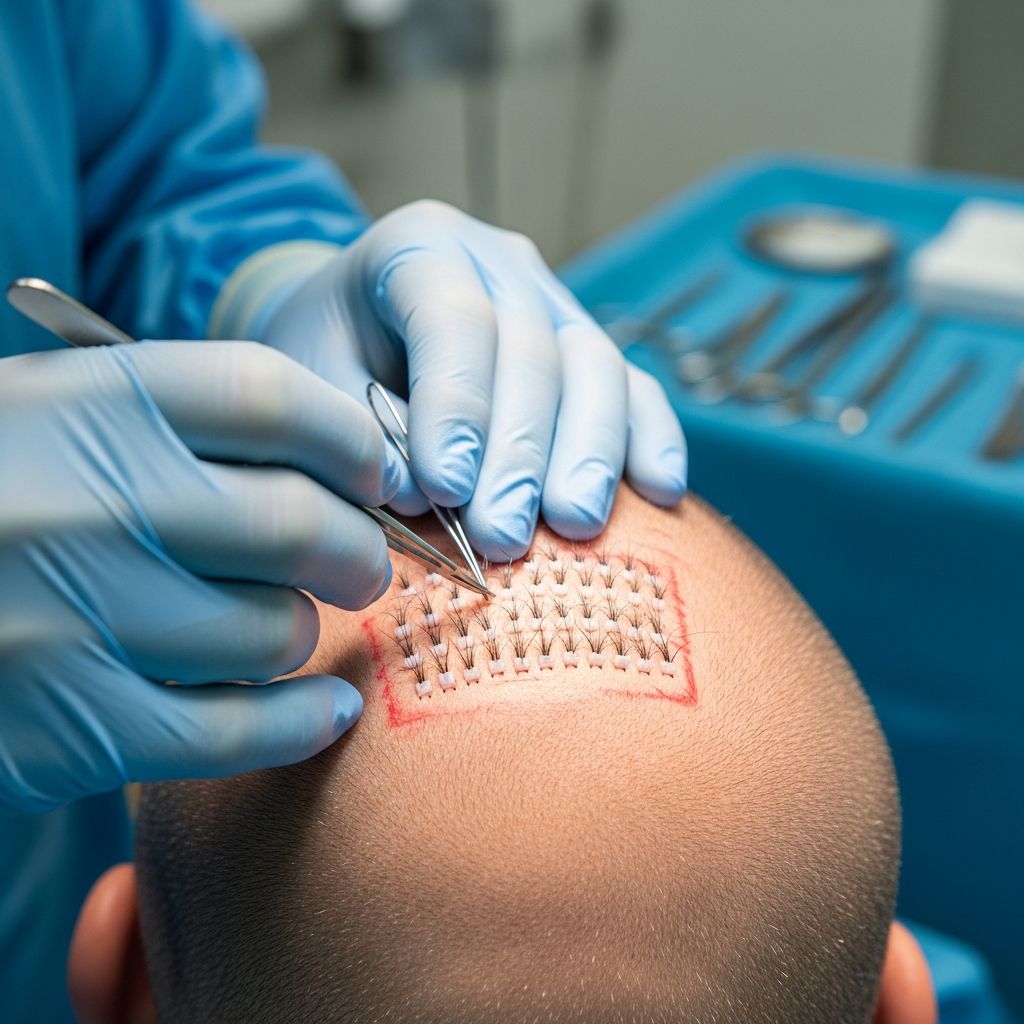
Hair replacement surgery, commonly known as hair transplantation, is a surgical procedure that relocates hair follicles from a donor site (typically the back or sides of the scalp) to balding or thinning areas. This minimally invasive technique provides natural-looking, permanent hair growth for individuals with androgenetic alopecia or other forms of hair loss.
What is hair replacement surgery?
Hair replacement surgery involves harvesting healthy, DHT-resistant hair follicles from a donor area—usually the occipital or parietal regions of the scalp—and implanting them into recipient sites in areas of hair loss. The two primary methods are Follicular Unit Transplantation (FUT) and Follicular Unit Extraction (FUE). FUT removes a strip of scalp for dissection into grafts, while FUE extracts individual follicles directly. These procedures have evolved since the 1950s, with modern techniques yielding high-density, natural results.
The surgery addresses pattern baldness by redistributing genetically stable follicles that continue growing in their new location, resisting dihydrotestosterone (DHT) effects. It is not a cure for ongoing hair loss elsewhere, often requiring adjunctive medications like minoxidil or finasteride.
Who is suitable for hair replacement surgery?
Ideal candidates are adults with stable hair loss patterns, sufficient donor hair density, and realistic expectations. Men with Norwood scale stages 3-6 and women with Ludwig scale types I-III typically qualify. Key criteria include:
- Age over 25 to ensure pattern stabilization.
- Good general health, without uncontrolled conditions like diabetes or clotting disorders.
- Adequate donor supply (minimum 40 follicular units/cm² in donor area).
- No active scalp infections, scarring alopecias, or diffuse unpatterned loss.
Pre-operative assessment by a dermatologist evaluates scalp laxity, hair characteristics (caliber, curl), and psychological readiness. Women require hormonal screening to exclude treatable causes.
What are the types of hair replacement surgery?
Follicular Unit Transplantation (FUT)
FUT, also called strip harvesting, involves excising a 1-2 cm wide elliptical strip from the donor area under local anesthesia. The strip (typically 15-30 cm long) is dissected into 1-4 hair follicular units using stereomicroscopes. Recipient sites are created with hypodermic needles or blades, and grafts are inserted meticulously to mimic natural angles.
Advantages include higher graft yield (up to 4,000 per session) for extensive baldness. Disadvantages: linear scar (1-2 mm wide, concealable with hair >2 cm).
Follicular Unit Extraction (FUE)
FUE uses a 0.8-1.2 mm punch to extract individual follicles directly, avoiding strips. The scalp is shaved in the donor area; follicles are harvested randomly or in patches. No sutures are needed; sites heal with tiny dots.
Benefits: minimal scarring, faster recovery, suitability for short hairstyles. Drawbacks: lower yield per session (1,000-2,500 grafts), higher transection risk (5-10%), and longer operative time.
| Aspect | FUT | FUE |
|---|---|---|
| Graft Yield | High (3,000-4,000) | Moderate (1,000-2,500) |
| Scarring | Linear scar | Dot scars |
| Recovery Time | 10-14 days | 5-7 days |
| Best For | Extensive loss | Small areas, short hair |
Related Stories



Preoperative preparation
Patients undergo scalp analysis, donor density mapping, and blood tests. Smoking cessation (4 weeks prior), avoidance of blood thinners (aspirin, NSAIDs 10 days prior), and hair loss stabilization with medications are advised. Custom plans detail graft numbers, design, and density goals.
- Consultation: Dermatologist assesses via trichoscopy.
- Simulation: Digital imaging predicts outcomes.
- Instructions: Hydration, light diet, no alcohol 48 hours pre-op.
Hair replacement surgery method
Performed outpatient under local anesthesia (lidocaine with epinephrine), sessions last 4-12 hours based on grafts. Steps:
- Donor Harvest: FUT strip excision/sutured; FUE punch extraction.
- Graft Prep: Follicles sorted in chilled solution.
- Recipient Sites: Slits/blades create sites matching hair direction.
- Implantation: Grafts placed with forceps; single-hair anteriorly for hairline.
Adjuncts like tumescent anesthesia minimize bleeding. Patients remain comfortable, often watching media.
Postoperative care following hair replacement surgery
Immediate: Gentle washing Day 1, head elevated, avoid touching grafts. Bandages optional (1-2 days).
- Weeks 1-2: No exercise, sun, hats; mild shampooing.
- Weeks 3-4: Resume light activity; scabs shed.
- Months 1-3: Shock loss normal; new growth starts Month 3-4.
Follow-ups at Days 1, 7, 1 month, 6 months, 1 year monitor progress.
Outcomes and results after hair replacement surgery
80-90% graft survival yields visible density by 6-9 months; full results at 12-18 months. Transplanted hair grows permanently at 1 cm/month. Maintenance meds prevent native loss.
Factors: Surgeon skill, patient compliance, follicle quality. Density: 30-50 grafts/cm² natural.
What are the complications and risks of hair replacement surgery?
Risks low (<5%) with experts:
- Common: Swelling (forehead, 2-5 days), numbness (resolves 3-6 months), folliculitis.
- FUT-Specific: Scar widening, pain.
- FUE-Specific: Overharvesting shock loss.
- Rare: Infection (<1%), necrosis, poor growth (poor grafts), unnatural look (dolls-hair).
Mitigation: Sterile technique, antibiotics, skilled design.
Alternatives to hair replacement surgery
Non-surgical options:
- Medications: Topical minoxidil (5%), oral finasteride (1 mg daily, men).
- PRP/Laser: Platelet-rich plasma injections, low-level laser therapy.
- Camouflage: Micropigmentation, wigs, hairpieces.
- Emerging: Stem cell therapy (regenerates follicles via donor/autologous cells).
Frequently Asked Questions
What is the success rate of hair transplants?
Success rates exceed 90% graft survival with experienced surgeons, leading to natural, permanent regrowth.
Does hair transplant last forever?
Yes, transplanted DHT-resistant follicles grow lifelong, but ongoing scalp hair loss may require meds.
Is FUE or FUT better?
FUE for minimal scarring/short hair; FUT for max grafts/large areas. Choice depends on needs.
Can women get hair transplants?
Yes, customized for female patterns after excluding reversible causes.
How painful is recovery?
Mild discomfort managed with analgesics; most resume work in 3-7 days.
Conclusion
Hair replacement surgery offers transformative, evidence-based restoration for suitable candidates. Consult dermatologists for personalized plans balancing techniques, risks, and alternatives.
References
- Stem Cell Hair Restoration vs. Hair Transplantation — Stem Cell Hair Restoration. 2023. https://stemcellhairrestoration.com/blogs/stem-cell-hair-restoration-vs-hair-transplantation
- Hair Transplant Procedures Melbourne — Sinclair Dermatology. 2024-01-15. https://www.sinclairdermatology.com.au/treatments/hair-transplantation/
- Hair transplant: Costs, recovery, and what to expect — Medical News Today. 2023-11-20. https://www.medicalnewstoday.com/articles/320153
- Hairpieces and wigs — DermNet NZ. 2024. https://dermnetnz.org/topics/hair-pieces-and-wigs
- Hair transplantation: Basic overview — PubMed (Indian J Dermatol Venereol Leprol). 2021-04-28. https://pubmed.ncbi.nlm.nih.gov/33905785/
Similar Articles








Read full bio of medha deb