Halo Mole Images: 5 Photos Showing Evolution Stages
Explore detailed images and clinical insights into halo moles, benign skin lesions with distinctive white halos around moles.
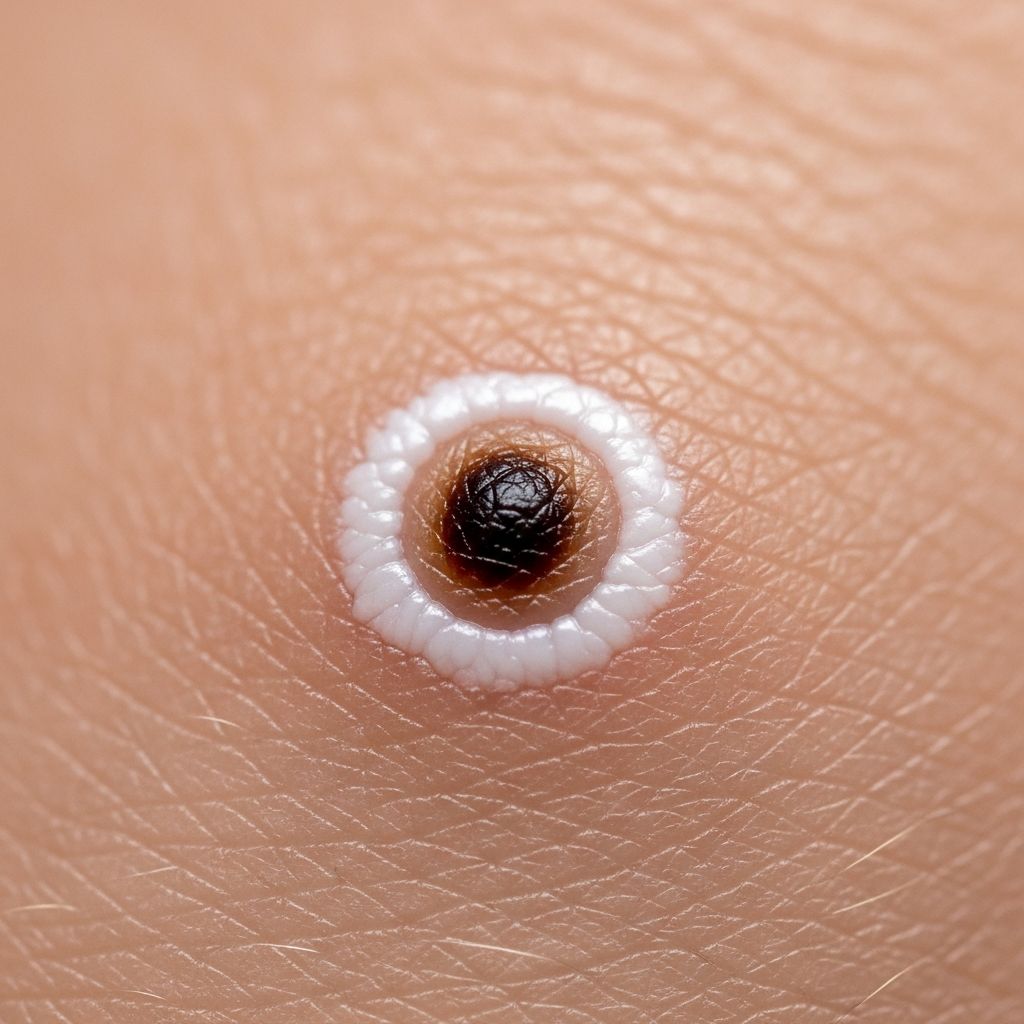
Halo moles, also known as halo nevi or Sutton nevi, are benign skin lesions characterized by a central mole surrounded by a distinctive white ring or halo of depigmented skin. These lesions are most common in children and young adults and typically resolve spontaneously over time. This article provides a visual and educational overview through clinical images, explaining their appearance, evolution, causes, and clinical significance.
What are halo moles?
A
halo mole
is a melanocytic nevus (mole) encircled by a symmetrical zone of depigmentation, forming a clear white halo. The central mole is usually brown, tan, or pink, and the halo measures about 0.5-1.0 cm in width. These are almost always benign and affect approximately 1% of the population, predominantly teenagers and young adults under 30 years old.Halo moles arise from an immune-mediated inflammatory response where T-lymphocytes attack melanocytes in the mole and surrounding skin, leading to pigment loss. They are asymptomatic except for cosmetic concerns and can appear singly or multiply, most often on the trunk (back, chest, abdomen), less commonly on limbs or head.
Clinical appearance and stages
Halo moles evolve through four distinct stages, which may take months to years to complete. Images illustrate these phases clearly:
- Stage 1: A circular ring of pale skin surrounds an intact, pigmented central mole. The halo is sharply demarcated and symmetrical.
- Stage 2: The central mole fades, becoming pinker or less pigmented as melanocytes are destroyed.
- Stage 3: The mole disappears entirely, leaving a circular or oval depigmented patch.
- Stage 4: The white patch gradually repigments, returning to normal skin color over 1-10 years.
Images of Stage 1 halo moles show a classic brown nevus with a crisp white rim on the back. In later stages, photos depict fading centers and persistent white areas on the trunk.
Images of halo moles
Clinical photography is essential for understanding halo moles. Below are descriptions of representative images:
- Image 1: Multiple halo nevi on the upper back of a young adult. Central tan moles are encircled by uniform white halos, approximately 1 cm wide. Skin otherwise normal.
- Image 2: Solitary halo mole on the abdomen in Stage 1: Dark brown nevus with symmetrical depigmented ring.
- Image 3: Stage 3 lesion on the chest: Circular white patch post-mole regression, no central pigmentation visible.
- Image 4: Atypical eyelid halo nevus with poliosis (white hairs in eyelashes), showing pink central papule and halo.
- Image 5: Cluster of halo nevi on the shoulder following sunburn trauma, illustrating Köbner phenomenon.
These images highlight the benign, uniform nature: round/oval shape, single color in the mole, no irregularity. Dermoscopy reveals globular patterns with blue-gray granules and white scar-like areas.
Causes and pathophysiology
The exact trigger for halo moles remains unclear, but it involves an autoimmune reaction. Cytotoxic T-cells and macrophages infiltrate the nevus, targeting melanocytes as foreign, possibly due to genetic factors, viral triggers, or trauma like sunburn.
In vitiligo patients, halo nevi occur more frequently, suggesting shared autoimmune pathways against melanocytes. Sunburn or injury (Köbner phenomenon) can precipitate them by making the nevus recognizable to the immune system. Histology shows melanocyte nests at the dermo-epidermal junction with inflammatory infiltrates.
Related Stories



Diagnosis
Diagnosis is clinical based on characteristic appearance. Use
ABCDE criteria
to rule out malignancy:| Feature | Description | Halo Mole vs. Cancer |
|---|---|---|
| Asymmetry | Uneven halves | Symmetrical in halo moles |
| Border | Ragged, blurred edges | Sharp, even borders |
| Color | Multiple shades | Uniform mole color |
| Diameter | >6mm changing | Stable size |
| Evolving | Recent changes | Expected staged evolution |
Dermoscopy aids confirmation; biopsy rarely needed unless atypical (e.g., irregular halo, older patient). Full skin exam recommended to exclude melanoma elsewhere.
Associated conditions
- **Vitiligo:** Higher incidence of halo nevi.
- **Melanoma:** Rare; halo around malignant melanoma or satellite halo nevi signaling occult melanoma.
- **Poliosis:** Localized white hairs, as in eyelid cases.
- **Autoimmune diseases:** Occasional links to thyroiditis or pernicious anemia.
In children, halo moles are reassuringly benign; in adults >30, vigilance increases.
Management and treatment
No treatment required; most regress spontaneously. Reassurance is key for cosmetic distress.
- Monitor for ABCDE changes or symptoms (itch, pain, growth).
- Sun protection to prevent triggering more lesions.
- Excisional biopsy only if suspicious for melanoma.
- Cosmetic options (camouflage makeup) for persistent depigmentation.
Patients with multiple halo nevi or family history of melanoma warrant annual skin checks.
Frequently Asked Questions (FAQs)
Are halo moles cancerous?
No, halo moles are benign in nearly all cases, especially in young people. Rarely, they may signal melanoma elsewhere; consult a dermatologist for evaluation.
Do halo moles go away?
Yes, they progress through stages and typically resolve fully within years, with repigmentation.
Why do I have a white ring around my mole?
It’s an immune attack on melanocytes, often idiopathic or post-trauma like sunburn.
Should I worry about multiple halo moles?
Usually not, but get a full skin exam to rule out associated conditions.
Can halo moles appear on the face?
Rarely; trunk is most common. Facial ones, like eyelid with poliosis, are atypical.
References
- Halo Nevus or Mole: Symptoms, Causes, Diagnosis, and Treatment — Healthline. 2023-10-15. https://www.healthline.com/health/halo-nevus
- Halo Naevus: Causes, Symptoms, and Treatment — Patient.info. 2024-05-20. https://patient.info/doctor/dermatology/halo-naevus
- Halo naevus – Primary Care Dermatology Society — PCDS.org.uk. 2025-01-31. https://www.pcds.org.uk/patient-info-leaflets/halo-naevus
- Atypical Presentation of Halo Nevus over Eyelid with Poliosis — PMC (NCBI). 2022-04-12. https://pmc.ncbi.nlm.nih.gov/articles/PMC9069907/
- What is a Halo Nevus Mole — Sanova Dermatology. 2023-08-10. https://www.sanovadermatology.com/skin-cancer-blog-cat/halo-nevus-my-mole-has-a-white-ring-around-it/
Similar Articles








Read full bio of Sneha Tete