Halo Naevus: Causes, Diagnosis, And Management Guide
Halo naevus: Benign moles with white halos, common in youth, autoimmune origin, rarely signals malignancy.
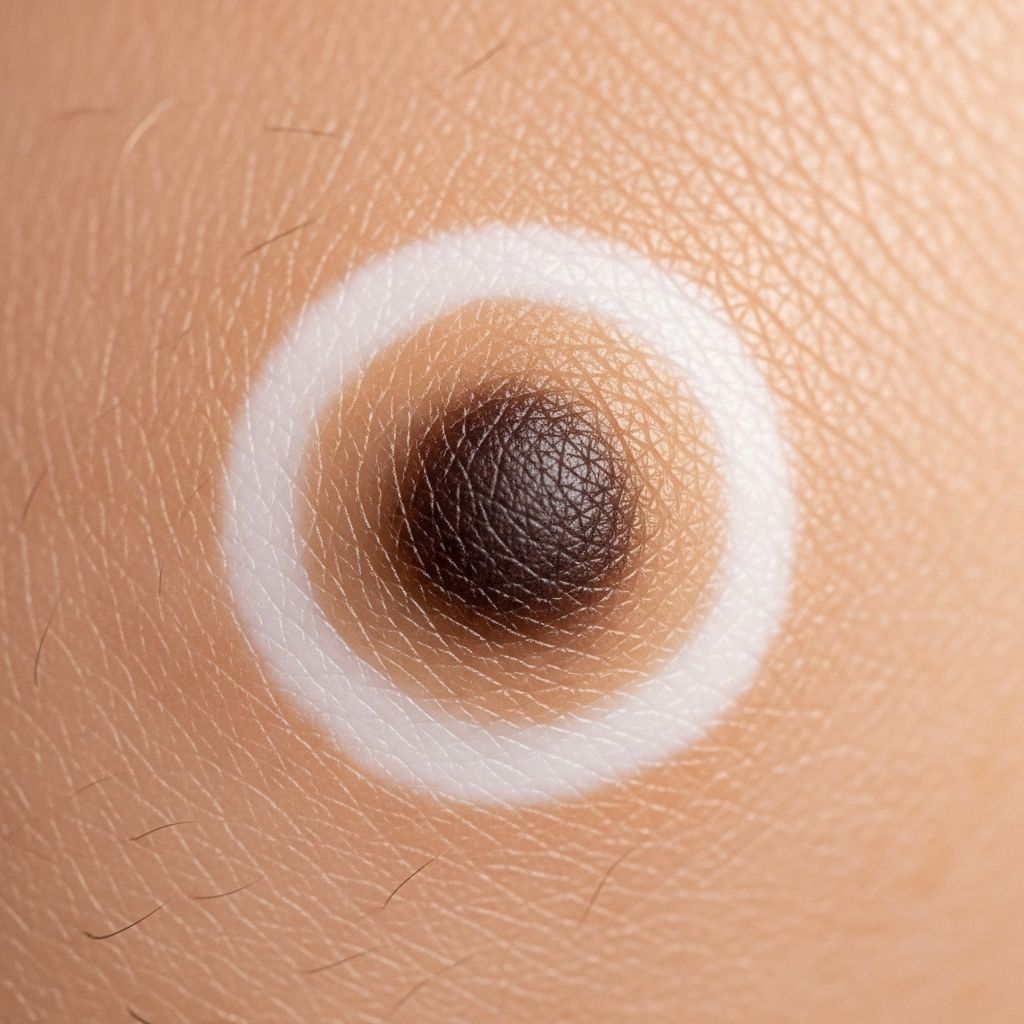
A
halo naevus
is a benign melanocytic naevus (mole) surrounded by a halo of depigmented skin. It is also known as aSutton naevus
orleukoderma acquisitum centrifugum
. Halo naevi are most common in children and young adults.Who gets halo naevus?
Halo naevi typically appear in
children, adolescents, and young adults
, with peak incidence between10–35 years
of age. They are uncommon after age 30 and rare in older adults.- Prevalence: Fairly common; affects fair-skinned individuals more noticeably.
- Risk factors: Fair skin, history of sunburn, local trauma, or psychosocial stress may trigger onset.
- Associations: May coexist with
vitiligo
(10–20% of cases) oratypical naevus syndrome
.
In children and teens, multiple halo naevi (up to 10–20) can erupt simultaneously on the trunk. Solitary lesions are also frequent.
What causes halo naevus?
Halo naevi result from an
autoimmune reaction
where the immune system targets melanocytes (pigment cells) in and around a pre-existing mole.- Pathophysiology: CD8+ T-lymphocytes and macrophages infiltrate the naevus, destroying melanocytes. This causes central fading of the mole and a surrounding
zone of depigmentation
. Circulating antibodies may play a minor role. - Triggers: Sunburn, mechanical trauma (Koebner phenomenon), or stress can initiate the immune response by making the mole appear ‘foreign’.
Genetic factors like
BRAF mutations
in naevus cells may express antigens that provoke immunity, leading to ‘oncogenic senescence’ and immune clearance.Note: Eruptive multiple halo naevi in adults (>30 years) may rarely associate with malignancy (e.g., melanoma, thyroid cancer). Incidence of cancer was 100x expected in one series (SIR=113 overall, SIR=955 for melanoma).
What are the clinical features of halo naevus?
Halo naevi are
asymptomatic
except for cosmetic concern. They evolve over weeks to months.Appearance
- Central lesion: Round/oval mole (dermal naevus, 2–6 mm), pink, light brown, or fading to white.
- Halo: Symmetrical white ring (1–5 cm wide), sharply demarcated, hypopigmented skin.
- Progression: Halo expands; mole fades/disappears (3–6 months); halo repigments over 1–3 years, often leaving faint outline.
Distribution
- Most common:
Trunk
(back, chest) – 70–80% of cases. - Less common:
Head/neck
, proximal limbs. - Rare: Distal limbs, palms/soles.
Images: Typical halo naevus shows a central pink papule with white halo on trunk. Multiple eruptive lesions in youth vs. solitary in adults.
Dermoscopy
- Atypical pigment network, peripheral globules, white structureless halo.
- Helps distinguish benign halo from regressing melanoma (asymmetrical, irregular borders).
Diagnosis
Diagnosis is
clinical
in typical cases (youth + trunk location).| Feature | Benign Halo Naevus | Melanoma with Halo (Rare) |
|---|---|---|
| Age | <30 years | >40 years |
| Number | Multiple/solitary | Solitary |
| Location | Trunk | Any, often limbs |
| Symptoms | Asymptomatic | Itch, bleed, grow |
| Dermoscopy | Symmetrical halo | Asymmetrical, blue-white veil |
ABCDE rule for concern: Asymmetry, Border irregularity, Color variation, Diameter >6mm, Evolving.
- Biopsy: Rarely needed; shows lichenoid infiltrate, melanocyte loss. Reserved for atypical/solitary adult cases.
- Differential: Vitiligo, idiopathic guttate hypomelanosis, regressing melanoma, halo congenital naevus.
Related Stories



Management
Reassurance is key for benign cases in youth: Self-resolving, no intervention needed.
- Monitoring: Full skin exam + photography. Review 3–6 months; teach self-exam.
- Excision: Solitary halo naevus in adults or ABCDE features. Confirm benign histology.
- Cosmetics: Camouflage makeup for persistent halo (repigments slowly).
- Sunscreen: SPF50+ on halo to prevent tanning contrast.
Avoid unnecessary biopsies in children to prevent scarring.
Complications
- Cosmetic: Visible white patch, especially summer.
- Scar: Post-biopsy/excision.
- Associated vitiligo progression (minority).
- Malignancy risk: Negligible in youth; screen adults with eruptive/multiple halos (dermoscopy, total body exam, consider PET if high suspicion).
Prevention
- Sun protection to avoid triggers.
- Avoid trauma to moles.
- Regular skin checks for fair-skinned individuals.
Prognosis
Excellent: 90% resolve fully within 3 years. Recurrence rare; new halos possible.
Frequently asked questions
What is a halo naevus?
A benign mole with a white ring from immune destruction of pigment cells.
Are halo naevi cancerous?
Almost always benign in children/young adults. Rarely mimics regressing melanoma in older patients.
Do halo naevi go away?
Yes: Mole fades in months; halo repigments in 1–3 years.
Should I have a halo naevus removed?
Usually no. Excision if atypical, adult-onset, or changing.
Can halo naevi appear anywhere?
Mostly trunk; rare on limbs/head.
Are multiple halo naevi dangerous?
Benign in youth; investigate in adults for underlying cancer.
Related topics
- Vitiligo
- Melanocytic naevus
- Malignant melanoma
- Congenital naevus
- Koebner phenomenon
References
- Halo naevus – Patient info leaflets — Primary Care Dermatology Society (PCDS). 2025-01-31. https://www.pcds.org.uk/patient-info-leaflets/halo-naevus
- Halo Naevus: Causes, Symptoms, and Treatment — Patient.info. Accessed 2026. https://patient.info/doctor/dermatology/halo-naevus
- Halo Nevus or Mole: Symptoms, Causes, Diagnosis, and Treatment — Healthline. Accessed 2026. https://www.healthline.com/health/halo-nevus
- Halo naevus – Clinical Guidance — Primary Care Dermatology Society (PCDS). 2023-12-14. https://www.pcds.org.uk/clinical-guidance/halo-naevus-syn-sutton-naevus
- Halo naevus (halo moles, halo nevi) — DermNet NZ. Accessed 2026. https://dermnetnz.org/topics/halo-naevus
- Eruptive Halo Naevi: A Possible Indicator of Malignant Disease — Acta Dermato-Venereologica. 2023. https://www.medicaljournals.se/acta/content/html/10.2340/00015555-3568
Similar Articles








Read full bio of Sneha Tete