Hand Dermatitis Images: 18 Photos To Spot Key Types
Comprehensive visual guide to hand dermatitis: Explore images of acute, chronic, atopic, and contact types for accurate identification and management.
Author: Prof. Dr. med. Peter Elsner, Professor of Dermatology, University of Jena, Germany. Translated into English by Dr Belinda Monk, London, UK. Reviewer for German translation: Prof. Dr. med. Thomas Rustemeyer, University of Berlin, Germany, 19 February 2024.
What is hand dermatitis?
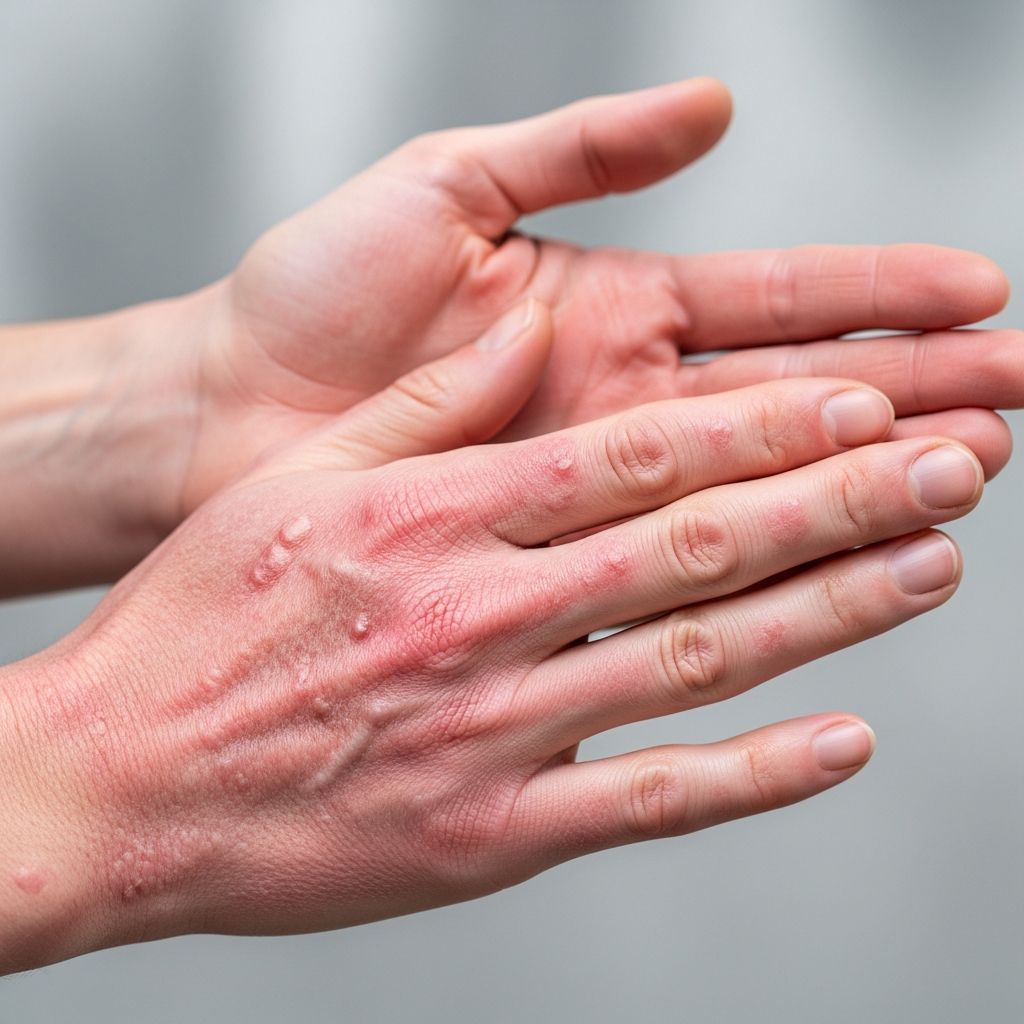
Hand dermatitis (hand eczema) is a common acute or chronic eczematous disorder affecting the dorsal and palmar aspects of the hands due to a variety of causes. It is also known as hand eczema. Hand dermatitis often results from a combination of causes, including genetic makeup (constitutional factors), environmental exposures, and occupational irritants or allergens. Frequently caused or aggravated by work, it is termed occupational dermatitis, particularly common in industries like cleaning, catering, metalwork, hairdressing, healthcare, and mechanical work.
Hand dermatitis varies in severity, starting as mild intermittent complaints but potentially becoming severe and persistent. It may affect the backs of the hands, palms, or both, often bilateral and symmetrical, though some contact forms may be unilateral. Acute phases feature redness, dryness, itchy papules, vesicles, scaling, fissures, weeping, and oedema. Chronic phases show skin thickening (lichenification), fissuring, and nail deformities. Bacterial infections can cause pustules, crusting, and pain, while viral infections like herpes simplex are rare but serious.
Who gets hand dermatitis?
Hand dermatitis affects 15–30% of the population at some point, with women twice as likely as men due to greater exposure to wet work and irritants. Atopic individuals (with asthma, hay fever, or atopic dermatitis) have a 2–4 times higher risk. Peak incidence occurs in young adults aged 20–40 years. Occupational risk is high in wet-work professions: cleaners (up to 50%), hairdressers (20–30%), food handlers, and healthcare workers, especially during pandemics like COVID-19 when hand hygiene increased dramatically.
Causes of hand dermatitis
Multifactorial etiology includes:
- Irritant contact dermatitis (80% of occupational cases): Water, detergents, solvents, acids, alkalis, friction, cold, heat, desiccating dusts damage the stratum corneum, impairing barrier function.
- Allergic contact dermatitis: Common allergens like nickel, fragrances, rubber accelerators, chromate (gloves), p-phenylenediamine (hair dye). Protein contact dermatitis in caterers.
- Atopic dermatitis: Inherited barrier dysfunction triggered by irritants, affecting 90% of backs of hands.
- Other types: Vesicular (pompholyx), discoid (nummular), fingertip, hyperkeratotic.
Clinical features of hand dermatitis
Symptoms include intense itch, burning, pain, dryness. Acute: Erythema, vesicles, oedema, weeping. Chronic: Lichenification, fissures, hyperkeratosis. Distribution varies by type.
Acute hand dermatitis images
Acute presentations show red, inflamed skin with vesicles and oedema. Image 1: Vesicles on dorsal hands from irritant exposure. Image 2: Oedematous fingers with blistering in allergic contact dermatitis.
Chronic hand dermatitis images
Chronic features: Dry, scaly, fissured skin with thickening. Image 3: Fissured palms in hyperkeratotic hand dermatitis. Image 4: Lichenified dorsal hands with nail dystrophy.
Atopic hand dermatitis images
Prefers dorsal hands (90%), fingers (70%), wrists (50–60%). Dry, erythematous with possible vesicles. Associated with hyperlinear palms, keratosis pilaris. Image 5: Discoid plaques on backs of hands. Image 6: Nail pitting and ridges from distal involvement.
Irritant contact dermatitis images
Often starts interdigital (‘sentinel sign’), spares palms. Image 7: Web-space erythema in cleaners. Image 8: Hyperkeratosis on fingertips from wet work.
Related Stories



Allergic contact dermatitis images
Clues: Spares areas covered by rings (nickel); Compositae shape (sesquiterpene lactones). Image 9: Nickel reaction on wrists. Image 10: Rubber allergy under gloves.
Vesicular hand dermatitis (pompholyx) images
Intensely itchy skin-coloured blisters on palms, sides of fingers; exacerbated by heat, stress, hyperhidrosis. Image 11: Crops of vesicles on palms. Image 12: Similar foot involvement.
Discoid (nummular) eczema images
Circumscribed plaques on dorsal hands/fingers. Image 13: Oval plaques on dorsa. Image 14: Exudative nummular lesions.
Fingertip dermatitis images
Isolated to fingertips: Scaling, fissuring. Image 15: Pulp involvement in one finger. Image 16: Multiple fingertip hyperkeratosis.
Hyperkeratotic hand dermatitis images
Thickened palms with painful fissures. Image 17: Callus-like palmar skin. Image 18: Cracking after water exposure.
Complications
- Bacterial infection (Staph/Strep): Pustules, crusting.
- Viral (eczema herpeticum): Rare, severe.
- Nail dystrophy: Pitting, ridges, onycholysis.
- Psychosocial impact: Occupational disability, reduced quality of life.
Diagnosis
Based on history, examination. Patch testing for allergens in chronic cases. Biopsy/scrapings if needed to exclude tinea, psoriasis.
Differential diagnosis
| Condition | Key Features |
|---|---|
| Psoriasis | Well-defined plaques, nail pitting, family history. |
| Tinea manuum | Asymmetrical, annular, KOH positive. |
| Scabies | Burrows, nocturnal itch, webs involved. |
| Lichen simplex | Localised lichenification from rubbing. |
Treatment of hand dermatitis
- Emollients: Frequent application of thick ointments (e.g., petroleum jelly) to restore barrier.
- Topical steroids: Potent on dorsum, very potent on palms for 2–4 weeks.
- Infection: Topical/oral antibiotics (flucloxacillin).
- Severe/chronic: Oral prednisone (2–4 weeks), immunosuppressants (azathioprine, methotrexate), alitretinoin, phototherapy (PUVA).
Prevention
- Avoid irritants/allergens: Use gloves (vinyl/nitrile, not rubber), soap substitutes.
- Barrier creams before wet work.
- Cotton liners under gloves.
- Short, lukewarm washes; pat dry.
Outlook
Many cases resolve with avoidance and treatment, but chronic/recurrent in atopics or occupational exposure. Early intervention prevents persistence; 50% occupational cases clear if occupation changed.
Frequently asked questions
What causes hand dermatitis?
Combination of irritants, allergens, atopy, genetics. Wet work major trigger.
Can hand dermatitis be cured?
Often managed long-term; cure possible with allergen avoidance.
Is hand dermatitis contagious?
No, but secondary infections are.
How to prevent occupational hand dermatitis?
Gloves, emollients, minimised wet work.
When to see a dermatologist?
If persists >2 months, severe, or occupational.
References
- Hand dermatitis (hand eczema) — DermNet NZ. 2024-02-19. https://dermnetnz.org/topics/hand-dermatitis
- Atopic hand dermatitis — DermNet NZ. 2024. https://dermnetnz.org/topics/atopic-hand-dermatitis
- Hand dermatitis (hand eczema) — Lincoln Family Doctors / DermNet NZ. 2017-11. https://lincolntonfamilydoctors.com/wp-content/uploads/2017/11/Hand-dermatitis.pdf
- Hand dermatitis — CME — DermNet NZ. 2024. https://dermnetnz.org/cme/dermatitis/hand-dermatitis
- Hand dermatitis PIL — Skin Health Info. 2023-10. https://www.skinhealthinfo.org.uk/wp-content/uploads/2018/11/Hand-dermatitis-PIL-Oct-2023.pdf
Similar Articles








Read full bio of Sneha Tete