Heart Conduction System: How Your Heart Controls Its Rhythm
Understand how your heart's electrical system controls every heartbeat and maintains your cardiovascular health.
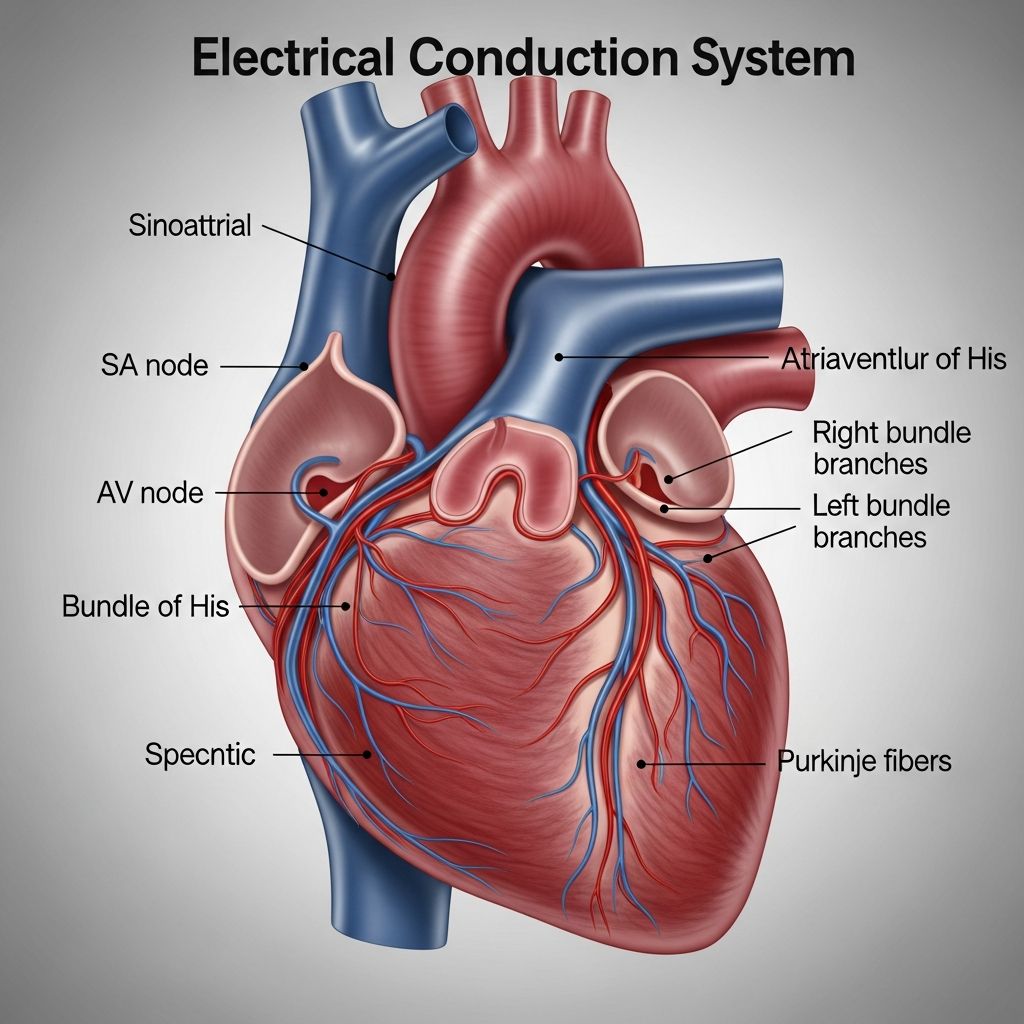
Understanding Your Heart’s Conduction System
Your cardiac conduction system is the network of specialized nodes, cells, and electrical signals that controls your heartbeat. Every time your heart beats, electrical signals travel through your heart muscle, causing different chambers to contract and expand in a coordinated sequence. This precise electrical choreography regulates blood flow through your heart and delivers oxygen-rich blood to your entire body.
Think of your heart’s conduction system like the electrical wiring in a building. Just as wires direct electricity to power lights and appliances, your heart’s conduction system directs electrical impulses to power each heartbeat. Without this sophisticated electrical network, your heart couldn’t maintain a steady, even rhythm or respond to your body’s changing needs for blood and oxygen.
How the Heart’s Electrical Signal Works
For each heartbeat, electrical signals travel through a specific pathway in your heart. This process begins when your sinoatrial node creates an initial excitation signal. This electrical impulse works much like electricity traveling through wires to power an appliance in your home. The signal then travels through your atria, stimulating them to contract and pump blood into your ventricles. Next, the signal reaches your atrioventricular node, which delays the impulse briefly, allowing your atria to fully empty before your ventricles contract. Finally, the signal travels through the bundle of His and bundle branches to reach the Purkinje fibers, which cause your ventricles to contract forcefully and pump blood out to your lungs and body.
Your heart’s electrical conduction system sends out thousands of signals per day to maintain a consistent heartbeat. Ideally, this system keeps up a steady, even heart rate while also allowing your heart to speed up when you need more blood and oxygen during physical activity or emotional stress, and to slow down when it’s time to rest and recover.
Key Components of Your Cardiac Conduction System
Your heart’s conduction system contains specialized cells and nodes that work together to generate and coordinate electrical impulses. Understanding these components helps explain how your heart maintains its vital rhythm:
The Sinoatrial (SA) Node: Your Heart’s Natural Pacemaker
Your sinoatrial node, located in the upper right chamber of your heart, serves as your heart’s natural pacemaker. This small cluster of specialized cells generates the electrical impulses that initiate each heartbeat. The SA node automatically sets the rhythm for your heart, typically maintaining a resting heart rate between 60 and 100 beats per minute in healthy adults. When your sinoatrial node functions properly, it provides a reliable electrical signal to start the heartbeat cycle. If your sinoatrial node isn’t working well, the lower segments of your conduction system act as backup pacemaker cells, ensuring your heart continues beating even if the primary pacemaker fails.
The Atrioventricular (AV) Node: The Electrical Gatekeeper
Your atrioventricular node, located near the central area of your heart, plays a crucial role in managing the timing of electrical signals. The AV node delays the signal from your sinoatrial node by a consistent amount of time—typically a fraction of a second—with each heartbeat. This deliberate delay serves an important purpose: it ensures that your atria (upper heart chambers) have time to fully contract and empty their blood into your ventricles (lower heart chambers) before ventricular contraction begins. Without this delay, blood wouldn’t fill your ventricles adequately, and your heart wouldn’t pump blood efficiently. The atrioventricular node also functions as an electrical gatekeeper, preventing abnormally fast atrial rhythms from reaching the ventricles and causing dangerous heart rates.
The Bundle of His and Bundle Branches
The bundle of His (pronounced “hiss”) is a branch of specialized nerve fibers that extends from your atrioventricular node. This fiber bundle receives the electrical signal from the AV node and carries it deeper into your heart. The bundle of His runs down the length of the septum—the muscular wall that separates your right and left ventricles. As the bundle of His descends, it divides into two main branches: the right bundle branch and the left bundle branch. These branches distribute the electrical signal to both ventricles, ensuring that both lower chambers contract in a coordinated, synchronized manner for optimal pumping efficiency.
The Purkinje Fibers: Final Signal Distribution
The Purkinje fibers represent the final destination of your heart’s electrical pathway. These specialized conduction cells distribute the electrical signal throughout the ventricles, triggering the ventricular muscle cells to contract forcefully. The Purkinje fibers ensure that the electrical signal reaches all parts of both ventricles nearly simultaneously, allowing them to contract as a unified unit. This coordinated contraction generates sufficient pressure to pump blood throughout your body.
Regulation of Heart Rate and Rhythm
The Autonomic Nervous System’s Role
While your sinoatrial node generates the basic heartbeat rhythm automatically, your autonomic nervous system fine-tunes your heart rate to match your body’s needs. Your autonomic nervous system includes two main branches: the sympathetic nervous system and the parasympathetic nervous system. The sympathetic nervous system increases your heart rate during the “fight or flight” response—when you’re stressed, exercising, or facing danger. This system releases adrenaline and noradrenaline, which speed up the signals from your sinoatrial node and increase the force of heart contractions. Conversely, the parasympathetic nervous system slows your heart rate during the “rest and digest” state. This system releases acetylcholine, which slows the signals from your sinoatrial node and helps your body conserve energy during periods of rest.
Adapting to Your Body’s Demands
Your cardiac conduction system continuously adapts to your body’s changing oxygen and blood flow demands. When you exercise or experience stress, your nervous system sends signals that cause your sinoatrial node to fire faster, increasing your heart rate to deliver more oxygen-rich blood to your muscles. When you rest or relax, signals slow your sinoatrial node, reducing your heart rate and allowing your body to conserve energy. This dynamic responsiveness ensures that your heart can meet your body’s requirements throughout the day.
Understanding the Complete Heartbeat Cycle
Each heartbeat represents a complete cycle of electrical and mechanical events. First, your sinoatrial node generates an electrical impulse that spreads across both atria, causing them to contract and push blood into the ventricles. Next, the impulse reaches the atrioventricular node, where it experiences a brief delay. This delay is crucial because it allows the atria to finish emptying and gives the ventricles time to fill with blood. Then, the signal travels through the bundle of His and its branches to the Purkinje fibers, triggering powerful ventricular contractions that pump blood out of the heart. Finally, the ventricles relax, and the cycle begins again. This coordinated sequence of electrical and mechanical events repeats thousands of times each day, with each cycle lasting less than one second.
What Happens When the Conduction System Malfunctions
When your heart’s conduction system doesn’t work properly, you may experience arrhythmias—irregular heartbeats that can range from harmless to life-threatening. Some people with conduction system problems may experience heart palpitations (the sensation of a fluttering or racing heart), dizziness, shortness of breath, or chest discomfort. Conduction abnormalities can affect any part of the system, from the sinoatrial node to the Purkinje fibers. Some conditions slow conduction (like heart block), while others accelerate it (like accessory pathways in Wolff-Parkinson-White syndrome). Modern medical treatments, including medications and pacemakers, can help manage many conduction system disorders and restore normal heart rhythm.
Clinical Advances in Conduction System Management
Recent advances in cardiac pacing have revolutionized how physicians manage conduction system disorders. Conduction system pacing (CSP) and cardiac resynchronization therapy (CRT) represent cutting-edge approaches to treating patients with severe conduction abnormalities that affect heart function. These therapies can help prevent or slow the development of heart failure by restoring synchronized contraction of the ventricles. Specialized multidisciplinary clinics combining electrophysiology and heart failure expertise have emerged as important resources for patients requiring complex conduction system management. These clinics provide comprehensive evaluation and personalized treatment plans that consider each patient’s unique cardiac physiology and clinical needs.
Frequently Asked Questions About the Heart’s Conduction System
Q: What is the sinoatrial node?
A: The sinoatrial node is a small cluster of specialized cells located in the upper right chamber of your heart that serves as your heart’s natural pacemaker. It generates the electrical impulses that initiate each heartbeat.
Q: Why does the atrioventricular node delay electrical signals?
A: The atrioventricular node delays signals by a fraction of a second to allow your atria to fully contract and empty blood into your ventricles before ventricular contraction begins. This delay is essential for proper blood flow and efficient heart pumping.
Q: What happens if the sinoatrial node fails?
A: If the sinoatrial node fails to generate impulses properly, backup pacemaker cells lower in the conduction system can take over and maintain a basic heart rhythm, though usually at a slower rate.
Q: How does the autonomic nervous system affect heart rate?
A: The sympathetic nervous system speeds up your heart during stress or exercise, while the parasympathetic nervous system slows it down during rest. These systems ensure your heart rate matches your body’s oxygen demands.
Q: What are common conduction system disorders?
A: Common disorders include atrial fibrillation, heart block, sick sinus syndrome, and Wolff-Parkinson-White syndrome. These conditions can affect heart rate and rhythm regulation.
Q: Can conduction system problems be treated?
A: Yes, many conduction disorders can be managed with medications, pacemakers, or more advanced therapies like cardiac resynchronization therapy or conduction system pacing.
References
- Heart Conduction System (Cardiac Conduction) — Cleveland Clinic. 2025. https://my.clevelandclinic.org/health/body/21648-heart-conduction-system
- Heart Rhythm Society Guideline Addresses Cardiac Physiologic Pacing for Heart Failure — Cleveland Clinic Consult QD. 2025. https://consultqd.clevelandclinic.org/heart-rhythm-society-guideline-addresses-cardiac-physiologic-pacing-for-heart-failure
- Cardiac Conduction System Pacing: A Comprehensive Update — PubMed Central. 2023. https://pubmed.ncbi.nlm.nih.gov/37589646/
- Heart: Anatomy & Function — Cleveland Clinic. 2025. https://my.clevelandclinic.org/health/body/21704-heart
- Wolff-Parkinson-White Syndrome: Diagnostic and Management — Cleveland Clinic Journal of Medicine. 2023. https://www.ccjm.org/content/92/2/119
Similar Articles








Read full bio of medha deb