Hemorrhoids: 4 Grades, Causes, Symptoms, Treatment
Comprehensive guide to hemorrhoids: causes, symptoms, diagnosis, treatments, and prevention strategies for effective management.
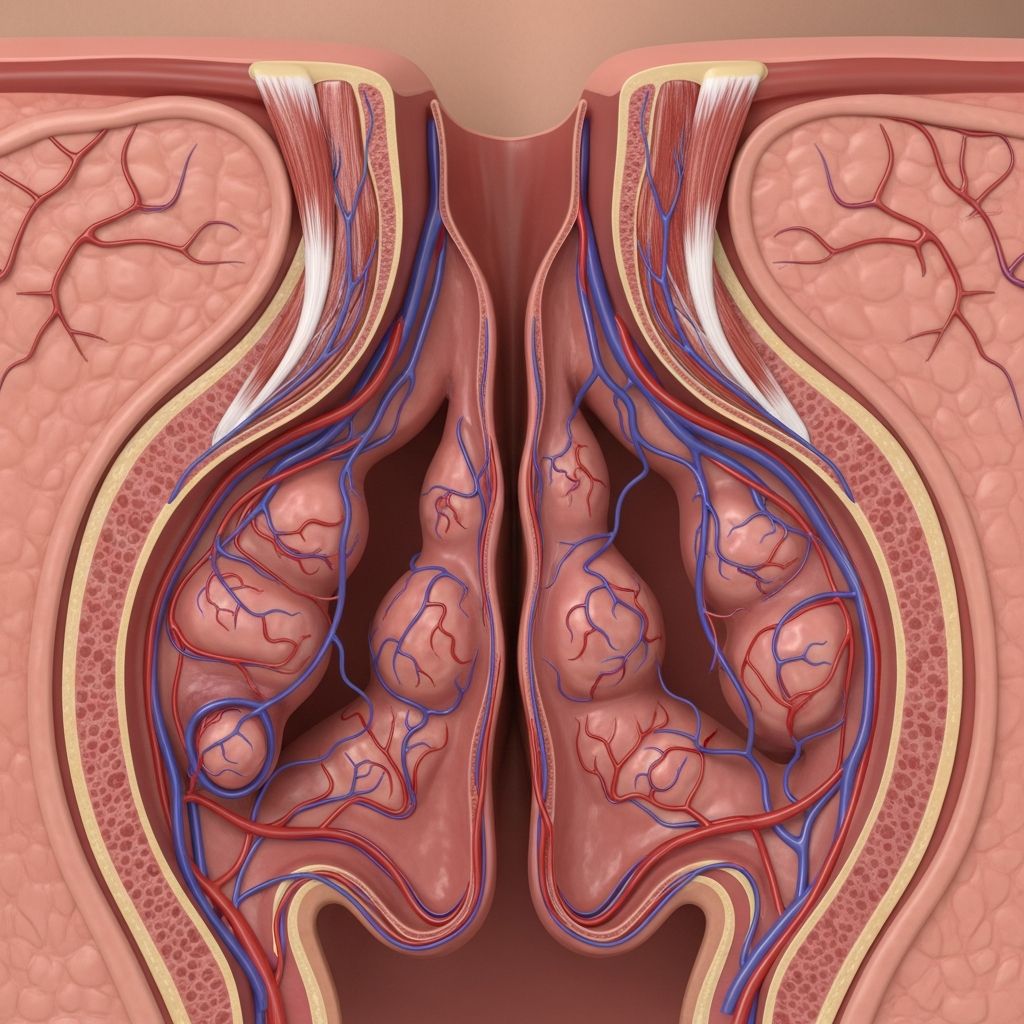
Hemorrhoids, often called piles, are swollen veins in the anus and lower rectum, resembling varicose veins. They affect millions worldwide and result from enlarged, displaced anal cushions.
What Are Hemorrhoids?
Hemorrhoids are defined as the symptomatic enlargement and distal displacement of the normal anal cushions, which are vascular structures in the anal canal. These cushions, typically three main ones located at the right anterior, right posterior, and left lateral positions, provide a watertight seal during defecation. When supporting tissues deteriorate, they prolapse, leading to venous dilatation and symptoms.
Pathologically, hemorrhoids show abnormal venous dilatation, vascular thrombosis, degenerative changes in collagen and fibroelastic tissues, and distortion of the anal subepithelial muscle. An inflammatory reaction, mucosal ulceration, ischemia, and thrombosis are common. Vascular hyperplasia and impaired sphincter-like mechanisms in the arteriovenous plexus contribute to hyperperfusion and cushion enlargement.
Types of Hemorrhoids
Hemorrhoids are classified as internal, external, or mixed based on their location relative to the dentate line.
- Internal hemorrhoids originate above the dentate line, where somatic pain fibers are absent, making them often painless.
- External hemorrhoids form below the dentate line, covered by anoderm, and can cause significant pain if thrombosed.
- Mixed hemorrhoids have components both above and below the dentate line.
Internal hemorrhoids are graded using Goligher’s classification:
- Grade I: Bleed but do not prolapse.
- Grade II: Prolapse on straining but reduce spontaneously.
- Grade III: Prolapse and require manual reduction.
- Grade IV: Irreducible prolapse, at risk for complications.
Symptoms of Hemorrhoids
The hallmark symptom is painless bright red rectal bleeding during bowel movements, often dripping into the toilet. Other symptoms include anal pruritus, mucus discharge, prolapse sensation, and fecal soiling. External hemorrhoids may present as perianal lumps, painful if thrombosed.
Bleeding can lead to fecal occult blood positivity or anemia, but colorectal cancer must be ruled out, especially in atypical cases or high-risk patients. Thrombosed external hemorrhoids cause acute pain from clot pressure on sensitive anoderm.
Causes and Risk Factors
While constipation and straining are traditionally implicated—increasing intra-abdominal pressure and shearing forces on cushions—recent evidence questions their primacy. Other factors include diarrhea, pregnancy, obesity, low-fiber diet, prolonged sitting, heavy lifting, and aging, which weaken connective tissues.
Pathophysiology centers on sliding anal canal lining theory: deterioration of supporting tissues causes downward displacement of cushions. Dysregulated vascular tone, hyperplasia, and impaired arteriovenous shunts exacerbate engorgement.
Diagnosis
Diagnosis begins with history: bright red blood per rectum, prolapse, pain. Physical exam includes visual inspection, digital rectal exam (DRE), and anoscopy. DRE detects tenderness, masses, or thrombosis. Anoscopy visualizes internal hemorrhoids.
Sigmoidoscopy or colonoscopy is essential if alarm symptoms (weight loss, anemia, age >50) or atypical bleeding suggest colorectal pathology. Avoid attributing significant bleeding solely to hemorrhoids without colonic evaluation.
Treatment
Treatment escalates from conservative to surgical based on grade and symptoms.
Related Stories



Conservative Management
First-line for grade I-II: high-fiber diet (25-30g/day), stool softeners, adequate hydration, sitz baths, and topical agents (corticosteroids, anesthetics). These reduce straining and inflammation.
Office Procedures
For persistent grade I-III: rubber band ligation (most common, effective for bleeding), sclerotherapy, infrared coagulation, or thrombectomy for external clots.
| Procedure | Best For | Success Rate | Complications |
|---|---|---|---|
| Rubber Band Ligation | Grade I-III internal | 70-90% | Pain, bleeding, rare infection |
| Sclerotherapy | Grade I-II | 70-80% | Ulceration, recurrence |
| Infrared Coagulation | Grade I-II | 60-80% | Minimal |
Surgical Options
For grade III-IV or failures: hemorrhoidectomy (excisional), stapled hemorrhoidopexy (SH), or Doppler-guided hemorrhoidal artery ligation (DG-HAL). SH repositions prolapsing mucosa; DG-HAL dearterializes feeding vessels. Both show good 18-month outcomes for grade III.
Prevention
- Eat high-fiber foods (fruits, vegetables, whole grains).
- Drink 8-10 glasses of water daily.
- Avoid straining; respond promptly to bowel urges.
- Exercise regularly to prevent constipation.
- Maintain healthy weight; limit prolonged sitting.
When to See a Doctor
Seek care for persistent bleeding, severe pain, prolapse not reducing, thrombosis, or symptoms lasting >1 week. Urgent evaluation if heavy bleeding, dizziness, or black stools.
Frequently Asked Questions (FAQs)
What causes hemorrhoids?
Hemorrhoids result from displaced anal cushions due to weakened support tissues, exacerbated by straining, constipation, pregnancy, and obesity.
Do hemorrhoids go away on their own?
Mild cases (grade I) often resolve with conservative measures; advanced grades require intervention.
Is hemorrhoid bleeding dangerous?
Usually not, but rule out colorectal cancer with colonoscopy if atypical or persistent.
How long do thrombosed hemorrhoids last?
Pain peaks in 48-72 hours; clot resolves in 1-2 weeks, but excision speeds relief.
Can diet prevent hemorrhoids?
Yes, high-fiber intake softens stool, reducing strain.
This comprehensive overview equips you with knowledge for managing hemorrhoids effectively. Consult a healthcare provider for personalized advice.
References
- Hemorrhoids: From basic pathophysiology to clinical management — Lohsiriwat V. World Journal of Gastroenterology. 2012-06-07. https://pmc.ncbi.nlm.nih.gov/articles/PMC3342598/
- National Institute of Diabetes and Digestive and Kidney Diseases (NIDDK) – Hemorrhoids — U.S. Department of Health and Human Services. 2023-10-10. https://www.niddk.nih.gov/health-information/digestive-diseases/hemorrhoids
- American Society of Colon and Rectal Surgeons (ASCRS) Practice Parameters for Hemorrhoids — ASCRS. 2024-01-15. https://fascrs.org/patients/diseases-and-conditions/a-z/hemorrhoids-expanded-information
- Diagnosis and management of hemorrhoids — Rakinic J, Poola VP. Cleveland Clinic Journal of Medicine. 2023-03-01. https://www.ccjm.org/content/90/3/155
- Hemorrhoids and thrombosed external hemorrhoid excision — Mayo Clinic. 2024-05-20. https://www.mayoclinic.org/diseases-conditions/hemorrhoids/diagnosis-treatment/drc-20360280
Similar Articles








Read full bio of Sneha Tete