Hereditary Gingival Fibromatosis: Causes, Diagnosis & 7 FAQs
Rare genetic condition causing progressive gum overgrowth, affecting oral function, aesthetics, and requiring surgical management.
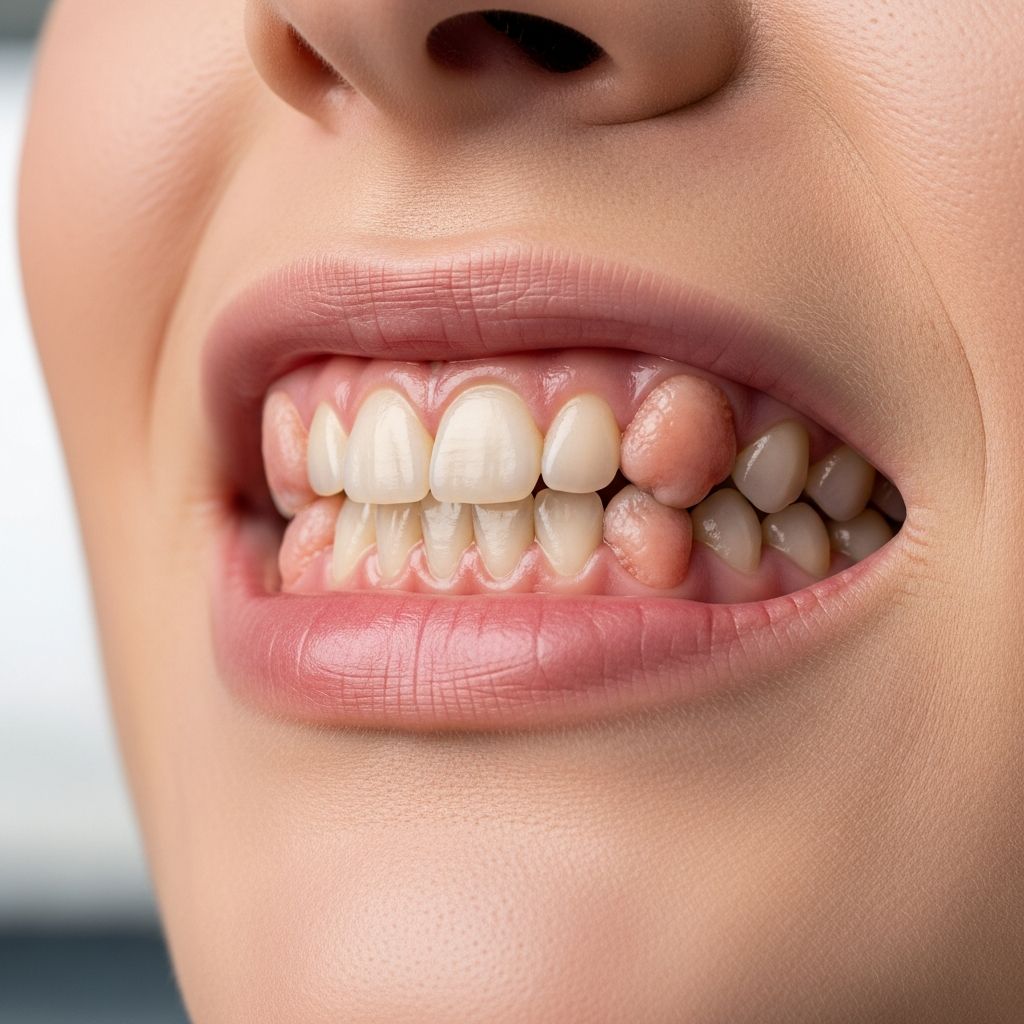
Hereditary gingival fibromatosis (HGF) is a rare benign condition characterised by slow but progressive enlargement of the keratinised gingiva. It may involve the marginal gingiva, attached gingiva, interdental papilla and, less commonly, the alveolar mucosa. The enlarged gingiva is fibrous, rubbery and dense, and it may cover all or part of the teeth. Gingival enlargement can be local or generalised, and it affects the maxilla, mandible or both jaws.
What is the cause of hereditary gingival fibromatosis?
Hereditary gingival fibromatosis is caused by mutations in specific genes involved in cellular signalling and extracellular matrix regulation. The most commonly implicated gene is
SOS1
(son-of-sevenless 1), a guanine nucleotide-exchange factor that regulates cell growth and differentiation via the RAS/MAPK pathway. Mutations, often a single nucleotide insertion, lead to excessive fibroblast proliferation, increased collagen and fibronectin synthesis, and reduced matrix metalloproteinase (MMP) activity, resulting in fibrous overgrowth.Two main genetic loci have been identified:
- HGF1: Linked to chromosome 2p21–p22 (SOS1 gene).
- HGF2: Linked to chromosome 5q13–q22.
Mutations in the
REST
(RE1-silencing transcription factor) gene have also been reported. HGF exhibits autosomal dominant inheritance with variable penetrance and expressivity; about 20% of cases are sporadic without family history. The condition often manifests during the transition from primary to permanent dentition, triggered by eruption-related inflammation that elevates transforming growth factor β1 (TGF-β1) levels, promoting fibroblast activation.HGF can occur isolated (nonsyndromic) or as part of syndromes such as:
- Rutherford syndrome
- Laband syndrome (with hypoplasia of nails or terminal phalanges, joint hypermobility, hepatosplenomegaly, mild deafness)
- Ramon syndrome (cherubism, juvenile rheumatoid arthritis, mental retardation, epilepsy)
- Jones syndrome (progressive hearing loss)
- Other associations: hypertrichosis, epilepsy, hearing defects, coarse facies, corneal dystrophy, dwarfism.
Who gets hereditary gingival fibromatosis?
HGF has a prevalence of approximately 1:175,000, with familial clustering due to its genetic basis. It affects both genders equally and typically presents in childhood or adolescence, coinciding with permanent tooth eruption, though neonatal cases exist. Severity varies; severe forms may be evident at birth, while milder cases progress slowly.
What are the clinical features of hereditary gingival fibromatosis?
The hallmark is localised or generalised fibrous gingival enlargement, firm, pink to coral-pink, non-inflamed unless secondarily infected. Overgrowth starts interdentrally, progressing to cover crowns partially or completely, most pronounced anteriorly.
Clinical manifestations include:
- Functional impairment: Impaired mastication, speech impediments (lisping), delayed tooth eruption, malocclusion, diastemas.
- Aesthetic concerns: Gingival eversion, macrogingivae distorting smile and lip competence.
- Dental complications: Tooth mobility, caries, periodontitis from plaque accumulation in gingival crevices, delayed or ectopic eruption.
- Severe cases: Complete crown coverage, open bites, pseudopockets >10 mm.
Paradental epithelial separation may occur due to dense connective tissue pushing epithelium away from teeth. Pain is uncommon unless ulceration or infection supervenes.
Related Stories



How is hereditary gingival fibromatosis diagnosed?
Diagnosis is primarily clinical, based on family history, characteristic gingival overgrowth pattern, and young age of onset. Key differentials include:
| Condition | Distinguishing Features |
|---|---|
| Drug-induced gingival hyperplasia (phenytoin, cyclosporine, nifedipine) | Drug history, resolves on discontinuation, more vascular/inflammatory. |
| Inflammatory gingival hyperplasia | Associated with poor hygiene, bleeding, resolves with hygiene improvement. |
| Leukaemic gingival infiltration | Systemic signs, rapid onset, systemic illness. |
| Gingival fibromatosis with systemic syndromes | Extraoral features (e.g., hearing loss, hypertrichosis). |
Investigations:
- Family pedigree analysis for inheritance pattern.
- Intraoral radiographs: Assess bone levels, eruption status, root development.
- Biopsy (if atypical): Confirms dense collagen bundles, fibroblasts, acanthotic epithelium with elongated rete ridges.
- Genetic testing: For SOS1/REST mutations in uncertain cases.
What is the treatment for hereditary gingival fibromatosis?
HGF does not resolve spontaneously; surgical excision is the mainstay. Timing is debated: early intervention for psychosocial/function benefits vs. post-permanent eruption to minimise recurrence.
Surgical options:
- External bevel gingivectomy: Scalpel excision of excess tissue, conservative for developing dentogingival junction (DGJ), no flap/sutures needed.
- Internal bevel gingivectomy: Full-thickness flap, repositions tissue apically; ideal for severe cases but longer operative time.
- Adjuncts: Scaling/root planing pre-op, chlorhexidine rinse post-op, periodontal dressing.
Post-op: Rigorous oral hygiene, 3-monthly recalls. Recurrence is common (variable rate), especially if surgery pre-permanent teeth; monitor lifelong.
Non-surgical: Limited role; hygiene instruction prevents secondary issues but doesn’t regress overgrowth.
Case evidence: In two 8-year-old boys, internal/external bevel gingivectomy under sedation restored function/aesthetics, promoted eruption, with low recurrence at 15 months follow-up.
What is the outcome for hereditary gingival fibromatosis?
Surgery improves aesthetics, function, and eruption but recurrence occurs in many, necessitating repeat procedures. Good hygiene reduces complications like periodontitis. Multidisciplinary care (periodontist, orthodontist, geneticist) optimises outcomes. Psychological support vital for children.
Frequently asked questions about hereditary gingival fibromatosis
What is hereditary gingival fibromatosis?
A rare genetic disorder causing progressive, fibrous overgrowth of gums, often covering teeth and impairing oral function.
Is hereditary gingival fibromatosis painful?
Usually painless unless secondarily infected or ulcerated.
Can hereditary gingival fibromatosis be cured?
No cure; surgery manages symptoms, but recurrence is possible.
At what age does hereditary gingival fibromatosis appear?
Typically with permanent tooth eruption (6–12 years), but can be congenital.
Does hereditary gingival fibromatosis affect adults?
Progresses slowly lifelong; adults may need repeated surgeries.
Is hereditary gingival fibromatosis hereditary?
Yes, autosomal dominant in most cases.
How is hereditary gingival fibromatosis treated in children?
Gingivectomy with sedation/local anaesthesia, timing balanced against recurrence risk.
References
- Hereditary gingival fibromatosis — National Organization for Rare Disorders (NORD). Accessed 2026. https://rarediseases.org/mondo-disease/hereditary-gingival-fibromatosis/
- Hereditary gingival fibromatosis: Characteristics and treatment approaches in children — PMC/NCBI (Rev Port Estomatol Med Dent Cir Maxilofac). 2017-05-01. https://pmc.ncbi.nlm.nih.gov/articles/PMC5410686/
- Hereditary gingival fibromatosis with distinct dental, skeletal and cephalic abnormalities — American Academy of Pediatric Dentistry (AAPD). 2002. https://www.aapd.org/globalassets/media/publications/archives/katz3-02.pdf
- Hereditary gingival fibromatosis — PMC/NCBI. 2014-10-01. https://pmc.ncbi.nlm.nih.gov/articles/PMC4178355/
- Hereditary gingival fibromatosis – Wikipedia — Wikipedia (informational, primary sources cited). Accessed 2026. https://en.wikipedia.org/wiki/Hereditary_gingival_fibromatosis
Similar Articles








Read full bio of medha deb