Hereditary Hemorrhagic Telangiectasia: Diagnosis & Treatment
Genetic disorder causing abnormal blood vessels, nosebleeds, and serious complications like AVMs in lungs, liver, and brain.
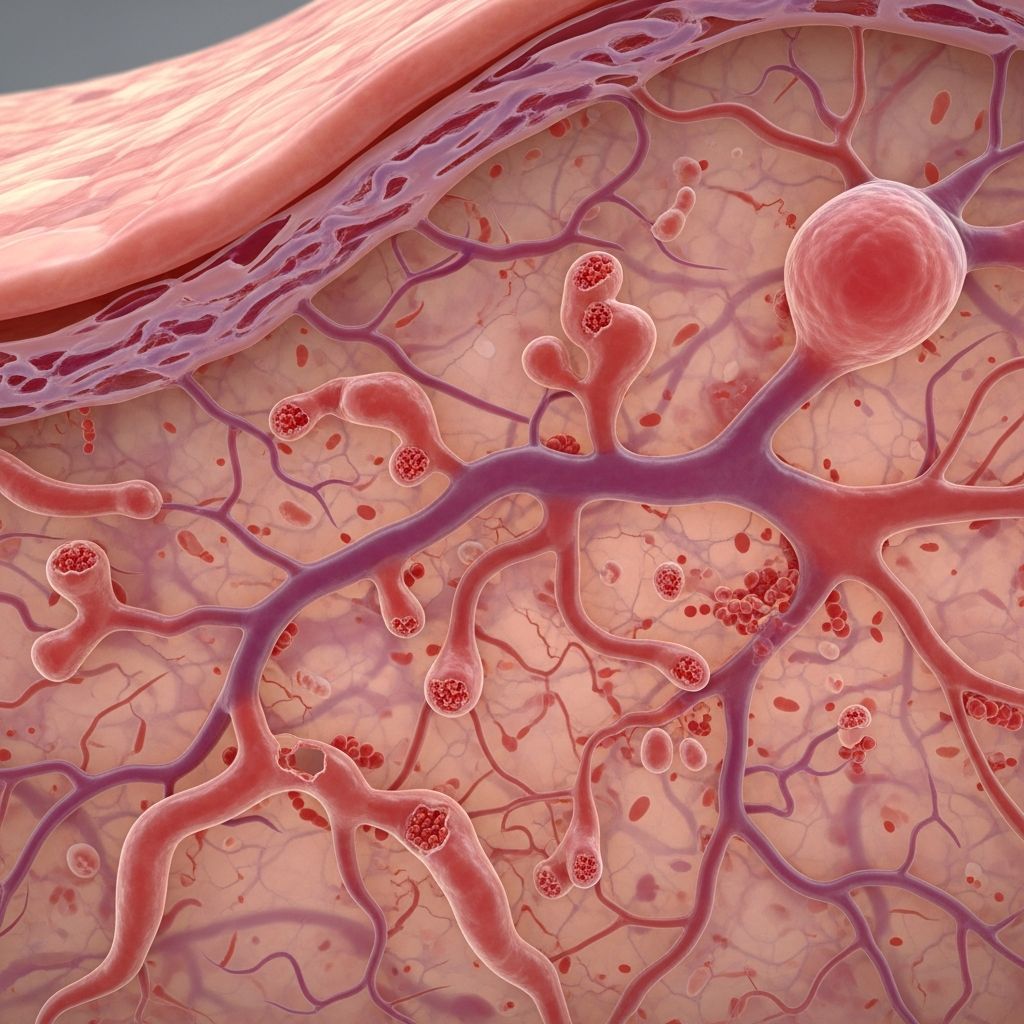
Hereditary haemorrhagic telangiectasia (HHT), also known as Osler-Weber-Rendu syndrome, is a genetic disorder characterized by the presence of multiple telangiectases and arteriovenous malformations (AVMs). These vascular abnormalities lead to recurrent bleeding, particularly epistaxis, and potential life-threatening complications from shunting in visceral organs. HHT affects approximately 1 in 5000–10,000 individuals worldwide, with symptoms often manifesting from childhood.
What is hereditary haemorrhagic telangiectasia?
HHT is an autosomal dominant inherited condition resulting from mutations in genes regulating vascular development, primarily ENG (HHT1), ACVRL1 (HHT2), and rarely SMAD4 (HHT with juvenile polyposis). These mutations disrupt transforming growth factor-beta (TGF-β) signaling, leading to fragile, dilated capillaries (telangiectases) and direct artery-to-vein connections (AVMs) bypassing capillary beds. Telangiectases appear as blanchable red puncta 1–5 mm in size, while AVMs are larger, high-flow lesions.
The hallmark is recurrent spontaneous nosebleeds (epistaxis) in 90% of cases, starting around age 12, alongside mucocutaneous telangiectases on lips, tongue, fingers, and nasal mucosa. Visceral involvement includes pulmonary (50%), hepatic (70%), cerebral (10–20%), and gastrointestinal AVMs, which may remain asymptomatic until complications arise.
Who gets hereditary haemorrhagic telangiectasia (epidemiology)?
HHT exhibits near-complete penetrance by age 60 but variable expressivity, affecting all ethnic groups equally. Prevalence is estimated at 1:5000–1:10,000, though underdiagnosis is common due to mild cases. HHT1 (ENG mutations) predominates in 60% of families, associating with severe pulmonary AVMs; HHT2 (ACVRL1, 40%) links to hepatic AVMs and pulmonary hypertension. Females may experience more severe epistaxis, while familial clustering prompts screening.
What causes hereditary haemorrhagic telangiectasia?
HHT arises from heterozygous pathogenic variants in TGF-β/BMP pathway genes:
- HHT1 (ENG, 9q34): Encodes endoglin on endothelial cells; defects impair vascular maturation.
- HHT2 (ACVRL1/ALK1, 12q13): Receptor for activin-like kinase 1; mutations heighten liver AVM risk.
- HHT3–6: Loci on chromosomes 5, 7, 12, not fully identified.
- JP-HHT (SMAD4, 18q21): 1–3% cases, with intestinal polyposis.
Autosomal dominant inheritance means 50% risk to offspring; de novo mutations are rare (~1–2%).
What are the clinical features of hereditary haemorrhagic telangiectasia?
Mucocutaneous telangiectases
Appear in 80–90% by age 40 as punctate red lesions on lips (90%), oral cavity (75%), fingers/nails (75%), nose (60%), and trunk. They blanch under pressure and rupture easily, causing bleeding.
Epistaxis
The most frequent symptom (90%), often daily from childhood/adolescence, worsening with age and causing iron-deficiency anaemia in 50%. Severity correlates with telangiectasia density.
Gastrointestinal telangiectases and bleeding
Affect 25–40%, typically post-50 years, in stomach/small bowel; present as chronic occult bleeding or acute haemorrhage leading to anaemia.
Visceral arteriovenous malformations
- Pulmonary AVMs (PAVMs): 15–50%, often multiple; risk paradoxical emboli causing stroke, brain abscess, migraine (30–50%).
- Hepatic AVMs (HAVMs): 40–75%, usually asymptomatic; complications include high-output heart failure (10%), portal hypertension, biliary ischaemia.
- Cerebral AVMs: 10–20%, risking haemorrhage, seizures.
- Spinal AVMs: Rare (<1%), causing myelopathy.
Anaemia
From chronic blood loss; iron deficiency affects ~50%, manifesting as fatigue, dyspnoea.
Other features
Related Stories



Pulmonary hypertension (HHT2), polycythaemia (hypoxaemia), jaundice (HAVMs). SMAD4 cases add juvenile polyposis.
Curacao criteria for diagnosis
Clinical diagnosis uses >3 criteria (sensitivity 89% at age >35):
- Epistaxis: spontaneous, recurrent (>2x/year).
- Telangiectases: multiple at lips, oral cavity, fingers, nose.
- Visceral lesions: GI telangiectasia, AVMs (PAVM, HAVM, CNS).
- Family history: first-degree relative with HHT per Curacao.
| Criteria Met | Diagnosis |
|---|---|
| 3 or more | Definite HHT |
| 2 | Possible HHT |
| <2 | Unlikely |
How is hereditary haemorrhagic telangiectasia diagnosed?
Diagnosis combines clinical Curacao criteria, imaging, and genetic testing (70–90% yield). Screening from age 0–5 years in at-risk families.
Screening protocols
- PAVM: Contrast echocardiography/chest CT ages 3–21, then 5-yearly if negative.
- HAVM: Liver ultrasound/MRI if symptoms (dyspnoea, ascites).
- Cerebral AVM: MRI ages 30+ or symptomatic.
- GI: Capsule endoscopy >50 years or iron deficiency.
Genetic confirmation identifies variants for family cascade screening.
What is the differential diagnosis for hereditary haemorrhagic telangiectasia?
- CREST syndrome (limited scleroderma): Raynaud, calcinosis, telangiectases.
- Ataxia-telangiectasia: Neurological decline, immunodeficiency.
- Sturge-Weber: Facial port-wine stain, seizures.
- Epistaxis from trauma, coagulopathy, hereditary haemorrhagic diathesis.
- Blue rubber bleb naevus: GI venous malformations.
What is the treatment for hereditary haemorrhagic telangiectasia?
Epistaxis management
- Conservative: Humidification, saline sprays, avoid NSAIDs/aspirin.
- Topical: Silver nitrate cauterization, electrocoagulation.
- Procedural: Laser ablation (Nd:YAG, KTP), septodermoplasty, embolization.
- Systemic: Tranexamic acid, IV iron, bevacizumab (anti-VEGF).
Anaemia
Iron supplementation (oral/IV), blood transfusions, erythropoietin if severe.
AVM treatment
- PAVM: Embolization if >3mm or symptomatic.
- HAVM: Embolization/transplantation for failure.
- Cerebral: Embolization/stereotactic radiosurgery.
GI bleeding
Endoscopic therapy, octreotide, thalidomide/bevacizumab.
Prophylaxis
Antibiotics for PAVM-related dental procedures; avoid diving/hypobaric exposure.
Complications of hereditary haemorrhagic telangiectasia
High-output cardiac failure (HAVM), stroke/abscess (PAVM), hepatic encephalopathy, massive haemorrhage.
Prognosis for hereditary haemorrhagic telangiectasia
Life expectancy normal with screening/treatment; mortality from PAVM complications (20–30% untreated). Multidisciplinary HHT centres improve outcomes.
Guidelines on hereditary haemorrhagic telangiectasia
- International HHT Guidelines (2019): Screening algorithms.
- Cure HHT recommendations.
Frequently Asked Questions (FAQs)
Q: Is HHT curable?
A: No cure exists; management focuses on symptoms and complications via multidisciplinary care.
Q: When to screen children for HHT?
A: Annual clinical review from birth; imaging per protocols from age 3.
Q: Does HHT affect pregnancy?
A: Increased PAVM/HAVM risks; preconception counselling essential.
Q: Can HHT be prevented?
A: Genetic counselling; preimplantation diagnosis possible.
References
- Hereditary hemorrhagic telangiectasia — Orphanet. 2023. https://www.orpha.net/en/disease/detail/774
- Hereditary Hemorrhagic Telangiectasia — NORD (rarediseases.org). 2024-01-15. https://rarediseases.org/rare-diseases/hereditary-hemorrhagic-telangiectasia/
- Hereditary Hemorrhagic Telangiectasia (HHT) — Yale Medicine. 2025. https://www.yalemedicine.org/conditions/hht
- Hereditary haemorrhagic telangiectasia (HHT) — NHS UK. 2024-05-20. https://www.nhs.uk/conditions/hereditary-haemorrahagic-telangiectasia/
- Signs and Symptoms — Cure HHT. 2025. https://curehht.org/understanding-hht/what-is-hht/signs-and-symptoms/
- Hereditary Hemorrhagic Telangiectasia (HHT) — Cleveland Clinic. 2024-08-10. https://my.clevelandclinic.org/health/diseases/15618-hereditary-hemorrhagic-telangiectasia-hht
- Hereditary Hemorrhagic Telangiectasia Symptoms — Stanford Health Care. 2023. https://stanfordhealthcare.org/medical-conditions/brain-and-nerves/hereditary-hemorrhagic-telangiectasia/symptoms.html
Similar Articles








Read full bio of Sneha Tete