High-Intensity Focused Ultrasound (HIFU): Purpose & Procedure
Understanding HIFU: A minimally invasive ultrasound treatment for tumors, fibroids, and tremor.
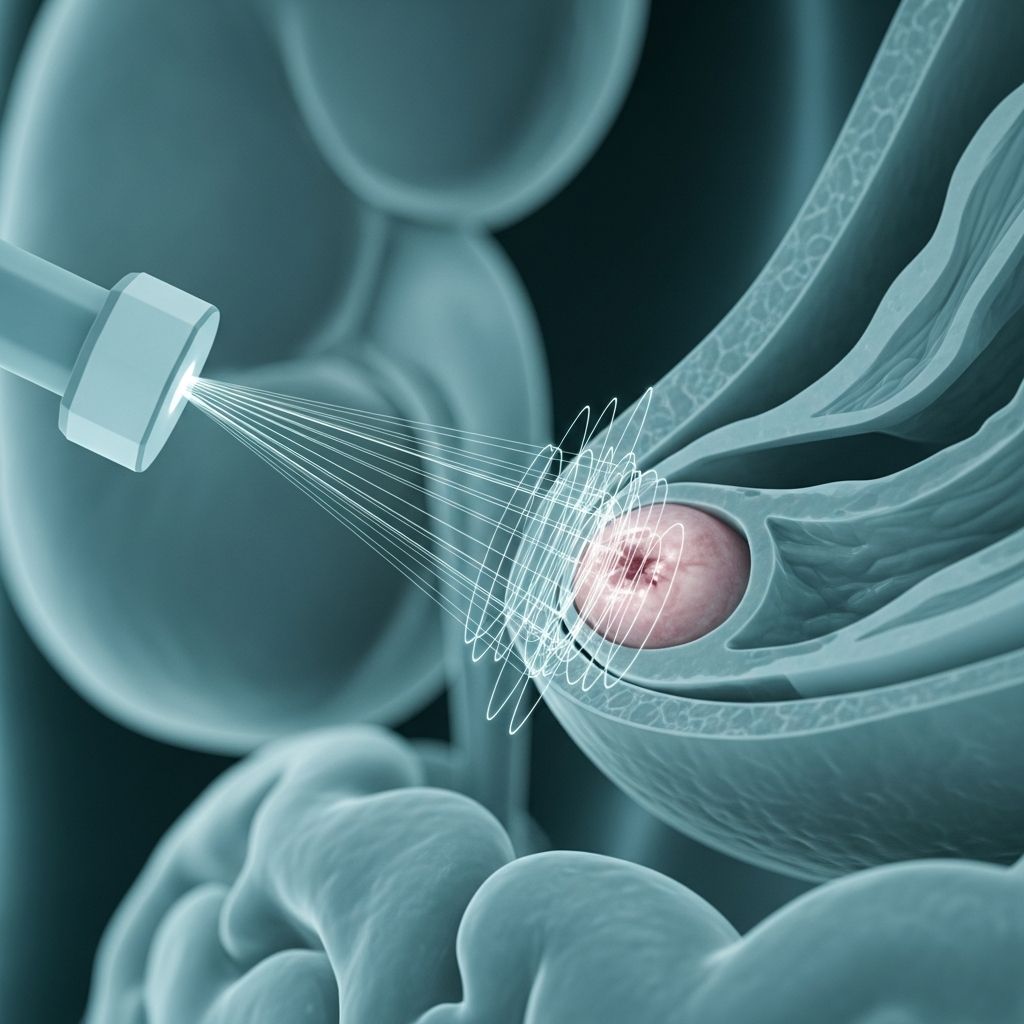
High-Intensity Focused Ultrasound (HIFU) is a minimally invasive medical procedure that uses ultrasound waves to treat certain conditions, such as tumors, uterine fibroids, and tremor. The very high-intensity and highly focused sound waves interact with targeted tissues in your body to modify or destroy them. This innovative treatment option offers patients an alternative to traditional surgery, with benefits including reduced recovery time, minimal scarring, and lower procedural risks.
How HIFU Works
The fundamental principle behind HIFU is similar to how a magnifying glass focuses sunlight on a target. In HIFU, many beams of ultrasound focus on the exact tissue area that requires treatment. The highly focused energy from the ultrasound causes the temperature of the tissue to rise, and the heat destroys (ablates) the targeted tissue area. The ultrasound beams can pass through layers of tissue (such as your skin), leaving them unharmed, until they reach their target. This precision allows for accurate treatment while preserving surrounding healthy tissue.
The tissue can reach temperatures of 150-200°F in just 20 seconds, creating immediate cell destruction through heat coagulation. The process is repeated as many times as necessary until the target tissue is completely destroyed. Real-time imaging through Magnetic Resonance Imaging (MRI) or ultrasound allows physicians to plan the treatment and monitor the degree of heating during the procedure.
Clinical Applications of HIFU
HIFU has received FDA approval for several medical conditions, making it a versatile treatment option across multiple specialties. The following represent key clinical applications:
Prostate Cancer Treatment
One of the most established uses of HIFU is in treating prostate cancer. The procedure uses high-frequency ultrasound energy to heat and destroy cancer cells in the prostate. A beam of ultrasound energy travels into the prostate from a probe placed into the rectum. Physicians can perform either focal HIFU, which treats areas of cancer in the prostate and a small area around them, or whole-prostate HIFU, which treats the entire prostate gland. The surgeon moves the beam around systematically, heating and destroying cancer cells one small area at a time, with each treated area being approximately the size of a grain of rice.
Uterine Fibroids
HIFU has emerged as an effective non-surgical alternative for women with uterine fibroids. The procedure allows for precise ablation of fibroid tissue while preserving the uterus, making it particularly valuable for women who wish to maintain fertility or avoid hysterectomy. The focused ultrasound energy penetrates the abdominal wall and precisely targets fibroid tissue, destroying it through thermal ablation.
Bone and Soft Tissue Conditions
HIFU is FDA-approved for treating various bone and soft tissue conditions, including osteoid osteomas, bone metastases, desmoid tumors, and undifferentiated pleomorphic sarcomas. These applications demonstrate the versatility of focused ultrasound technology in oncology and musculoskeletal medicine. Patients with these conditions benefit from the precision of HIFU, which creates a sharp boundary between necrotic treated tissue and viable untreated tissue measuring less than 1 millimeter.
Related Stories



Essential Tremor and Movement Disorders
HIFU has shown remarkable promise in treating essential tremor and other movement disorders. Magnetic resonance-guided focused ultrasound represents a novel non-invasive method that may serve as an alternative to open neurosurgical procedures for treating brain disorders. Patients with essential tremor often experience immediate or near-immediate improvement in tremor symptoms following a single treatment session. This application has transformed the quality of life for many patients, offering relief without the risks associated with traditional brain surgery.
The HIFU Procedure: What to Expect
Pre-Procedure Preparation
Before undergoing HIFU treatment, patients undergo thorough preparation to ensure optimal procedural outcomes. For neurological procedures, the entire head is typically shaved to avoid any interference with the sound waves used during treatment. A silicone cap is placed on the head, along with a frame to ensure your head remains still during the procedure. Imaging studies are obtained to confirm the target is still accessible and appropriate for treatment.
During the Procedure
The HIFU procedure is performed with patients remaining awake to provide feedback about tremor improvement, possible side effects, and muscle tone or strength changes. The procedure itself is painless, though some patients may experience minor discomfort at the sites where the stabilizing frame is attached to the head. Local anesthesia is administered to address any discomfort at attachment sites.
Separate pulses of focused ultrasound energy, known as “sonications,” are applied through the skin using a transducer integrated into the MRI scanner table. Each sonication lasts approximately 20 seconds. At the end of the procedure, an injection of MRI contrast dye (gadolinium) is administered to confirm that the target tissue has been successfully destroyed and to assess the non-perfused treatment volume.
Post-Procedure Recovery
One of the most significant advantages of HIFU is the rapid recovery. Patients are typically able to return home within 1-2 hours of their procedure. Many experience rapid and substantial pain relief within just a few days and are often able to reduce or completely stop analgesic use shortly thereafter. This rapid recovery contrasts sharply with traditional surgical approaches, which typically require longer hospital stays and extended recovery periods.
Key Advantages of HIFU Treatment
HIFU offers numerous advantages compared to traditional surgical and radiological interventions:
Non-Invasive Nature
HIFU produces in-depth precise tissue necrosis using an external applicator, with no need to insert an instrument into the target tissue or blood vessels. The procedure is completely incisionless and non-invasive, carrying negligible risks of inducing hemorrhage or infection compared to traditional surgical approaches. The absence of incisions means no surgical scars and a significantly lower infection risk.
Precision and Repeatability
The focused ultrasound treatment is extremely precise, with the boundary zone between necrotic treated and viable untreated tissue measuring less than 1 millimeter. Unlike radiation therapy, the passage of ultrasound energy through intervening tissue has no cumulative effect on that tissue or tissue beyond the focus. This means HIFU is easily repeatable, unlike radiotherapy where tissue toxicity makes repeated treatment problematic. There is no dose limit associated with HIFU, allowing for multiple treatments when clinically necessary.
Single Session Treatment
HIFU typically requires just a single session of treatment, unlike the multiple sessions required for traditionally fractionated radiotherapy. This single-session approach not only reduces total treatment time but also minimizes disruption to the patient’s daily life and reduces overall healthcare costs.
No Radiation Exposure
Because HIFU is guided by MRI or diagnostic ultrasound rather than ionizing radiation, patients receive no exposure to harmful radiation. This is particularly important for younger patients or those who may be at increased risk from radiation exposure.
Effectiveness in Challenging Anatomical Situations
HIFU can be used even in the presence of large adjacent blood vessels, which can act as heat-sinks and limit tumor killing by other modalities such as radiofrequency ablation. This is because HIFU employs near-instantaneous delivery of focused energy and does not depend on heat conduction to treat the tumor, making it effective in anatomically complex cases.
Efficacy and Clinical Outcomes
Clinical studies have demonstrated excellent outcomes with HIFU treatment across various indications. Research has shown disease-free survival rates of 95%, recurrence-free survival rates of 89%, and 90% reduction in tumor size in treated patients with appropriate follow-up periods. For esophageal tumors, complete tumor necrosis has been observed in some cases, with objective tumor response and significant improvement in swallowing difficulties within 15 days of treatment. These results demonstrate the clinical efficacy of HIFU as a treatment modality.
Advantages Over Traditional Approaches
| Factor | HIFU | Traditional Surgery | Radiation Therapy |
|---|---|---|---|
| Invasiveness | Non-invasive | Highly invasive | Non-invasive |
| Recovery Time | 1-2 hours to home | Days to weeks | Weeks to months |
| Scarring | None | Significant | None |
| Infection Risk | Negligible | Moderate | Minimal |
| Radiation Exposure | None | None | Yes |
| Repeatability | Easily repeatable | Limited | Limited due to tissue toxicity |
| Sessions Required | Usually one | One | Multiple (fractionated) |
| Precision | Excellent (<1mm boundary) | Good | Good |
Frequently Asked Questions About HIFU
Q: Is HIFU painful?
A: No, HIFU is not painful. The procedure is completely painless, though patients may experience minor discomfort at attachment sites for stabilization frames. Local anesthesia is provided to address any discomfort.
Q: How long does a HIFU procedure take?
A: The duration varies depending on the condition being treated and the treatment area size. Each ultrasound pulse (sonication) lasts approximately 20 seconds, and multiple sonications are applied as needed. Most procedures are completed within a few hours.
Q: What conditions can HIFU treat?
A: HIFU is FDA-approved for treating prostate cancer, uterine fibroids, osteoid osteomas, bone metastases, desmoid tumors, undifferentiated pleomorphic sarcomas, and essential tremor. Research is ongoing for additional applications.
Q: What is the recovery time after HIFU?
A: Most patients return home within 1-2 hours of their procedure. Many experience rapid pain relief within days and can often reduce or stop pain medications shortly after treatment.
Q: Can HIFU be repeated if needed?
A: Yes, HIFU is easily repeatable with no dose limits. Unlike radiation therapy, repeated HIFU treatments do not cause cumulative tissue damage, making it an excellent option for patients requiring multiple interventions.
Q: Does HIFU use radiation?
A: No, HIFU does not use ionizing radiation. Instead, it is guided by MRI or ultrasound imaging, eliminating radiation exposure entirely.
Q: How precise is HIFU treatment?
A: HIFU is extremely precise, with the boundary between treated and untreated tissue measuring less than 1 millimeter. This allows for targeted destruction of disease tissue while preserving surrounding healthy structures.
Conclusion
High-Intensity Focused Ultrasound represents a significant advancement in minimally invasive medical treatment, offering patients an effective alternative to traditional surgery and radiation therapy. With its non-invasive nature, rapid recovery, excellent precision, and ability to treat multiple conditions, HIFU continues to expand its clinical applications and improve patient outcomes. As technology advances and clinical experience grows, HIFU is poised to become an increasingly important treatment option across various medical specialties.
References
- High-Intensity Focused Ultrasound (HIFU): Purpose & Procedure — Cleveland Clinic. 2025. https://my.clevelandclinic.org/health/treatments/16541-hifu-high-intensity-focused-ultrasound
- An Introduction to High Intensity Focused Ultrasound — National Institutes of Health, National Center for Biotechnology Information. 2020. https://pmc.ncbi.nlm.nih.gov/articles/PMC7073974/
- High-Intensity Focused Ultrasound (HIFU) — UCSF Radiology. 2025. https://radiology.ucsf.edu/patient-care/services/high-intensity-focused-ultrasound-hifu
- High Intensity Focused Ultrasound (HIFU) — University of Michigan Health. 2025. https://www.uofmhealth.org/our-care/specialties-services/high-intensity-focused-ultrasound-hifu
- High intensity focused ultrasound (HIFU) — Prostate Cancer UK. 2025. https://prostatecanceruk.org/prostate-information-and-support/treatments/hifu
- High-Intensity Focused Ultrasound (HIFU) — MD Anderson Cancer Center. 2025. https://www.mdanderson.org/treatment-options/high-intensity-focused-ultrasound.html
- High Intensity Focused Ultrasound (HIFU) – Greenwich Hospital — Greenwich Hospital. 2025. https://www.greenwichhospital.org/services/neurology-neurosurgery/high-intensity-focused-ultrasound
Similar Articles








Read full bio of Sneha Tete