Histiocytic Necrotizing Lymphadenitis: 3 Phases And Diagnosis
Comprehensive guide to Kikuchi-Fujimoto disease: symptoms, diagnosis, pathology, and management of this rare self-limiting lymphadenitis.
*This article was last updated in 2025.*
What is histiocytic necrotising lymphadenitis?
Histiocytic necrotising lymphadenitis (HNL), also known as Kikuchi-Fujimoto disease, is a rare, benign, self-limiting disorder primarily affecting lymph nodes. It is characterized by histiocytic necrosis without neutrophil infiltration, typically presenting with cervical lymphadenopathy and systemic symptoms such as fever. First described in 1972 by Kikuchi in Japan and independently by Fujimoto et al., HNL predominantly affects young adults, especially women, with an incidence skewed towards Asian populations, though cases occur worldwide.
The condition is self-resolving in most cases within 1–4 months, but it can mimic serious diseases like lymphoma or tuberculosis, necessitating accurate diagnosis via lymph node biopsy. Cutaneous involvement occurs in up to 40% of cases, featuring nonspecific eruptions that aid in clinical suspicion.
Who gets histiocytic necrotising lymphadenitis?
HNL most commonly affects individuals aged 20–40 years, with a marked female predominance (female-to-male ratio of 4:1). While initially reported in Japanese patients, subsequent cases confirm its occurrence across ethnicities, including Caucasians, Africans, and Hispanics. Familial clustering is rare but documented, suggesting possible genetic predisposition in select cases.
- Peak incidence: Young adults (20–30 years)
- Gender: 75–80% female
- Ethnicity: Higher in Asians, but global distribution
- Risk factors: Associations with HLA-DRB1 alleles; possible viral triggers (EBV, HHV-6, parvovirus B19)
What causes histiocytic necrotising lymphadenitis?
The aetiology remains idiopathic, but an exaggerated immune response to infectious agents is widely hypothesized. Numerous pathogens have been implicated, though no single causative agent is confirmed. Proposed mechanisms include:
- Infectious triggers: Epstein-Barr virus (EBV), human herpesvirus 6 (HHV-6), parvovirus B19, cytomegalovirus (CMV), HIV, and Yersinia enterocolitica.
- Immune dysregulation: Hyperactivation of CD8+ T-cells and histiocytes leading to apoptotic necrosis of lymphoid cells.
- Genetic factors: Associations with specific HLA types (e.g., DRB1*0701, DRB1*1101).
No definitive viral or bacterial isolate consistently reproduces the pathology, supporting a post-infectious hypersensitivity reaction model.
What are the clinical features of histiocytic necrotising lymphadenitis?
The hallmark presentation is painful or tender cervical lymphadenopathy, often unilateral, involving posterior triangle nodes. Systemic symptoms accompany in 30–50% of cases.
| Symptom/Sign | Frequency | Description |
|---|---|---|
| Cervical lymphadenopathy | 80–100% | Tender, enlarged nodes (1–4 cm), posterior cervical chain |
| Fever | 25–50% | Low-grade to high, lasting 1–3 weeks |
| Night sweats/weight loss | 10–30% | Mild B symptoms |
| Skin rash | 10–40% | Maculopapular, morbilliform, urticarial; face, trunk, extremities |
| Leucopenia | 25–50% | Atypical lymphocytosis |
Rare extranodal involvement includes liver (hepatosplenomegaly), lungs, bone marrow, and skin. Recurrence occurs in 3–4% of cases.
How is histiocytic necrotising lymphadenitis diagnosed?
Diagnosis requires excisional lymph node biopsy, as fine-needle aspiration is often nondiagnostic. Clinical suspicion arises from young female with cervical adenopathy and fever, excluding infection and malignancy.
- Laboratory: Leukopenia (50%), elevated ESR/CRP, negative ANA/ANCA.
- Imaging: Ultrasound/CT shows necrotic nodes.
- Definitive: Histopathology (see below).
What are the histopathological features of histiocytic necrotising lymphadenitis?
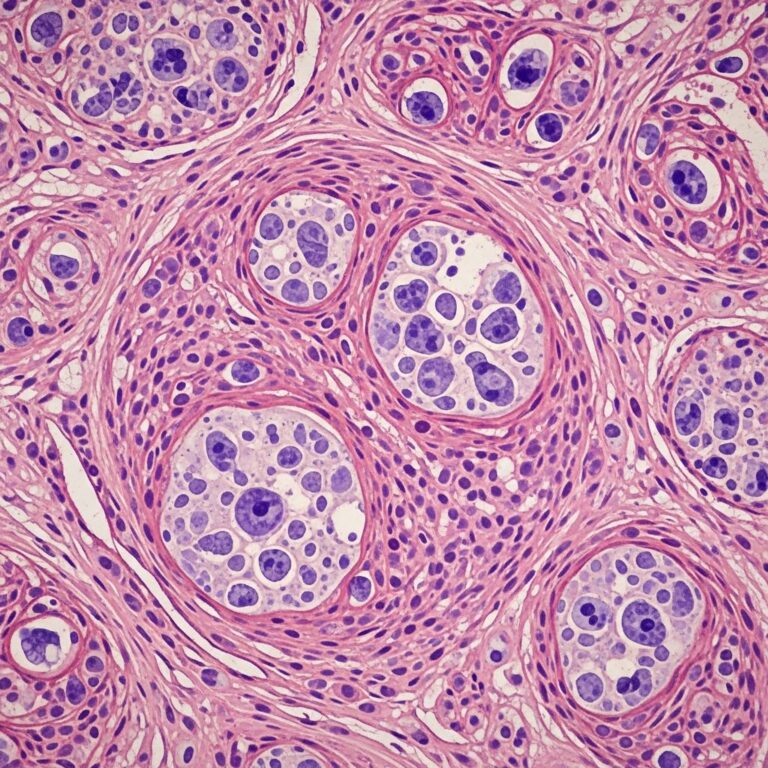
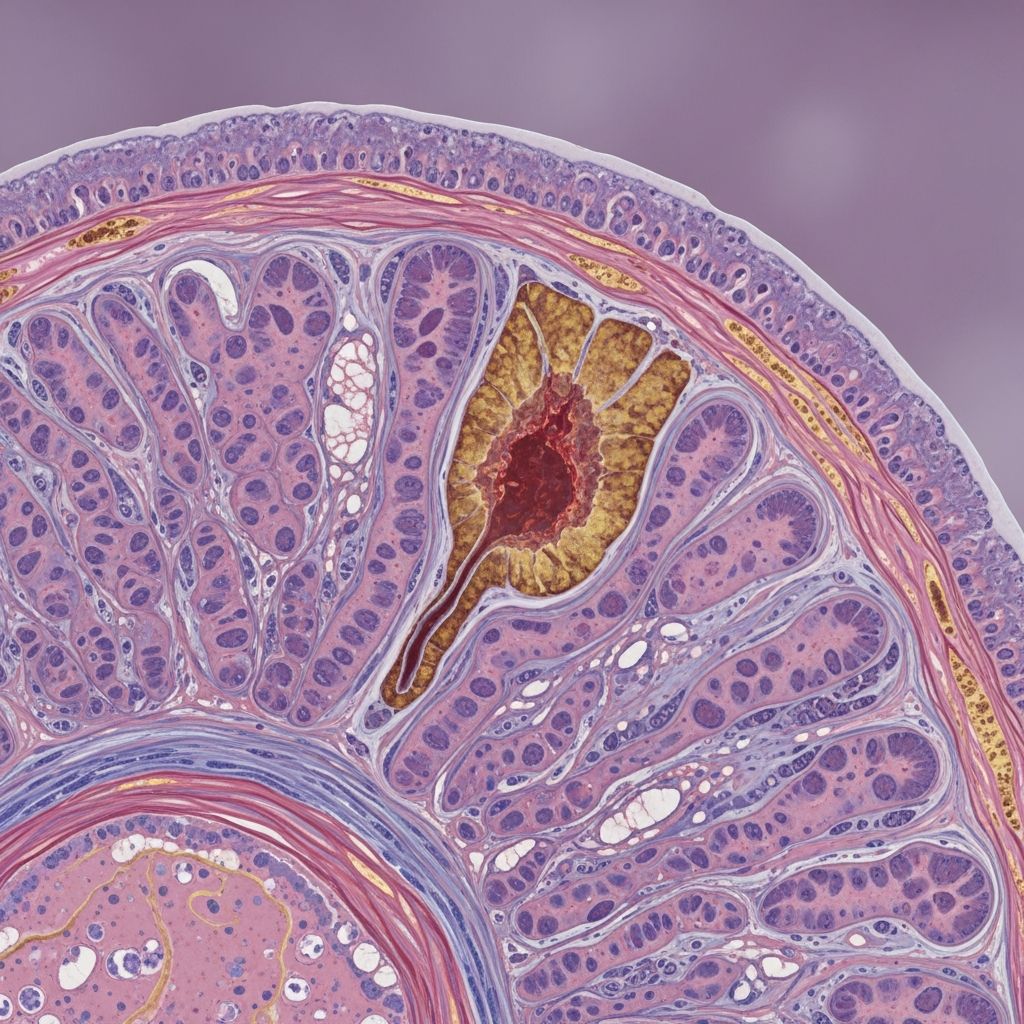
Classic triad: patchy paracortical necrosis, karyorrhectic debris, and histiocytic infiltrate lacking neutrophils/plasmacytes. Three histologic phases: proliferative, necrotizing, xanthomatous.
- Proliferative phase: CD68+ histiocytes, CD8+ T-cells, plasmacytoid dendritic cells.
- Necrotizing phase: Eosinophilic fibrinoid necrosis with nuclear dust (karyorrhexis).
- Xanthomatous phase: Foamy histiocytes, resolves spontaneously.
Immunohistochemistry: MPO-negative histiocytes distinguish from granulomatous diseases. Electron microscopy shows tubular inclusions in histiocytes (nonspecific).
Related Stories




What is the differential diagnosis for histiocytic necrotising lymphadenitis?
| Condition | Key Distinguishing Features |
|---|---|
| Systemic lupus erythematosus (SLE) | Neutrophils, plasma cells, positive ANA; hematoxylin bodies |
| Tuberculous lymphadenitis | Caseating granulomas, AFB positive, neutrophils |
| Non-Hodgkin lymphoma (T-cell) | Monoclonal proliferation, atypical cells |
| Infectious mononucleosis | EBV serology, paracortical expansion with immunoblasts |
| Anaplastic large cell lymphoma | CD30+, ALK expression |
What is the treatment for histiocytic necrotising lymphadenitis?
Supportive care suffices as the disease is self-limiting. Symptomatic relief includes NSAIDs for pain/fever. Severe cases (e.g., airway obstruction, recurrence) may require corticosteroids (prednisone 1 mg/kg). No role for antivirals or antibiotics unless secondary infection.
- First-line: Observation, analgesics.
- Steroids: For severe symptoms (20–40% response rate).
- Other: Hydroxychloroquine, IVIG in refractory cases (anecdotal).
Prognosis excellent; mortality <1%, usually from misdiagnosis as malignancy.
Complications of histiocytic necrotising lymphadenitis
Rare, including recurrent disease (3%), progression to SLE (5–10% in some series), and hemophagocytic syndrome. Skin lesions resolve without scarring.
Prevention of histiocytic necrotising lymphadenitis
No known preventive measures, as etiology is unclear. Early biopsy prevents unnecessary treatments.
Further reading and references
Frequently asked questions
Is histiocytic necrotising lymphadenitis contagious?
No, HNL is not contagious. It is a noninfectious inflammatory process despite possible viral triggers.
Can Kikuchi disease turn into cancer?
No causal link to malignancy; however, it mimics lymphoma, requiring biopsy to exclude.
How long does Kikuchi-Fujimoto disease last?
Typically 1–4 months; full resolution in 90% without sequelae.
Does HNL affect skin?
Yes, in 30–40%; eruptions are morbilliform or erythematous, correlating with systemic activity.
*Cutaneous histopathology mirrors nodal: interface dermatitis, perivascular lymphocytic infiltrate.*
References
- Kikuchi’s disease: case report and systematic review of cutaneous and histopathologic presentations — Atwater AR, Longley BJ, Aughenbaugh WD. J Am Acad Dermatol. 2008-07-01. https://pubmed.ncbi.nlm.nih.gov/18462833/
- Kikuchi disease (histiocytic necrotizing lymphadenitis) in association with systemic lupus erythematosus — Yasuda K, et al. Br J Dermatol. 1997-04-01. https://academic.oup.com/bjd/article/136/4/610/6682413
- Kikuchi Disease with Facial Rash and Erythema Multiforme — Parappil A, et al. Pediatr Dermatol. 2001-05-01. https://onlinelibrary.wiley.com/doi/abs/10.1046/j.1525-1470.2001.01965.x
- Kikuchi-Fujimoto Disease — Pillai V, et al. StatPearls [Internet]. 2023 (updated; authoritative despite maintenance note). https://www.ncbi.nlm.nih.gov/books/NBK430830/
Similar Articles








Read full bio of Sneha Tete