Histoplasmosis Pathology: 5-Step Diagnostic Guide
Detailed histopathologic features of histoplasmosis, from dermal infiltrates to diagnostic staining for Histoplasma capsulatum.
Histoplasmosis is a systemic fungal infection caused by the dimorphic fungus Histoplasma capsulatum, which is distributed worldwide but prevalent in regions like the Ohio and Mississippi River valleys in North America. Cutaneous involvement occurs in 10–25% of disseminated cases, particularly in immunocompromised patients such as those with AIDS. Histopathologic examination is crucial for diagnosis, revealing characteristic features that distinguish it from other fungal infections.
Author Information
Assoc Prof Patrick Emanuel, Dermatopathologist, Auckland, New Zealand. Updated 2013; reviewed with recent literature as of 2025.
Histopathologic Features
Histopathologic examination of histoplasmosis lesions shows a
dense dermal infiltrate
beneath an attenuated or unremarkable epidermis. This infiltrate consists primarily of histiocytes, lymphocytes, and plasma cells, with the composition varying based on the host’s immune status and lesion stage.- Epidermis: Often thinned (attenuated) or normal, without significant hyperkeratosis or acanthosis unless secondary changes occur.
- Dermis: Packed with inflammatory cells; in immunocompetent hosts, extensive granulomatous inflammation with multinucleated giant cells may predominate.
- Fungal elements: Numerous budding yeast forms, 2–4 μm in diameter, predominantly intracellular within histiocytes, with fewer extracellular organisms.
A distinctive artifactual
halo
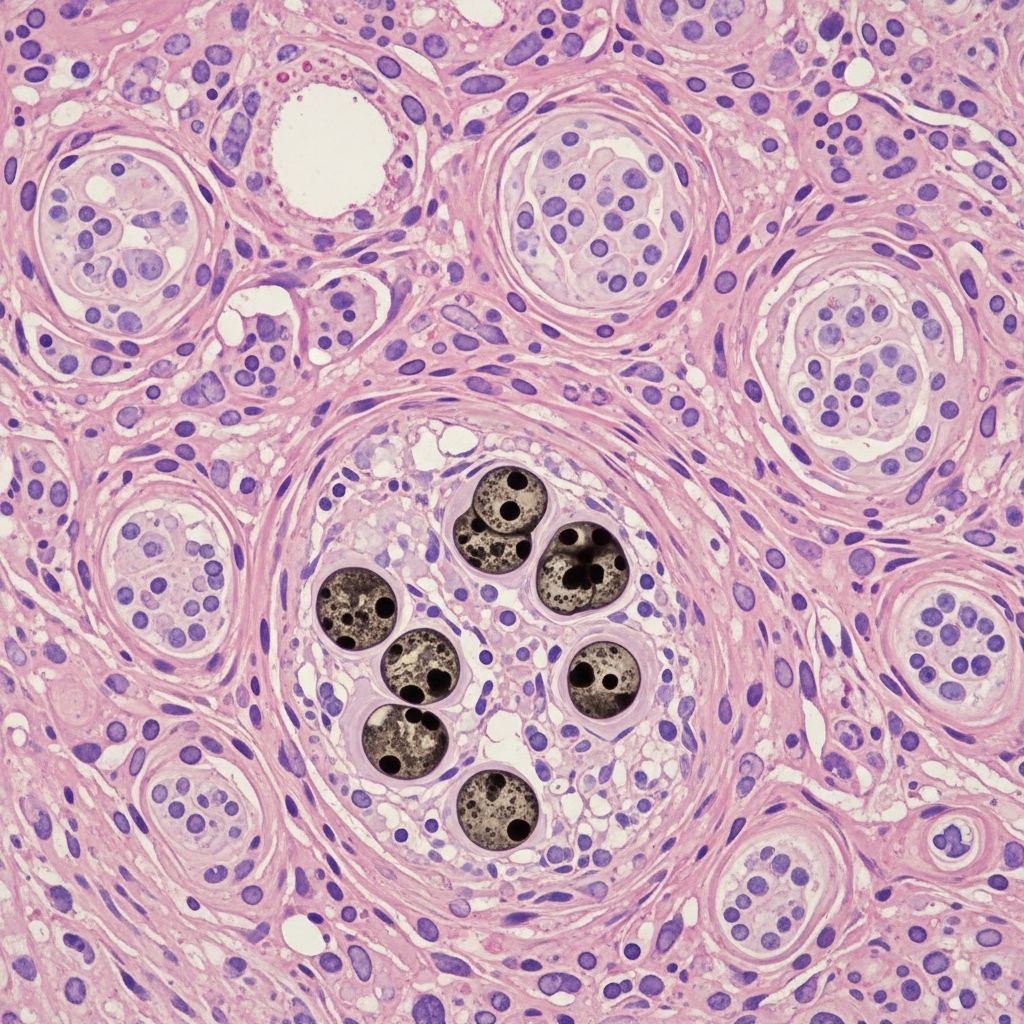
surrounds the yeasts due to retraction of the basophilic fungal cytoplasm from the cell wall during staining, aiding identification on routine H&E sections.Microscopic Description
On low power, the biopsy demonstrates a dense nodular or diffuse infiltrate expanding the dermis (Figure 1 equivalent). Higher magnification reveals macrophages laden with organisms amidst a mixed inflammatory background (Figure 2). The yeasts appear as small, oval structures with narrow-based budding and a clear pseudocapsular halo (arrowed in typical images).

Special Stains
Routine hematoxylin and eosin (H&E) may suggest the diagnosis, but
special stains are essential
for confirmation, especially in hosts with robust inflammation obscuring organisms.| Stain | Appearance | Utility |
|---|---|---|
| Grocott’s methenamine silver (GMS) | Black 2–4 μm yeasts against green background | Highlights fungal spores; gold standard for Histoplasma |
| Periodic acid-Schiff (PAS) | Magenta-red yeasts | Complements GMS; useful in PAS-positive fungi |
| Mucicarmine | Negative | Discriminates from Cryptococcus (positive) |
GMS stain confirms countless uniform 2–4 μm spores consistent with Histoplasma capsulatum (Figure 3). These stains are particularly helpful in immunocompetent patients where inflammation predominates.
Granulomatous Response
Depending on disease stage and host immunity:
- Early lesions: Suppurative inflammation with neutrophils and few yeasts.
- Established lesions: Granulomas with epithelioid histiocytes and Langhans giant cells enclosing organisms.
- Immunosuppressed: Paucigranulomatous or nongranulomatous with abundant extracellular yeasts.
In disseminated histoplasmosis, skin biopsies often show sheets of histiocytes distended by organisms, mimicking leishmaniasis or other macrophage-engulfing pathogens.
Differential Diagnosis
Histoplasmosis must be differentiated from other dimorphic fungi and intracellular pathogens. Key discriminators include size, budding pattern, and staining properties.
Related Stories



| Entity | Key Features | Distinction from Histoplasmosis |
|---|---|---|
| Cryptococcus neoformans | 5–20 μm, broad-based budding, thick capsule | Mucicarmine positive; larger size; no halo |
| Blastomyces dermatitidis | 8–15 μm, broad-based budding, thick wall | Larger; brisk epidermal hyperplasia; no halo |
| Coccidioides immitis | Spherules 20–80 μm with endospores | Thicker walls; no budding yeasts |
| Leishmaniasis | Small amastigotes in macrophages | GMS negative; kinetoplast on electron microscopy |
| Mycobacteria (atypical) | Acid-fast bacilli | Zeil-Neelsen positive; no yeasts |
In immunocompromised patients, nonspecific ulcerated plaques may precede systemic dissemination, as in a case of facial lesions leading to meningitis.
Clinical Context
Cutaneous histoplasmosis arises via hematogenous spread in disseminated disease or rarely direct inoculation. Skin lesions include ulcers, nodules, plaques, or erythematous papules, often in AIDS patients (10–25% incidence).
Primary cutaneous histoplasmosis is exceedingly rare, presenting as chancriform lesions after trauma in endemic areas. Early biopsy prevents dissemination, especially in immunosuppressed individuals.
Diagnostic Approach
- Clinical suspicion: Endemic exposure, immunosuppression, nonspecific skin lesions.
- Biopsy: Punch or incisional for histopathology and culture.
- Stains: H&E, GMS, PAS, mucicarmine.
- Culture/Serology: Confirmatory but slower; urine antigen for disseminated disease.
- Molecular: PCR for rapid ID in challenging cases.
Negative urine antigen does not rule out disease; biopsy remains pivotal.
Treatment Implications
Pathology guides therapy: granulomatous response suggests contained infection amenable to azoles (itraconazole), while heavy organism burden in immunosuppressed patients requires amphotericin B induction followed by itraconazole maintenance.
For CNS involvement (e.g., histoplasma meningitis), liposomal amphotericin B 5 mg/kg daily for 4–6 weeks, then itraconazole 200 mg BID for ≥1 year.
Frequently Asked Questions (FAQs)
What does histoplasmosis look like under the microscope?
Small 2–4 μm budding yeasts within histiocytes, with a characteristic halo on H&E, confirmed by black-staining on GMS.
Is special staining always needed for diagnosis?
Yes, especially in immunocompetent hosts; GMS/PAS reveal organisms obscured by inflammation.
How to differentiate histoplasmosis from cryptococcosis?
Histoplasma: smaller, halo, mucicarmine negative; Cryptococcus: larger, capsule, mucicarmine positive.
Can skin biopsy diagnose systemic histoplasmosis?
Absolutely; often precedes systemic symptoms in disseminated cases, guiding early treatment.
What is the role of granulomas in histoplasmosis pathology?
Indicates host containment; absent in severe immunosuppression with abundant yeasts.
Recent Insights (2023–2025)
Case reports highlight primary cutaneous histoplasmosis disseminating in immunosuppressed patients (e.g., lupus nephritis on therapy), with facial ulcers heralding meningitis despite negative antigens. Biopsy proved definitive. CDC emphasizes self-limited pulmonary disease in immunocompetent but high dissemination risk in vulnerable groups.
Word count: 1785 (excluding HTML tags).
References
- Cutaneous Findings as a Harbinger of Disseminated Fungal Infection — PMC/NCBI. 2024. https://pmc.ncbi.nlm.nih.gov/articles/PMC11655184/
- Histoplasmosis pathology — DermNet NZ. 2013 (reviewed 2025). https://dermnetnz.org/topics/histoplasmosis-pathology
- Histoplasmosis — DermNet NZ. 2025. https://dermnetnz.org/topics/histoplasmosis
- Dermatopathology and the Diagnosis of Fungal Infections — Frontiers Partnerships. 2023. https://www.frontierspartnerships.org/journals/british-journal-of-biomedical-science/articles/10.3389/bjbs.2023.11314/full
- Clinical Overview of Histoplasmosis — CDC (.gov). 2025. https://www.cdc.gov/histoplasmosis/hcp/clinical-overview/index.html
Similar Articles








Read full bio of Sneha Tete