Understanding Holmium Laser Stone Removal
Learn how advanced laser technology safely eliminates kidney stones with minimal recovery time.
Kidney stone disease affects millions of people worldwide, causing significant pain and complications when stones become lodged in the urinary tract. Modern medical science has developed several effective treatment approaches, with holmium laser lithotripsy emerging as one of the most successful and least invasive options available. This procedure represents a major advancement in urology, allowing physicians to address problematic kidney stones without traditional surgical incisions. For patients considering this treatment, understanding the mechanics, preparation, and recovery process is essential for making informed healthcare decisions.
The Evolution of Laser Technology in Stone Treatment
Laser-based stone treatment has transformed urology over the past three decades. Early laser systems proved unsuitable for kidney stone fragmentation because they operated in continuous mode, generating excessive heat that damaged surrounding tissue. The breakthrough came with pulsed laser technology, particularly holmium:YAG (Ho:YAG) lasers, which emit energy in controlled bursts rather than continuous beams. This pulsed approach creates a photothermal effect that vaporizes stone material while minimizing damage to healthy tissue and reducing the retropulsion effect—the tendency for stone fragments to move backward away from the laser.
Today’s most advanced systems operate at 100-120 watts of power and incorporate sophisticated pulse modulation. The latest innovation, the “Moses” technology, further enhances treatment precision by creating two distinct laser pulses: the first separates water between the laser fiber and stone surface, while the second delivers energy directly to the stone. This dual-pulse approach decreases operative time, reduces unwanted stone movement, and improves overall ablation efficiency, ultimately benefiting patients through shorter procedures and faster recovery.
How Holmium Laser Lithotripsy Accomplishes Stone Fragmentation
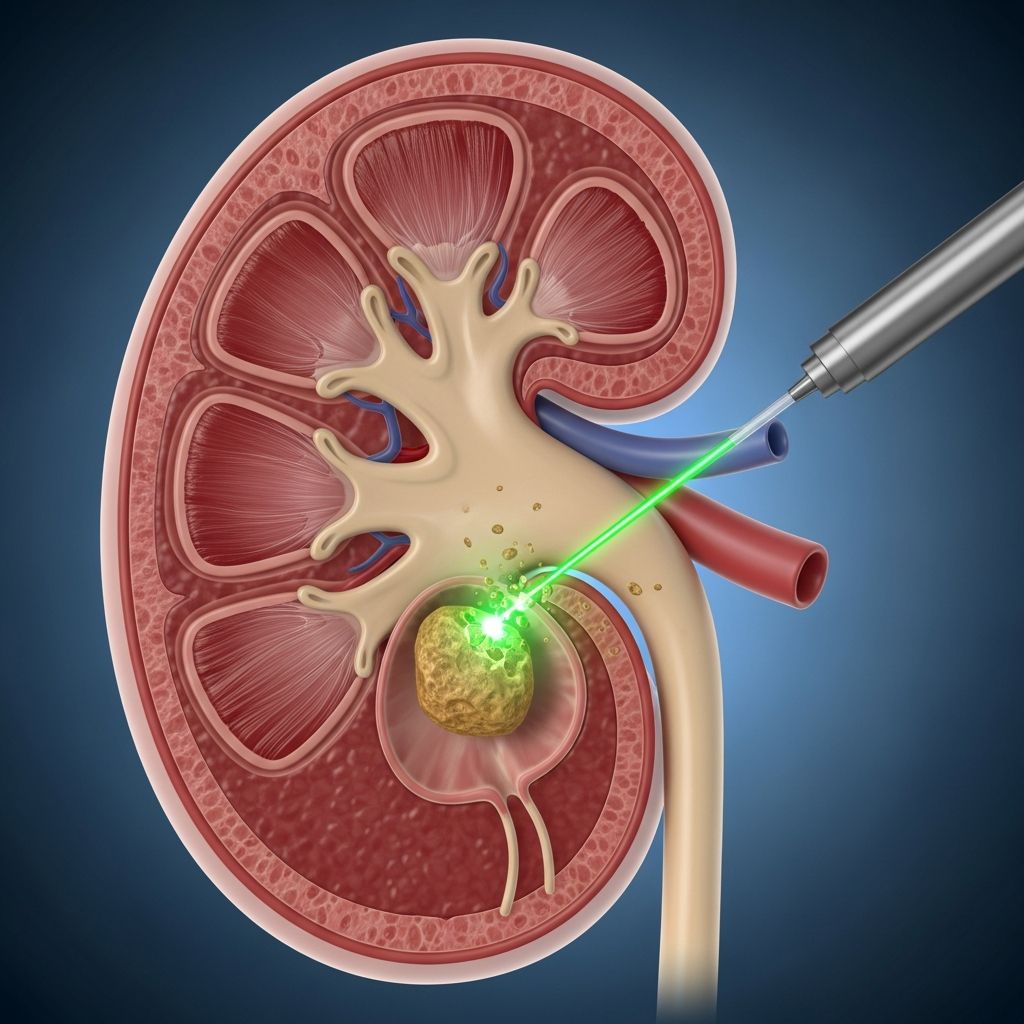
The holmium laser procedure operates through direct visualization and targeted energy delivery. The surgeon begins by inserting a small lighted instrument called a ureteroscope into the urethra, advancing it through the bladder to reach the ureter and kidney. This scope contains fiber optics that transmit high-definition images to a monitor, allowing the surgeon to locate and visualize the stone precisely.
Once the stone comes into view, a laser fiber transmits holmium energy to break it apart. Surgeons have multiple fragmentation strategies at their disposal:
- Fragment and Basket Retrieval: The surgeon breaks the stone into larger pieces and removes them through the urethra using a small basket device, with any remaining fragments passing naturally during urination
- Dusting Technique: Using higher frequency laser pulses (greater than 50 Hz) at lower energy levels, the surgeon reduces stones to fine powder particles that pass easily through the urinary system without basket extraction
- Moses Effect Technology: This advanced modulation technique optimizes stone fragmentation, potentially reducing the need for basket removal and decreasing stent placement requirements
The choice of fragmentation method depends on stone composition, size, location, and patient-specific factors. Modern dusting techniques combined with Moses technology have significantly improved outcomes by reducing operative time and minimizing post-procedure complications.
Stent Placement and Its Role in Recovery
Following stone fragmentation, the surgeon typically inserts a temporary plastic tube called a ureteral stent between the kidney and urethra. This small, internally-positioned tube serves multiple critical functions during the healing process. The stent maintains ureter patency, allowing urine to flow freely while swelling and inflammation from the stone and procedure resolve. Additionally, it facilitates easier passage of remaining stone fragments through the narrowed urinary tract.
Related Stories



Stent placement occurs while the patient remains under anesthesia, so no additional recovery time is needed. The stent remains in place for approximately one week, after which the surgeon removes it during a brief office procedure requiring minimal sedation. Patients should be aware that the stent is entirely internal and invisible from the outside, though some may experience mild discomfort or increased urinary frequency while it is in place.
Preparation: What You Need to Know Before Your Procedure
Proper preparation significantly influences procedure success and recovery outcomes. Your urologist will provide comprehensive pre-operative instructions tailored to your specific situation, including specific guidelines regarding medication management and dietary modifications. Most laser lithotripsy procedures occur on an outpatient basis, meaning you will return home the same day as your surgery.
Key preparation steps typically include:
- Discussing all current medications with your surgeon, as some may require temporary discontinuation
- Following fasting instructions before surgery, typically starting at midnight the evening before your procedure
- Arranging transportation, as general anesthesia renders you unable to drive or operate machinery for 24 hours after surgery
- Informing your surgical team about any allergies or adverse reactions to anesthesia
- Completing any necessary pre-operative blood work or imaging studies your surgeon requests
Because general anesthesia is standard for these procedures, it is essential to follow all fasting and medication guidelines precisely. Anesthesia ensures you remain still and comfortable during the surgery, which is critical for the surgeon’s precision in locating and treating the stone while minimizing operative time.
The Surgical Experience and Operative Timeline
On surgery day, you will receive general anesthesia before the procedure begins, allowing you to sleep throughout the entire treatment. This is particularly important because any patient movement could compromise the surgeon’s ability to target the stone accurately. Modern lasers are remarkably precise and powerful, enabling surgeons to control and fragment stones with exceptional accuracy.
The entire procedure typically requires less than one hour, though this duration varies based on stone size, number, and composition. The combination of advanced laser technology and refined surgical technique has enabled practitioners to complete these procedures more efficiently than ever before, reducing anesthesia exposure and allowing faster return to normal daily activities.
Once stone fragmentation is complete and all accessible fragments are removed, the surgeon places the ureteral stent while you remain under anesthesia. You will then be transferred to recovery, where nursing staff monitor you until the anesthesia wears off completely.
Post-Operative Recovery and Expectations
One of the most significant advantages of holmium laser lithotripsy is the minimal invasiveness and rapid recovery it offers. Because the procedure involves no external incisions, pain levels are substantially lower than with traditional surgical approaches. Most patients experience some mild discomfort or lower abdominal pressure, which typically responds well to over-the-counter pain medication.
During the first week following your procedure, expect the following:
- Some blood in your urine, which is normal as healing occurs
- Mild discomfort or pressure in the lower abdomen or back
- Increased urinary frequency or urgency while the stent is in place
- Possible temporary urinary retention or difficulty urinating, though this is uncommon
- Gradual return to light activities as tolerated
Your surgeon will provide specific instructions about activity restrictions, which typically allow return to light daily activities within days, with full unrestricted activity resuming within one to two weeks. The presence of the stent may cause mild symptoms such as increased urinary urgency or minor discomfort, which resolve once the stent is removed.
Comparison with Alternative Stone Treatment Approaches
While holmium laser lithotripsy is highly effective, other treatment options exist for kidney stones, each with distinct advantages and limitations. Extracorporeal shock wave lithotripsy (ESWL) uses focused sound waves to fragment stones without any instrumentation, making it completely non-invasive. However, ESWL is generally less successful than laser treatment and often requires multiple procedures to achieve complete stone clearance.
For very large stone burdens, percutaneous nephrolithotomy (PNL) may be preferred, as it allows direct kidney access through a small back incision, enabling the surgeon to visualize and remove large stone fragments directly. This approach is more invasive than ureteroscopy with laser lithotripsy but may be necessary for certain complex cases.
Laser lithotripsy represents an excellent balance, offering superior stone-free rates compared to ESWL while maintaining less invasiveness than PNL. The direct visualization provided by the ureteroscope allows the surgeon to ensure complete stone removal with minimal risk of missed fragments.
Advantages of Choosing Holmium Laser Treatment
Holmium laser lithotripsy offers numerous benefits that have made it the preferred treatment for many urologists and their patients:
- Minimally Invasive: No external incisions are required, reducing infection risk and post-operative pain
- High Success Rate: Direct stone visualization enables precise treatment with excellent stone-free rates
- Rapid Recovery: Most patients return to normal activities within days, not weeks
- Reduced Anesthesia Time: Modern laser systems complete procedures in under one hour, minimizing anesthesia risks
- Adaptable Technique: Surgeons can adjust fragmentation methods based on stone characteristics for optimal outcomes
- Lower Complication Rates: The photothermal mechanism minimizes tissue damage compared to older laser technologies
Understanding Stone Composition and Treatment Selection
The type of stone you have may influence treatment planning, though holmium lasers are remarkably effective across all common stone compositions. Calcium oxalate stones, the most prevalent type, respond excellently to laser fragmentation. Uric acid stones, calcium phosphate stones, struvite stones, and even cystine stones can all be treated successfully with holmium laser technology.
Your urologist will likely have ordered imaging studies before your procedure to characterize your stone, including its size, location, and density. This information helps the surgeon select the most appropriate fragmentation technique and predict operative time and recovery trajectory.
Long-Term Outlook and Stone Recurrence Prevention
While laser lithotripsy effectively treats existing kidney stones, preventing recurrence is equally important for long-term kidney health. After your procedure, your urologist will discuss lifestyle modifications and dietary changes that may reduce your risk of forming new stones. These typically include increased water intake, dietary adjustments based on your stone type, and management of underlying metabolic conditions.
Follow-up imaging, usually performed about one week after stent removal, confirms complete stone clearance. Your urologist may recommend periodic follow-up to monitor for new stone formation, particularly if you have a history of recurrent stones.
Frequently Asked Questions
- Will I feel pain during the laser procedure?
- No. You will receive general anesthesia, so you will be asleep throughout the entire procedure and will not experience any discomfort during the surgery.
- How long does complete recovery take?
- Most patients return to light activities within several days and resume full activity within one to two weeks. However, individual recovery varies based on stone size and procedural complexity.
- What happens if stone fragments remain after surgery?
- Small fragments will pass naturally through your urinary system during urination over the following days to weeks. Your surgeon will discuss whether any remaining fragments require observation or additional treatment.
- Is it possible to have kidney stones again after laser treatment?
- Yes, some patients develop recurrent stones, particularly if underlying metabolic factors are not addressed. Your urologist will discuss prevention strategies to reduce this risk.
- What are the risks of holmium laser lithotripsy?
- Complications are rare but may include urinary tract infection, temporary urinary retention, or ureteral injury. Your surgeon will discuss specific risks and benefits relevant to your situation.
Conclusion: Taking Control of Your Stone Disease
Holmium laser lithotripsy represents a modern, effective solution for patients suffering from kidney stones. The combination of precise visualization, advanced laser technology, and refined surgical technique has revolutionized stone treatment, offering patients the prospect of swift relief with minimal recovery time. If you and your urologist have determined that this procedure is appropriate for your situation, understanding the process—from preparation through recovery—empowers you to approach treatment with confidence and realistic expectations. Discuss any remaining questions or concerns with your surgical team to ensure you are fully prepared for this life-improving procedure.
References
- A Patient’s Guide to Laser Treatment for Urinary Stones — American Urological Association (Urology Health). 2018. https://www.urologyhealth.org/healthy-living/care-blog/2018/a-patients-guide-to-laser-treatment-for-urinary-stones
- Lasers for the treatment of urinary stone disease — National Center for Biotechnology Information (NIH). May 2021. https://www.ncbi.nlm.nih.gov/pmc/articles/PMC8100020/
- Ureteroscopy with Laser Lithotripsy Treatment for Kidney Stones — District of Columbia Urology. https://dcurology.net/procedures/ureteroscopy-with-laser-lithotripsy.php
- Urologic Stone Treatments — University of Washington Department of Urology. https://urology.uw.edu/patient-care/conditions-and-treatments/urologic-stone-treatments
- Laser Lithotripsy: Before Your Procedure — Alberta Health Services. https://myhealth.alberta.ca/Health/aftercareinformation/pages/conditions.aspx?hwid=zp4425
Similar Articles








Read full bio of medha deb