9 Moves for a Killer Ab Workout at Home
Master this grueling three-circuit superset ab workout designed to hit every part of your core at home.
9 Moves Are All You Need for a Killer Ab Workout at Home
Building impressive abdominal muscles doesn’t require expensive gym memberships or specialized equipment. With dedication and the right exercises, you can develop a strong, defined core from the comfort of your own home. This comprehensive guide outlines a grueling three-circuit superset workout specifically designed to target every part of your abdominals and obliques, delivering results that rival any gym-based routine.
The beauty of this workout lies in its simplicity and effectiveness. Using only bodyweight as resistance, these nine movements work synergistically to engage your upper abs, lower abs, and side obliques through different angles and intensities. Whether you’re a beginner looking to strengthen your core or an advanced fitness enthusiast seeking a new challenge, this workout can be adapted to meet your fitness level.
Understanding the Workout Structure
This home ab workout is organized into three distinct supersets, each containing multiple exercises performed back-to-back with minimal rest. This format maximizes time efficiency while maintaining high intensity throughout. The combination of dynamic movements like press-ups with isometric holds like planks ensures comprehensive core development.
Rest periods are strategically placed to allow muscle recovery while keeping your heart rate elevated. Between supersets, longer rest periods permit adequate recovery before the next challenging sequence begins. This balanced approach prevents excessive fatigue while promoting muscle adaptation and growth.
Superset 1: Dynamic Core Engagement
The first superset focuses on dynamic movements that combine compound exercises with core activation. These exercises build functional strength while targeting multiple muscle groups simultaneously.
Spiderman Press-up
Sets: 3 | Reps: 15 | Rest: None | Equipment: None
The Spiderman press-up is a compound movement that challenges your chest, triceps, and shoulders while demanding intense core stabilization. This variation forces your abdominals and obliques to work harder than standard press-ups because your body is only supported at three points when your leg moves forward.
How to perform:
- Begin in a high-plank position with your core engaged and shoulders positioned away from your ears
- Lower yourself toward the floor while simultaneously bringing your right knee toward your right elbow
- Squeeze your obliques and keep your knee off the floor throughout the movement
- Press back up to the high-plank position as you return your leg to the starting position
- Repeat the movement on the alternate side, alternating legs with each repetition
This exercise demands constant core tension and body awareness. The combination of horizontal pressing with dynamic leg movement creates an unstable situation that your core must stabilize, making it significantly more challenging than a standard press-up.
Hanging Leg Raises
Sets: 3 | Reps: Varies | Rest: None | Equipment: Pull-up bar
Hanging leg raises are among the most effective lower abdominal exercises available. This movement requires access to a pull-up bar or similar equipment but delivers exceptional results for lower ab development.
How to perform:
- Grab a pull-up bar and lower yourself into a dead hang with your shoulders positioned away from your ears
- Tuck your pelvis under and straighten your legs with flexed feet
- Pull your navel toward your spine to fully engage your core
- Raise your legs until your thighs are perpendicular to your torso
- Hold briefly at the top position, then lower slowly back to the starting position
The key to maximizing this exercise is controlled movement throughout. Avoid using momentum or swinging, as this reduces the effectiveness and places unnecessary stress on your shoulders. If full leg raises are too challenging initially, begin with knee raises before progressing to straight-leg variations.
Superset 2: Multi-Angle Core Targeting
The second superset combines rotational movements with static holds, attacking your core from different angles while building muscular endurance.
Oblique Crunch
Sets: 3 | Reps: 20 | Rest: 2 minutes | Equipment: None
Oblique crunches specifically target your side abdominal muscles, which contribute significantly to waist definition and functional core strength. This movement requires careful form to ensure proper muscle engagement.
How to perform:
- Lie on your back with your knees bent and feet flat on the floor
- Position your right hand behind your head with your elbow flared out
- Keep your left palm down perpendicular to your torso
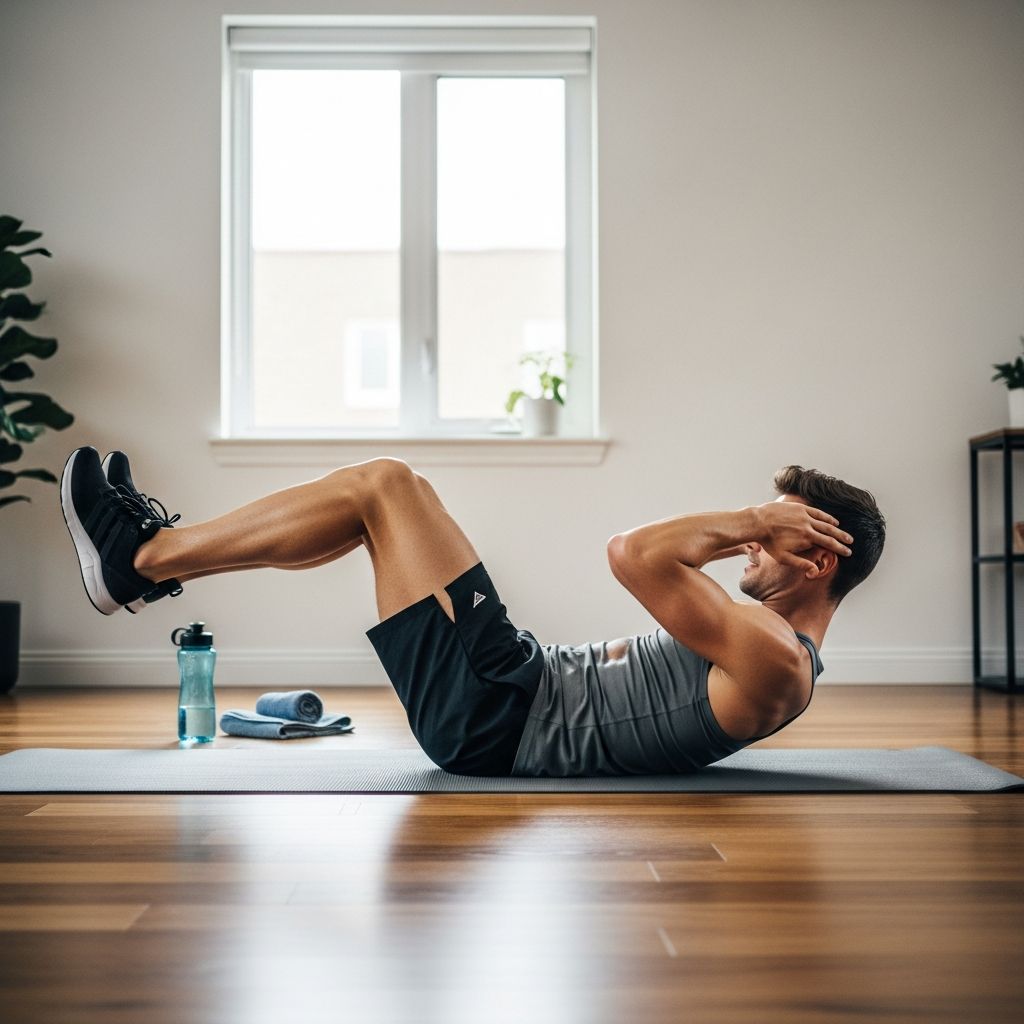
- Contract your abs to lift your shoulders off the floor and rotate your body
- Bring your right elbow toward your left knee in a controlled movement
- Slowly lower and repeat all repetitions before swapping sides
Proper oblique engagement is essential. Rather than simply twisting your torso, focus on the rotational crunch component that actually contracts your oblique muscles. Avoid pulling excessively on your head, which can strain your neck.
Sit-up
Sets: 3 | Reps: 25 | Rest: None | Equipment: None
Traditional sit-ups remain effective for upper abdominal development when performed with proper form. This classic exercise has endured because it effectively targets the rectus abdominis muscle.
How to perform:
- Lie down on the floor with your knees bent
- If possible, hook your feet under something that prevents them from moving
- Place your hands behind your head and tense your core
- Lift your torso up so your upper body forms a V shape with your thighs
- Lower under control back to the starting position
The controlled descent is just as important as the upward movement. Avoid jerky movements or momentum, which reduce effectiveness and increase injury risk. If full sit-ups are challenging, begin with crunches and progress gradually.
Star Plank
Sets: 3 | Reps: 1 minute | Rest: 2 minutes at end of superset | Equipment: None
The star plank is an advanced plank variation that dramatically increases the difficulty by expanding your base of support. Your entire body must be held in place by your core for the duration of the exercise, making this movement exceptionally demanding.
How to perform:
- Start from a press-up position with your hands and feet in standard plank configuration
- Walk your palms and toes out and away from your body until they form an X-shape
- Brace your core to keep a flat line from your head to your hips and toes
- Hold for the required time while maintaining perfect form
- Walk back to a normal press-up position to complete the repetition
This exercise demands tremendous core stability. If you cannot maintain a flat line from head to toes, you haven’t walked out far enough. Progressive workouts should see you gradually expanding the X-shape as your core strength increases.
Circuit: Finishing Sequence
The final circuit targets your core from multiple angles with high-repetition movements designed to induce muscular fatigue and maximize core activation.
Crunch
Sets: 2 | Reps: 20 | Rest: None | Equipment: None
Crunches remain a staple for upper abdominal development. This movement provides excellent muscular tension through a shortened range of motion.
How to perform:
- Lie flat on your back with your knees bent at a 90-degree angle
- Place your hands on either side of your head
- Push your lower back into the floor as you lift your shoulders a few inches off the floor
- Ensure your lower back stays in contact with the ground throughout the movement
- Tense your abs hard at the top point, then return under control to the start position
The key distinction in proper crunch technique is the shortened range of motion. You’re not attempting to sit up; instead, you’re simply lifting your shoulders off the floor through abdominal contraction. This focused movement maximizes upper ab engagement.
Reverse Crunch
Sets: 2 | Reps: 20 | Rest: None | Equipment: None
Reverse crunches specifically target your lower abdominals by reversing the traditional crunch motion. This movement is essential for complete core development and preventing muscular imbalances.
How to perform:
- Lie on your back with your arms on the floor at your sides, palms facing down
- Bend your knees and bring them toward your chest by contracting your abs
- As your knees rise, roll your pelvis to lift your hips off the floor
- Squeeze at the top position before slowly lowering until your thighs are perpendicular to the floor
- To regress the movement, bend your knees more; to progress, straighten your legs further
This exercise demands lower abdominal engagement that many people initially struggle to feel. Focus on the pelvic tilt component, as this is where true lower ab activation occurs.
Side Plank
Sets: 2 | Reps: 1 minute each side | Rest: None | Equipment: None
Side planks develop your obliques and lateral core muscles, which support the lower back and prevent back pain. Research demonstrates that stronger hip and back extensor muscles significantly reduce lower back pain occurrence.
How to perform:
- Lie on your left side with your knees straight
- Prop your upper body up to take its weight on your forearm
- Brace your core and raise your hips until your body forms a straight line
- Hold this position while breathing deeply and keeping your shoulder away from your ear
- Roll over and repeat on the other side
Perfect side plank form requires maintaining a completely straight line from your head through your hips to your feet. Any sagging hips indicates fatigue and should prompt you to conclude the set.
Russian Twist
Sets: 2 | Reps: 25 | Rest: 1 minute at end of circuit | Equipment: Optional weight
Russian twists are dynamic rotational exercises that engage your obliques through continuous movement. While the bodyweight version is effective, adding light weight increases difficulty as you progress.
How to perform:
- Begin seated on the floor with your legs bent in front of you and feet planted on the floor
- Lean back until you can feel your core engage
- Hold weight in front of you and bring it from side to side without it touching the floor
- Keep your hips even to work your obliques harder and prevent momentum-based movement
- Complete all repetitions in a controlled manner
This exercise demands continuous core engagement. The slower you move, the more challenging the exercise becomes. Avoid jerky movements and focus on rotational control throughout.
Implementation and Progression
This workout should be performed two to three times weekly as part of your overall training program. Allow at least one full day of recovery between sessions to permit adequate muscle repair and adaptation.
As your fitness improves, implement progressive overload by increasing repetitions, extending hold times, or reducing rest periods. These modifications ensure continued progress without requiring additional equipment. Some movements can progress from standard versions to more challenging variations, such as moving from knee raises to full leg raises.
Frequently Asked Questions
Q: How often should I perform this workout?
A: Perform this ab circuit two to three times weekly with at least one recovery day between sessions. This frequency allows adequate muscle recovery while maintaining consistent training stimulus.
Q: Can beginners perform this workout?
A: Yes, but beginners should reduce sets and repetitions initially, performing only one or two sets per exercise. As fitness improves, gradually increase volume and intensity over several weeks.
Q: Do I need equipment for this workout?
A: Most exercises require no equipment. However, a pull-up bar is needed for hanging leg raises, and light weights can be added to Russian twists for progression, though these are optional.
Q: How long does this workout take?
A: The complete workout typically requires 30 to 40 minutes depending on your fitness level and strict adherence to prescribed rest periods.
Q: Will this workout give me visible abs?
A: Building strong abdominal muscles requires both consistent training and proper nutrition. This workout effectively develops ab musculature, but visible definition also requires reducing body fat through dietary modifications.
Q: Can I modify exercises if they’re too difficult?
A: Absolutely. Reduce repetitions, decrease hold times, or perform easier variations like knee raises instead of leg raises until your strength improves sufficiently.
References
- These 9 Moves Are All You Need for a Killer Ab Workout at Home — Men’s Health UK. 2024. https://www.menshealth.com/uk/workouts/g754403/no-gym-home-six-pack-circuit/
- Jeremy Ethier’s No-Equipment 6-Pack Ads Core Training Workout — Men’s Health. 2022. https://www.menshealth.com/fitness/a38332864/jeremy-ethier-6-pack-abs-bodyweight-workout/
- These No-Gym Six-Pack Movements Are All You Need — Men’s Health Australia. 2024. https://menshealth.com.au/at-home-ab-workout/
- Hip and Back Extensor Muscle Strength in Relation to Lower Back Pain — Journal of Spinal Disorders & Techniques, Kuopio University. 2015. https://pubmed.ncbi.nlm.nih.gov/
Similar Articles







Read full bio of Sneha Tete