Home Vision Tests: 4 Reliable Ways To Check Your Vision
Discover if at-home eye tests and online glasses ordering deliver accurate results or fall short of professional care.
At-home vision screening tools have surged in popularity, offering quick checks for visual acuity without leaving your living room. These digital apps, printable charts, and online platforms promise convenience, especially for minor updates to glasses prescriptions. However, their reliability varies, and they cannot replace comprehensive professional eye examinations. This article delves into the science behind self-tests, their accuracy compared to clinical standards, best practices for use, and critical reasons to prioritize in-office visits for optimal eye care.
Understanding Visual Acuity and Its Measurement
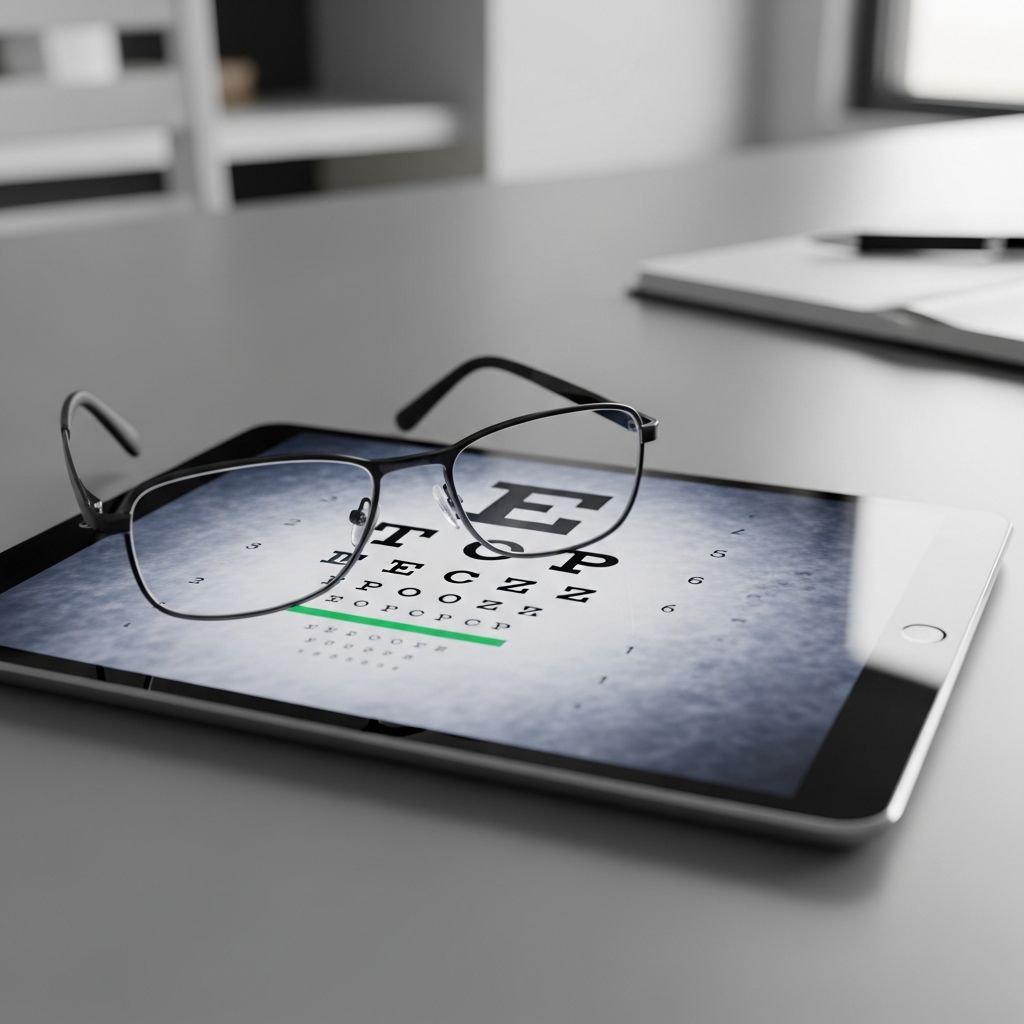
Visual acuity refers to the clarity or sharpness of vision, typically measured by identifying letters or symbols on a chart at a standardized distance. Clinicians use Snellen charts or more precise ETDRS (Early Treatment Diabetic Retinopathy Study) logs during exams. At-home equivalents include printed eye charts, smartphone apps like DigiVis or Peek Acuity, and web-based tools. These aim to replicate professional tests but face challenges like inconsistent lighting, screen calibration, and user error.
Research shows that under controlled conditions, certain home tests align closely with office results. For instance, studies validate printed charts and apps as comparable within one line of Snellen acuity to in-office measurements. Yet, real-world variability—such as viewing distance or room illumination—often widens this gap, making self-tests better suited for screening rather than diagnosis.
Popular Types of Home Vision Screening Methods
- Printed Charts: Simple, low-tech options like wall-hung Snellen charts. Hang at 10 or 20 feet, cover one eye, and read lines aloud. They show the highest correlation to clinical tests due to standardized sizing.
- Mobile Apps: Apps like iSight Professional, Peek Acuity, and DigiVis use device cameras and algorithms for distance acuity, color vision, and astigmatism checks. DigiVis demonstrates limits of agreement (LOA) within 0.2 logMAR, matching clinical benchmarks.
- Online Platforms: Websites prompt users to input answers via webcam or phone. While accessible, they often yield larger mean differences from office results (e.g., -0.13 logMAR).
- Specialized Grids: Amsler grids detect central vision distortions from macular issues, useful for monitoring age-related conditions.
Each method excels in accessibility but requires strict protocols: use a well-lit room, hold devices at arm’s length, and test each eye separately.
Scientific Validation: How Accurate Are They Really?
Peer-reviewed studies provide robust evidence on home test performance. A randomized trial with 218 participants found three remote tests (chart, app, website) within one Snellen line of best-corrected in-office acuity, with mean differences of -0.07 to -0.13 logMAR. No significant differences existed among methods, validating their use for telehealth.
A systematic review of 10 studies confirmed apps like DigiVis, iSight Professional, and Peek Acuity offer accuracy comparable to clinical assessments in pragmatic settings, with 95% LOA approaching ±0.15-0.2 logMAR—acceptable against clinical variation of ±0.15 logMAR. Test-retest reliability is strong for DigiVis (high intraclass correlation coefficients), though pooled data for others shows minor inconsistencies.
| Test Type | Mean Difference (logMAR) | 95% LOA | Key Strength |
|---|---|---|---|
| Printed Chart | -0.07 | Within 1 line | Highest correlation |
| Mobile App (e.g., DigiVis) | -0.12 | ≤0.2 logMAR | High reliability |
| Website | -0.13 | Comparable | Easy access |
Despite positives, biases arise from non-standardized conditions. Older users report digital access barriers, and surveys indicate preference for professional confirmation due to accuracy doubts.
Pros and Cons of Self-Administered Eye Checks
Home tests democratize initial screening, ideal for remote areas or pre-appointment prep. A survey of 101 users found 90% would reuse kits and 91% recommend them for ease. They detect gross impairments effectively, aiding timely professional follow-up.
Drawbacks include limited scope: they measure acuity but miss refraction details like cylinder for astigmatism, pupil dilation needs, or binocular vision. Online refractive tests often underperform, risking incorrect prescriptions. False results can delay care for glaucoma, cataracts, or retinal issues unseen in basic acuity checks.
Related Stories



Navigating Online Glasses Purchases
Ordering glasses online tempts with low costs and home delivery, using self-measured pupillary distance (PD) and recent prescriptions. Valid for up to two years (or one for under 16s), prescriptions enable this—but home tests rarely provide them accurately.
Steps for safe online buying:
- Verify prescription recency from a licensed provider.
- Measure PD accurately (average 54-74mm; use ruler or app).
- Choose reputable sites with return policies.
- Test fit: Glasses should sit 2-3mm from eyes, frames aligned.
Online vision tests for new prescriptions are unreliable, often questioned for precision. They lack slit-lamp exams or fundus checks, essential for full health scans.
Critical Limitations and Health Risks
Beyond acuity, eye exams screen for systemic issues like diabetes via retinal vessels. Home tools ignore these, potentially masking diseases. Studies note mobile apps provide ‘rough estimates’ with variances from clinical standards.
Children, seniors, and contact lens users need specialized testing unavailable at home. Inaccurate glasses from flawed self-tests cause headaches, strain, or worsened vision. Experts urge annual professional exams, biennially for low-risk adults.
Best Practices for Reliable At-Home Testing
- Test in natural daylight, 10 feet from chart/screen.
- Calibrate devices per instructions.
- Record results for doctor sharing.
- Retest if inconsistent; seek care for 20/40 or worse.
Combine with lifestyle checks: limit screen time, use 20-20-20 rule (every 20 minutes, view 20 feet away for 20 seconds).
When to Schedule a Professional Exam
Consult an optometrist or ophthalmologist if:
- Blurry/double vision persists.
- Family history of eye disease.
- Symptoms like flashes, floaters, or pain.
- Age 40+ or diabetes/hypertension.
Frequency: Comprehensive dilated exams every 1-2 years.
FAQ
Can I trust a home vision test for new glasses?
No—use for screening only. Accurate prescriptions require professional refraction.
Are online eye exams as good as in-office?
Studies show limited reliability; they miss health screenings.
How often should I get an eye exam?
Adults: Every 1-2 years; children: Annually.
What’s pupillary distance, and how to measure it?
Distance between pupils; use a mirror and ruler for 54-74mm average.
Do home tests detect color blindness?
Some apps do, but confirm professionally.
Future of Tele-Optometry
Post-COVID, validated home tests expand access in rural or underserved areas. Hybrid models—self-tests triaged to telehealth—promise efficiency without compromising care. Ongoing research refines apps for broader utility.
References
- Study Confirms Validity of At-Home Visual Acuity Tests — Review of Optometry. 2022-03-31. https://www.reviewofoptometry.com/article/study-confirms-validity-of-athome-visual-acuity-tests
- Accuracy and reliability of self-administered visual acuity tests — PMC (National Library of Medicine). 2023. https://pmc.ncbi.nlm.nih.gov/articles/PMC10286971/
- Evaluating the Accuracy of Mobile Apps for Eye Testing — Optometry Innovations. Accessed 2026. https://optometryinnovations.com/optometric-instruments/portable-devices/evaluating-accuracy-mobile-apps-eye-testing/
- Is There Such a Thing as Home Vision Tests? — iSight of Denison. Accessed 2026. https://www.isightdenison.com/is-there-such-a-thing-as-home-vision-tests/
- Ease of Use and Acceptability of an At-home Vision Screening Kit — Dove Press. Accessed 2026. https://www.dovepress.com/ease-of-use-and-acceptability-of-an-at-home-vision-screening-kit-in-a–peer-reviewed-fulltext-article-OPTH
Similar Articles








Read full bio of Sneha Tete