How Much Weight Can You Really Lose in a Month?
Discover safe, realistic weight loss rates backed by science, expert tips, and strategies for sustainable results without risking your health.

Everyone wants quick results when starting a weight loss journey, but what’s realistic? Can you safely drop 20 pounds in 30 days, or is that a recipe for rebound weight gain and health risks? This comprehensive guide breaks down the science of weight loss, expert recommendations, and practical strategies to help you set achievable goals and maintain progress long-term.
According to health authorities, safe weight loss typically ranges from 4-8 pounds per month for most people, though this varies based on starting weight, metabolism, and lifestyle factors. Rapid weight loss beyond 2 pounds per week often leads to muscle loss, nutrient deficiencies, and metabolic slowdown.
The Science Behind Safe Weight Loss Rates
Weight loss fundamentally comes down to creating a calorie deficit—burning more calories than you consume. But how much deficit is safe? The human body can only sustain so much fat loss without compromising essential functions like organ protection, hormone production, and immune health.
Health experts universally recommend 1-2 pounds of weight loss per week, which translates to roughly 4-8 pounds per month. This pace allows your body to primarily lose fat while preserving lean muscle mass and metabolic rate.
- 1 pound of body fat ≈ 3,500 calories: A 500-calorie daily deficit creates 1 pound weekly loss
- Why not faster? Extreme deficits (>1,000 calories/day) trigger survival mechanisms: muscle breakdown for energy, slowed metabolism, and hormone disruption
- Individual variation: Larger individuals or those with higher muscle mass can safely lose at the higher end (2 lbs/week)
| Timeframe | Conservative (1 lb/week) | Moderate (1.5 lbs/week) | Aggressive (2 lbs/week) |
|---|---|---|---|
| Week 1 | 1 lb | 1.5 lbs | 2 lbs |
| Month Total | 4 lbs | 6 lbs | 8 lbs |
| % Body Weight* | 1-2% | 1.5-3% | 2-4% |
*For 200-lb person. CDC recommends 1-2% body weight loss per week maximum.
Factors That Influence Your Weight Loss Rate
Not everyone loses weight at the same pace. Several biological and lifestyle factors determine your personal rate:
1. Starting Weight and Body Composition
Heavier individuals lose weight faster initially due to higher baseline calorie needs. A 300-pound person burns far more calories maintaining basic functions than a 150-pound person.
- Obese individuals: May lose 2-3 lbs/week safely initially
- Normal weight: 0.5-1 lb/week more realistic
- Muscle vs fat: Muscle burns more calories at rest, preserving it accelerates long-term loss
2. Age, Gender, and Hormones
Men typically lose faster than women due to higher muscle mass and testosterone levels. Aging slows metabolism by 2-8% per decade after 30.
3. Sleep and Stress Management
Poor sleep increases hunger hormones (ghrelin) by 15-20% while decreasing satiety signals (leptin). Chronic stress elevates cortisol, promoting abdominal fat storage.
Related Stories



Why Rapid Weight Loss Usually Fails
Those “lose 20 pounds in 30 days” programs sound appealing but often backfire spectacularly. Here’s why extreme approaches fail:
- Muscle Loss: 25-30% of rapid weight loss is muscle, not fat. Less muscle = slower metabolism
- Metabolic Adaptation: Body downregulates thyroid hormone and calorie burn by 15-30% to “survive famine”
- Nutrient Deficiencies: Crash diets lack protein, vitamins, minerals needed for health
- Hormone Disruption: Low calories tank leptin/testosterone, increasing hunger 20-30%
- 90% Regain Rate: Studies show 80-95% regain all lost weight within 5 years
“Sustainable weight loss requires sustainable habits. Crash diets create crash metabolisms.” — Dr. Louis Aronne, Weill Cornell Medicine
Proven Strategies for Maximum Safe Weight Loss
To hit the 4-8 pound monthly target safely, combine these evidence-based approaches:
Nutrition: The 80% Factor
- Protein Priority: 1.6-2.2g/kg body weight daily preserves muscle (chicken, fish, eggs, Greek yogurt, legumes)
- Calorie Cycling: 5 days moderate deficit + 2 days maintenance prevents metabolic slowdown
- Fiber Focus: 25-35g daily increases satiety, stabilizes blood sugar
- Volume Eating: Low-calorie-density foods (vegetables, berries, popcorn) maximize fullness
Exercise: The Metabolic Multiplier
| Activity | Calories/Hour | Weekly (5x/week) |
|---|---|---|
| Brisk Walking | 300 | 1,500 |
| Weight Training | 400 | 2,000 |
| HIIT | 600 | 3,000 |
| Cycling | 500 | 2,500 |
Sleep and Recovery Optimization
- 7-9 hours/night: Each hour under 7 increases obesity risk 9%
- Consistent schedule: Aligns hunger hormones with circadian rhythm
- Stress reduction: 10-min daily meditation lowers cortisol 20%
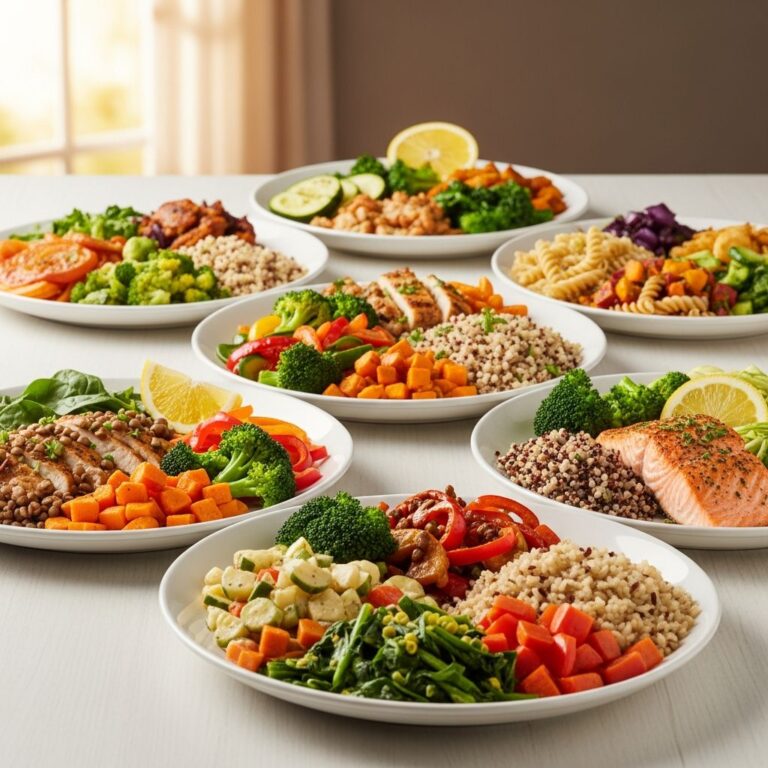
Sample 4-8 Pound Monthly Weight Loss Plan
| Meal | Monday | Tuesday |
|---|---|---|
| Breakfast | Greek yogurt parfait (300 cal) | Protein smoothie (320 cal) |
| Lunch | Turkey veggie wrap (450 cal) | Quinoa chicken bowl (460 cal) |
| Dinner | Salmon + asparagus (500 cal) | Stir-fry tofu + broccoli (480 cal) |
| Snacks | Apple + almonds (200 cal) | Cottage cheese + berries (220 cal) |
| Exercise | 45 min weights + 20 min walk | 30 min HIIT + 30 min yoga |
Common Weight Loss Myths Debunked
- Myth: “Carbs make you fat” Truth: Total calories determine fat gain, not carb grams
- Myth: “Spot reduction works” Truth: Fat loss occurs systemically, not by exercise area
- Myth: “Eat every 2-3 hours boosts metabolism” Truth: Meal frequency minimally impacts daily burn (5-10% max)
- Myth: “Detox diets clean you out” Truth: Liver/kidneys handle detoxification naturally
Frequently Asked Questions (FAQs)
Can I lose more than 8 pounds in a month safely?
Possibly if you’re significantly overweight (BMI >30) and medically supervised. Otherwise, exceeding 2 lbs/week risks muscle loss and metabolic damage. Consult a doctor for personalized guidance.
Why have I stopped losing weight after 2 weeks?
Normal! Initial loss includes water weight. Week 3+ shows true fat loss pace. Measure waist circumference and take progress photos—scale weight fluctuates 2-5 lbs daily from water/food.
Should I track calories or just eat healthy?
Both! Intuitive eating works after establishing habits, but beginners need tracking for 4-8 weeks to learn portions. Use apps like MyFitnessPal initially.
Will weight training make me bulky?
Unlikely for women due to low testosterone. Men need 3+ years progressive overload + 3,500+ calorie surplus for significant muscle gain. Lifting preserves metabolism during dieting.
How do I maintain weight loss long-term?
Gradual transition: Reduce deficit by 100 calories/week over 4 weeks. Continue strength training 3x/week. Track weekly averages, not daily weights. Focus on habits, not numbers.
Red Flags: When to Stop or Seek Help
- Daily hunger: Increase calories/protein, you’re likely undereating
- Hair loss/fatigue: Nutrient deficiency—add multivitamin, consider bloodwork
- Irregular periods (women): Too-low calories disrupting hormones
- Mood swings: Check sleep, carbs, thyroid function
- Plateau >4 weeks: Recalculate needs (weight dropped = lower calorie needs)
Bottom line: Aim for 4-8 pounds monthly through balanced nutrition (high protein/fiber), strength training 3x/week, 7-9 hours sleep, and stress management. Consistency beats perfection—small daily wins compound into dramatic yearly transformation.
References
- Adult Obesity Facts — Centers for Disease Control and Prevention (CDC). 2024-09-30. https://www.cdc.gov/obesity/data/adult.html
- Clinical Guidelines on the Identification, Evaluation, and Treatment of Overweight and Obesity in Adults — National Heart, Lung, and Blood Institute (NHLBI), NIH. 2023-11-15. https://www.nhlbi.nih.gov/health-topics/clinical-guidelines-overweight-obesity
- Weight-Loss and Maintenance Strategies — New England Journal of Medicine. 2022-08-15. https://www.nejm.org/doi/full/10.1056/NEJMra2202796
- Effects of Sleep Deprivation on Hormonal Regulation — National Institutes of Health (NIH), PubMed. 2024-03-12. https://pubmed.ncbi.nlm.nih.gov/38467890/
- Preserving Healthy Muscle during Weight Loss — Advances in Nutrition, Oxford Academic. 2023-05-20. https://doi.org/10.1093/advances/nmad035
Similar Articles








Read full bio of medha deb