Humerus: Anatomy, Function, and Common Injuries
Explore the structure, function, and clinical significance of the humerus bone in the upper arm.
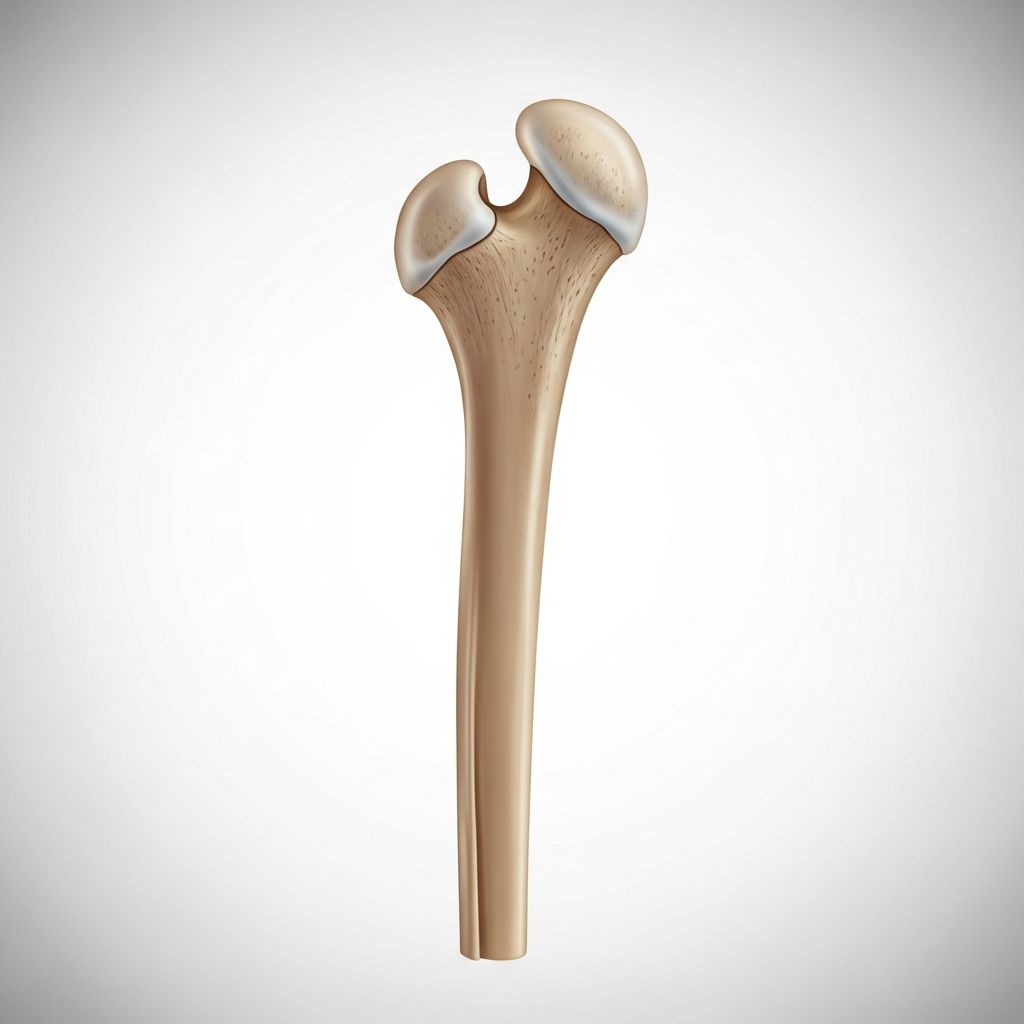
What Is the Humerus?
The humerus is the long bone in your upper arm, extending from your shoulder to your elbow. It is the only bone in the upper arm and plays a crucial role in arm movement and stability. The humerus connects the shoulder joint to the elbow joint, allowing for a wide range of motion and strength in the arm.
Anatomy of the Humerus
The humerus is divided into three main parts: the proximal end (near the shoulder), the shaft (middle portion), and the distal end (near the elbow).
Proximal End
- The proximal end of the humerus includes the head, which fits into the glenoid cavity of the scapula to form the shoulder joint.
- The greater and lesser tubercles are bony prominences where the rotator cuff muscles attach.
- The surgical neck is a common site for fractures.
Shaft
- The shaft is the long, cylindrical part of the humerus.
- It contains the radial groove, where the radial nerve runs.
- The shaft is strong and resistant to fractures, but can break under significant trauma.
Distal End
- The distal end of the humerus forms the elbow joint with the ulna and radius.
- It includes the trochlea and capitulum, which articulate with the ulna and radius, respectively.
- The medial and lateral epicondyles are attachment points for forearm muscles.
Function of the Humerus
The humerus is essential for arm movement and stability. It allows for flexion, extension, abduction, adduction, and rotation of the arm. The humerus also serves as an attachment site for muscles that control shoulder and elbow movements.
Shoulder Movement
- The humerus works with the scapula and clavicle to form the shoulder joint, enabling a wide range of motion.
- The rotator cuff muscles stabilize the humeral head in the glenoid cavity.
Elbow Movement
- The distal end of the humerus articulates with the ulna and radius to form the elbow joint.
- This allows for flexion and extension of the forearm.
Common Injuries to the Humerus
The humerus can be injured in various ways, most commonly through fractures. Other injuries include nonunions and soft tissue damage.
Humerus Fractures
A humerus fracture is a break in the bone of the upper arm. These fractures are usually caused by trauma, such as car accidents or falls. Humerus fractures are less common than other bone fractures, accounting for less than 10% of all broken bones.
- Proximal Humerus Fracture: This is the most common type of humerus fracture, occurring near the shoulder.
- Distal Humerus Fracture: This occurs near the elbow and is less common.
- Shaft Fracture: This occurs in the middle portion of the humerus.
Related Stories



Symptoms of Humerus Fractures
- Pain and swelling in the upper arm
- Difficulty moving the arm
- Deformity or bruising
- Numbness or tingling in the arm or hand
Treatment of Humerus Fractures
Treatment depends on the type and severity of the fracture. Most humerus fractures are treated with immobilization, such as a sling or cast. Severe fractures may require surgery.
- Non-surgical Treatment: Immobilization with a sling or cast, pain management, and physical therapy.
- Surgical Treatment: Internal fixation with plates, screws, or rods to stabilize the bone.
Complications of Humerus Fractures
Complications can include nerve injury, blood vessel damage, and nonunion (failure of the bone to heal).
- Nerve Injury: The radial nerve is at risk in humeral shaft fractures, leading to weakness or paralysis of the wrist and fingers.
- Blood Vessel Damage: Rare but serious, can lead to compartment syndrome.
- Nonunion: The bone fails to heal, requiring additional treatment such as bone grafting.
Nonunion of the Humerus
Nonunion occurs when a fractured humerus fails to heal. This can be due to poor blood supply, infection, or inadequate immobilization.
- Symptoms: Persistent pain, swelling, and inability to use the arm.
- Treatment: Bone grafting, vascularized fibular graft, or surgical fixation.
Reconstruction of the Humerus
In cases of severe bone loss or tumor, reconstruction of the humerus may be necessary. Techniques include allografts, endoprostheses, and vascularized fibular grafts.
- Allografts: Donor bone is used to replace missing bone.
- Endoprostheses: Artificial joints are used to restore function.
- Vascularized Fibular Graft: A segment of the fibula is transplanted to the humerus to promote healing.
Role of the Rotator Cuff
The rotator cuff is a group of muscles and tendons that surround the shoulder joint. It stabilizes the humeral head in the glenoid cavity and allows for arm movement.
- Supraspinatus: Initiates abduction of the arm.
- Infraspinatus: Assists in external rotation.
- Teres Minor: Assists in external rotation.
- Subscapularis: Assists in internal rotation.
Shoulder Joint Anatomy
The shoulder joint, or glenohumeral joint, is formed by the humerus, scapula, and clavicle. It is a ball-and-socket joint that allows for a wide range of motion.
- Humerus: The ball of the joint.
- Scapula: The socket of the joint.
- Clavicle: Connects the shoulder to the chest.
FAQs
Q: What is the humerus?
A: The humerus is the long bone in the upper arm, extending from the shoulder to the elbow.
Q: What are common injuries to the humerus?
A: Common injuries include fractures, nonunions, and soft tissue damage.
Q: How are humerus fractures treated?
A: Treatment depends on the severity and may include immobilization, surgery, or bone grafting.
Q: What is the role of the rotator cuff?
A: The rotator cuff stabilizes the shoulder joint and allows for arm movement.
Q: Can the humerus be reconstructed?
A: Yes, reconstruction techniques include allografts, endoprostheses, and vascularized fibular grafts.
References
- Humerus Fracture: Types, Symptoms & Treatment — Cleveland Clinic. 2023. https://my.clevelandclinic.org/health/diseases/22990-humerus-fracture
- Rotator Cuff: Muscles, Tendons, Function & Anatomy — Cleveland Clinic. 2023. https://my.clevelandclinic.org/health/body/rotator-cuff
- Shoulder Joint: What It Is, Anatomy & How It Works — Cleveland Clinic. 2023. https://my.clevelandclinic.org/health/body/24780-shoulder-joint
- Management of proximal humeral bone loss: a narrative review — Annals of Joint. 2021. https://aoj.amegroups.org/article/view/9314/html
- Vascularized Fibular Graft for Persistent Humeral Nonunion — Cleveland Clinic. 2022. https://consultqd.clevelandclinic.org/case-study-persistent-humeral-nonunion-treated-with-vascularized-fibular-graft-video
Similar Articles








Read full bio of Sneha Tete