Hydrus Vs IStent: Head-To-Head Comparison For OAG
Discover how Hydrus and iStent microstents stack up in managing open-angle glaucoma, with key insights on IOP control, medication reduction, and long-term safety from recent studies.
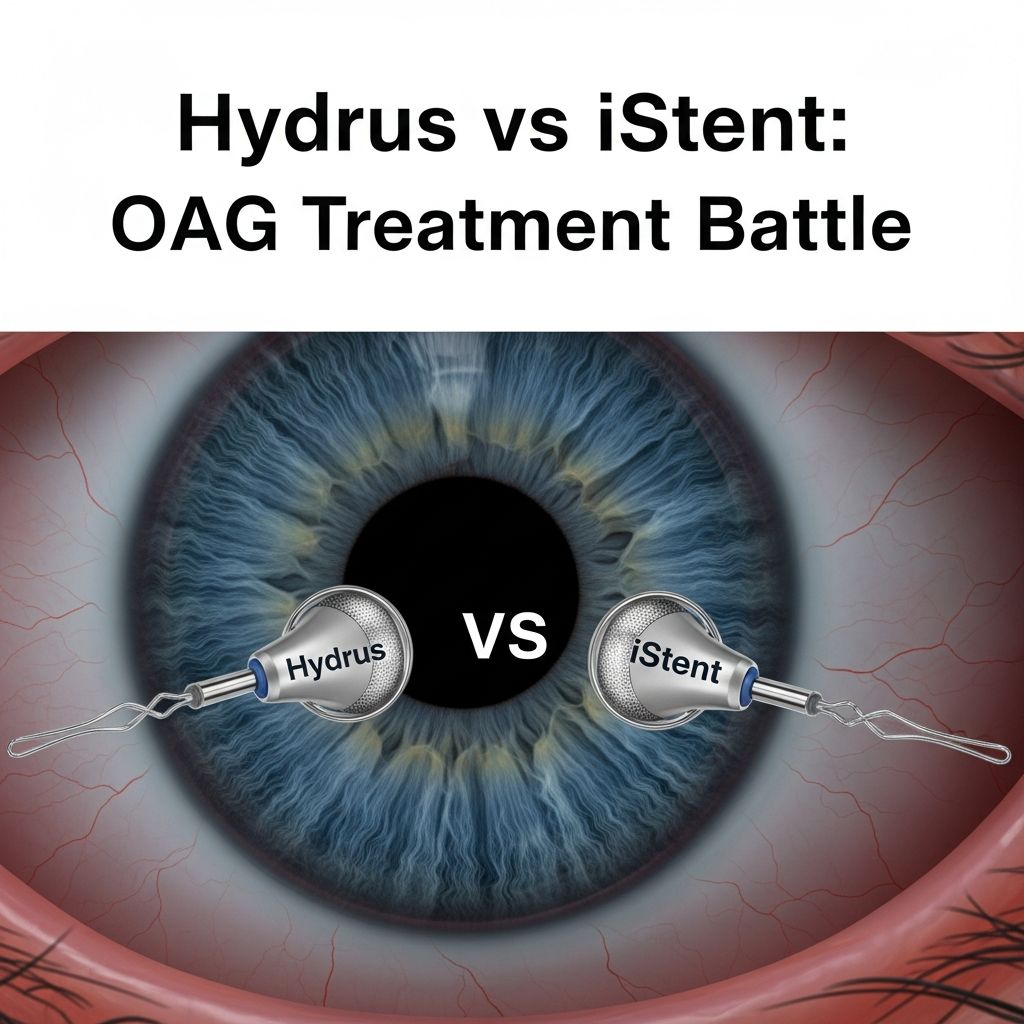
Open-angle glaucoma (OAG) remains a leading cause of irreversible vision loss worldwide, characterized by progressive optic nerve damage due to elevated intraocular pressure (IOP). Traditional management relies on medications and laser therapies, but microinvasive glaucoma surgery (MIGS) devices like the Hydrus Microstent and iStent offer promising alternatives, especially when combined with cataract surgery. These implants enhance aqueous humor outflow through the trabecular meshwork, providing sustained IOP reduction with minimal risk. This article delves into their comparative performance based on recent clinical data, helping clinicians weigh options for mild-to-moderate OAG patients.
Understanding MIGS Devices for Glaucoma Control
MIGS represents a paradigm shift in glaucoma care, prioritizing safety and rapid recovery over aggressive IOP lowering. The Hydrus Microstent (Alcon) is a 8mm-long, nitinol scaffold that spans Schlemm’s canal, dilating it to facilitate collector channel access and improve trabecular outflow. In contrast, the iStent inject (Glaukos) consists of two pre-loaded titanium stents placed directly into the trabecular meshwork, bypassing high-resistance segments to boost conventional outflow pathways.
Both devices are FDA-approved for use with phacoemulsification in mild-to-moderate OAG, targeting patients on one to three medications with IOPs typically 18-30 mmHg. Their appeal lies in ab interno implantation, avoiding conjunctival disruption and preserving future surgical options. Standalone use is also emerging, particularly for Hydrus in more advanced cases.
Key Clinical Trials: Head-to-Head Performance
Multiple studies have pitted Hydrus against iStent, revealing nuanced differences. A prospective, non-randomized trial involving 65 eyes tracked outcomes over 24 months. The iStent cohort (n=35) achieved mean IOP of 15.9 ± 3.0 mmHg, while Hydrus (n=30) reached 16.2 ± 1.8 mmHg—a non-significant gap (p=0.683).
The Fight Glaucoma Blindness (FGB) registry analyzed 344 eyes (224 iStent inject, 120 Hydrus) post-phacoemulsification. Propensity-matched data showed IOP reductions of 3.1 mmHg for iStent versus 2.3 mmHg for Hydrus at 24 months (p=0.530). Medication use dropped by 1.0 in iStent eyes versus 0.5 in Hydrus (p=0.081), hinting at a slight edge for iStent in medication sparing.
Extending to 48 months, another FGB analysis found no significant differences in surgical success (≥20% IOP drop to ≤21 mmHg or ≥1 medication reduction). Over 40% of eyes in both groups met this endpoint without further interventions.
IOP Reduction: Sustained but Comparable Results
Across studies, both devices deliver reliable IOP lowering. Baseline IOPs averaged 16-18 mmHg in combined phaco-MIGS settings. At two years:
| Metric | iStent inject | Hydrus | p-value |
|---|---|---|---|
| Mean IOP Reduction (mmHg) | 3.1 | 2.3 | 0.530 |
| 24-Month Mean IOP (mmHg) | 15.9 ± 3.0 | 16.2 ± 1.8 | 0.683 |
Hydrus shows tighter IOP variability, beneficial for patients prone to spikes. For IOP ≤18 mmHg success (medication-free), Hydrus edged ahead in some cohorts (53.7% vs 63.9% initially, stabilizing favorably long-term).
Medication Reduction: Where Differences Emerge
- Hydrus: 79.6% mean reduction at 24 months (from baseline), superior in high-baseline medication users (≥3 drugs, HR=0.23).
- iStent: 71.7% reduction; better for low-medication patients (1-2 drugs, HR=1.58-2.23).
- FGB data: iStent reduced meds by 1.0 vs 0.5 for Hydrus (p=0.081).
Hydrus excels in polypharmacy cases, potentially due to greater canal dilation. iStent’s dual-stent design aids milder cases. Complete success (IOP ≤18 mmHg, no meds) favored Hydrus by 46.1% risk reduction.
Related Stories



Safety Profiles and Adverse Events
MIGS safety is exemplary, with low complication rates. In the 65-eye study, no vision-threatening issues occurred. FGB reported 5.4% secondary procedures for iStent vs 7.5% for Hydrus (p=0.738).
- Common transient events: Hyphema (self-resolving), stent malposition (<2%).
- Hydrus-specific: Canal scaffold risks minor inflammation.
- iStent-specific: Rare trabecular damage from injection.
Long-term, both maintain safety through 48 months, with similar adverse event incidences.
Patient Selection: Tailoring Devices to Profiles
Age influences outcomes: Under 70s benefit more from Hydrus (HR=0.81 risk reduction); over 70s from iStent (HR=1.33).
| Patient Factor | Preferred Device | Rationale |
|---|---|---|
| High baseline IOP (>18 mmHg) | Hydrus | Superior risk reduction (HR=0.23 for ≥3 meds). |
| Low meds (1-2) | iStent | Better prognosis (HR=1.58-2.23). |
| Normal-tension glaucoma | iStent | Higher proportion in studies, slight med edge. |
| Combined phaco | Either | Comparable IOP/med outcomes. |
Standalone Hydrus may outperform in moderate OAG, per COMPARE study contrasts.
Long-Term Durability: Beyond Two Years
48-month FGB data confirms durability: No significant divergence in IOP, meds, or success rates. Over 40% success without reintervention underscores MIGS reliability, challenging traditional trabeculectomy needs.
Cost-Effectiveness and Adoption Trends
Hydrus implantation costs more upfront due to its length and delivery system, but medication savings (e.g., $500+/year per eye) may offset in high-users. iStent’s simpler dual-injection appeals for efficiency. Adoption favors combined phaco-MIGS in the US, with registries like FGB driving evidence.
Future Directions in MIGS Evolution
Ongoing trials explore next-gen stents, like iStent infinite or Hydrus enhancements. Head-to-head RCTs are needed to resolve medication discrepancies. Patient-reported outcomes, including quality of life, warrant integration into decision-making.
Frequently Asked Questions (FAQs)
What is the main difference between Hydrus and iStent?
Hydrus scaffolds Schlemm’s canal for broader outflow; iStent uses dual trabecular punctures for targeted bypass.
Which reduces IOP more effectively?
Results are comparable at 24-48 months, with minor variations per study (2.3-3.1 mmHg drops).
Are complications common?
Rare and transient; secondary procedures <8%.
Best for standalone use?
Hydrus shows promise in moderate OAG without cataract.
How long do benefits last?
Sustained to 48 months, with >40% success.
References
- Comparison of Safety and Efficacy of Hydrus and iStent Combined… — PMC/NCBI. 2023-02-28. https://pmc.ncbi.nlm.nih.gov/articles/PMC10002347/
- Comparative study of 2-year outcomes for Hydrus or iStent inject… — Save Sight Registries. 2023. https://savesightregistries.org/publications/comparative-study-of-2-year-outcomes-for-hydrus-or-istent-inject-microinvasive-glaucoma-surgery-implants-with-cataract-surgery/
- Long-term comparative outcomes of Hydrus versus iStent inject… — PubMed. 2024. https://pubmed.ncbi.nlm.nih.gov/40830030/
- New Surgical Technologies to Expand Your Treatment Algorithm — Glaucoma Today. 2022-05. https://glaucomatoday.com/articles/2022-may-june-insert/new-surgical-technologies-to-expand-your-treatment-algorithm
- Comparison of efficacy of two stent treatments — Dove Press. 2023. https://www.dovepress.com/comparison-of-efficacy-of-combined-phacoemulsification-and-istent-inje-peer-reviewed-fulltext-article-OPTH
Similar Articles








Read full bio of Sneha Tete