Hyperandrogenism: Complete Guide To Causes And Treatment
Understanding hyperandrogenism: symptoms, causes, diagnosis, and effective management strategies for androgen excess.
Revised: January 2026
What is hyperandrogenism?
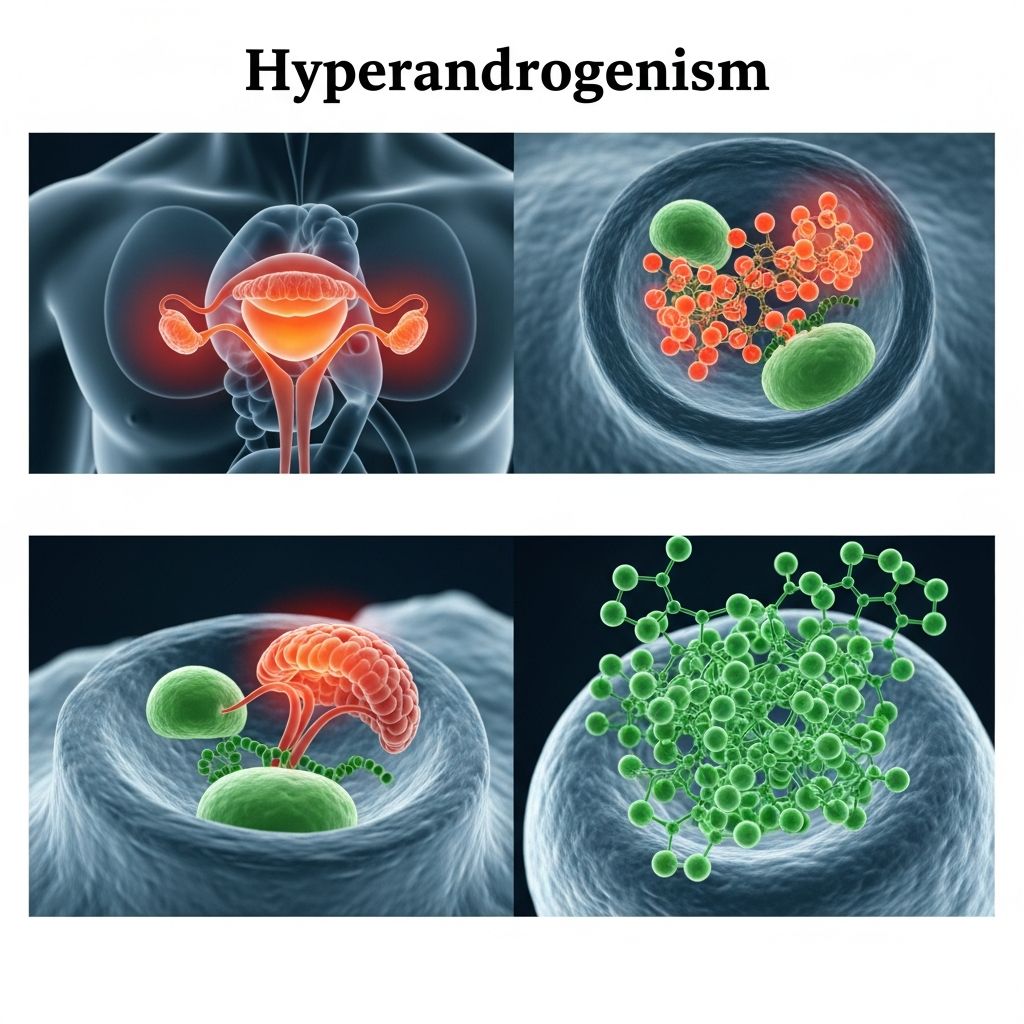
Hyperandrogenism refers to a condition characterized by excessive levels of androgens—male sex hormones such as testosterone and dihydrotestosterone—in the body, particularly affecting women. These hormones are present in both sexes but in much lower concentrations in females. Elevated androgen levels disrupt normal physiological processes, leading to a range of clinical manifestations, most notably in skin, hair, and reproductive health. It impacts approximately 5–10% of women of reproductive age, with symptoms often becoming evident during late adolescence or early adulthood.
The condition arises from overproduction of androgens by the ovaries or adrenal glands, or reduced metabolism of these hormones. While men may experience subtle effects due to naturally higher baseline levels, women exhibit more pronounced virilizing features. Untreated hyperandrogenism can contribute to metabolic complications like insulin resistance, dyslipidemia, and type 2 diabetes.
Who gets hyperandrogenism?
Hyperandrogenism predominantly affects women of reproductive age (15–49 years), with a prevalence of 5–10% in this demographic. It is less common in postmenopausal women due to declining ovarian function but can persist or emerge from adrenal sources. Certain ethnic groups, such as those of South Asian or Mediterranean descent, may have higher rates due to genetic predispositions like congenital adrenal hyperplasia (CAH). Risk factors include obesity, family history of polycystic ovary syndrome (PCOS), and use of androgenic medications.
- Reproductive-age females: 5–10% prevalence
- Associated with PCOS in 70% of cases
- Risk amplified by insulin resistance and obesity
What causes hyperandrogenism?
Hyperandrogenism stems from ovarian, adrenal, or peripheral sources. The most frequent etiology is PCOS, accounting for 70–80% of cases, characterized by ovarian overproduction of androstenedione and testosterone due to disrupted folliculogenesis.
Ovarian hyperandrogenism
Ovarian sources include PCOS, where multiple small cysts lead to irregular ovulation and elevated androgens. Rare causes are androgen-secreting tumors like Sertoli-Leydig cell tumors, which rapidly elevate testosterone levels, often exceeding 200 ng/dL.
Adrenal hyperandrogenism
Adrenal glands produce dehydroepiandrosterone sulfate (DHEA-S). Key causes: non-classic CAH (21-hydroxylase deficiency, enzyme mutation causing androgen buildup), Cushing syndrome (excess cortisol with secondary androgens), and adrenal carcinomas. DHEA-S levels >700 μg/dL suggest tumors.
Other causes
- Drugs: Anabolic steroids, progestins, antiepileptics (e.g., phenytoin), valproate.
- Peripheral: Obesity increases androgen production in fat tissue; insulin resistance amplifies ovarian output.
- Idiopathic: 5–15% cases with mild hirsutism, normal androgens.
What are the clinical features of hyperandrogenism?
Symptoms vary by severity and duration. Common cutaneous signs: hirsutism (60–83%), acne (11–43%), androgenetic alopecia (25%). Metabolic: obesity, acanthosis nigricans. Reproductive: oligomenorrhea, infertility.
| Symptom | Description | Prevalence |
|---|---|---|
| Hirsutism | Male-pattern hair on face, chest, abdomen | 60–83% |
| Acne/Seborrhea | Oily skin, inflammatory lesions | 11–43% |
| Alopecia | Scalp hair thinning (vertex) | 25–61% |
| Menstrual irregularity | Oligo/amenorrhea | Common in PCOS |
| Virilization | Deep voice, clitoromegaly (severe) | Tumors |
In one study of 200 patients, hirsutism affected 99%, alopecia 61.5%, acne 54.5%. Rapid onset suggests tumors; gradual indicates PCOS.
Related Stories



Diagnosis of hyperandrogenism
Diagnosis combines history, exam, labs, imaging. Ferriman-Gallwey score ≥8 indicates hirsutism. Labs: total/free testosterone, DHEA-S, SHBG, 17-hydroxyprogesterone (for CAH), FSH/LH (LH:FSH >2 in PCOS). Exclude pregnancy, prolactinoma, thyroid dysfunction.
- Severe (testosterone >150–200 ng/dL): Rule out tumors via pelvic/adrenal CT/MRI.
- Mild (normal labs): Idiopathic; trial anti-androgens.
Transvaginal ultrasound for PCOS shows ≥12 antral follicles/ovary.
How is hyperandrogenism treated?
Treatment targets symptoms, underlying cause, comorbidities. Lifestyle: weight loss (5–10% reduces androgens 20%).
Pharmacological
- Oral contraceptives (OCPs): First-line; suppress ovarian androgens, increase SHBG. E.g., ethinylestradiol + drospirenone.
- Anti-androgens: Spironolactone (100–200 mg/day), cyproterone acetate; use with OCP to prevent fetal risk.
- Metformin: For insulin resistance in PCOS (500–2000 mg/day).
- For CAH: Glucocorticoids (dexamethasone).
Cosmetic
Laser hair removal, electrolysis for hirsutism; topical minoxidil/retinoids for acne/alopecia.
Surgical
Laparoscopic ovarian drilling for PCOS resistant cases; tumor resection.
Monitor every 3–6 months; fertility counseling for those desiring pregnancy.
What is the outcome for hyperandrogenism?
Prognosis excellent with treatment; hirsutism improves 6–12 months. PCOS requires lifelong management to avert diabetes/cardiovascular risks. Early intervention prevents psychosocial impact.
Frequently asked questions
Does hyperandrogenism affect fertility?
Yes, via anovulation; OCPs for regulation, clomiphene/metformin for ovulation induction.
Can diet help manage symptoms?
Low-glycemic diets reduce insulin/androgens; aim for BMI <25.
Is hyperandrogenism curable?
Not always; PCOS managed lifelong, tumors curable if resected early.
When to seek urgent care?
Rapid virilization, testosterone >200 ng/dL—suspect tumor.
References
- Hyperandrogenism – Wikipedia — Wikipedia. 2023-10-01. https://en.wikipedia.org/wiki/Hyperandrogenism
- Hyperandrogenism: Causes and solutions — Instituto Bernabeu. 2023-01-15. https://www.institutobernabeu.com/ar/blog/hyperandrogenism-causes-and-solutions/
- Ovarian overproduction of androgens — MedlinePlus (U.S. National Library of Medicine). 2024-05-20. https://medlineplus.gov/ency/article/001165.htm
- Unmasking hyperandrogenism: What clinical symptoms reveal — Cosmoderma. 2023-08-10. https://cosmoderma.org/unmasking-hyperandrogenism-what-clinical-symptoms-reveal-about-hormonal-mysteries/
- Practical Approach to Hyperandrogenism in Women — PMC (NCBI). 2021-10-15. https://pmc.ncbi.nlm.nih.gov/articles/PMC8548673/
- Screening and Management of the Hyperandrogenic Adolescent — American College of Obstetricians and Gynecologists (ACOG). 2019-10-01. https://www.acog.org/clinical/clinical-guidance/committee-opinion/articles/2019/10/screening-and-management-of-the-hyperandrogenic-adolescent
Similar Articles








Read full bio of Sneha Tete