Hyperbaric Oxygen Therapy: Uses, Benefits, and How It Works
Complete guide to hyperbaric oxygen therapy: understanding treatment, benefits, and medical applications.
What Is Hyperbaric Oxygen Therapy?
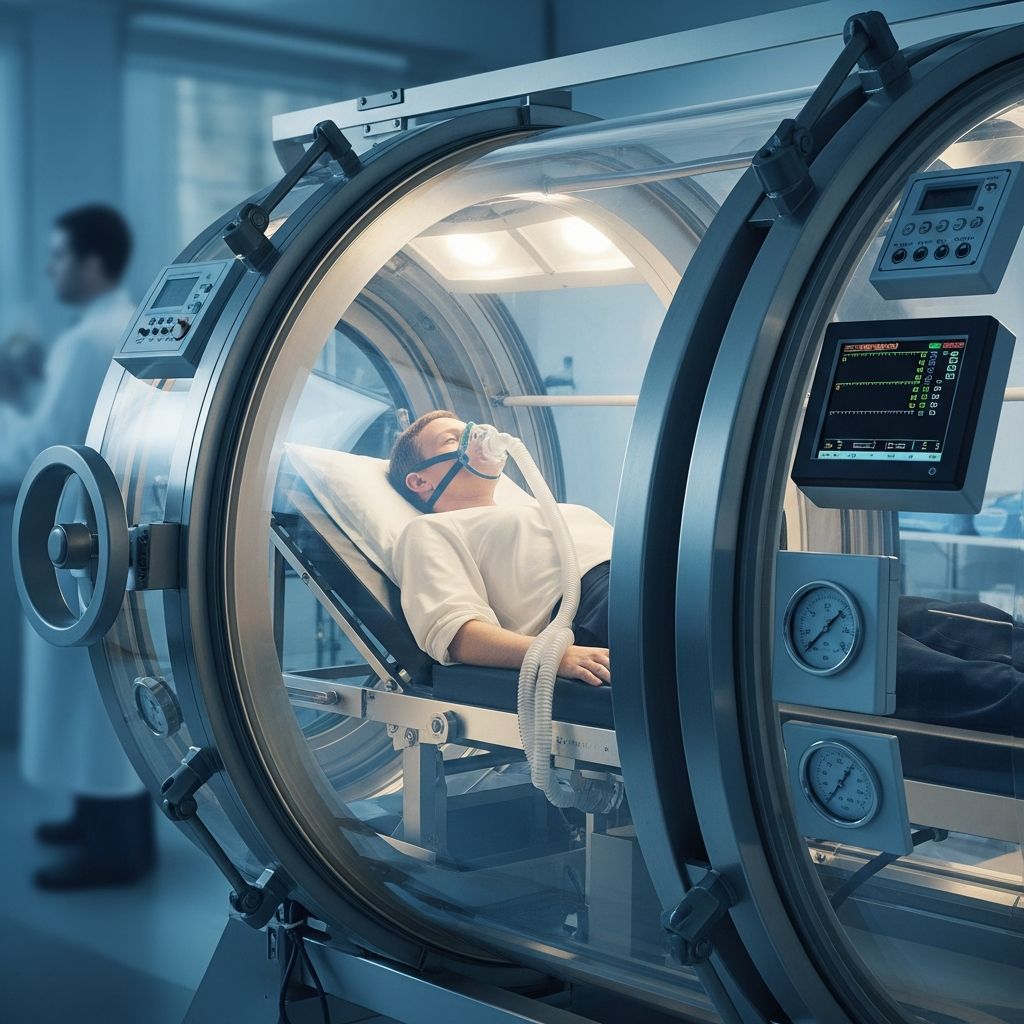
Hyperbaric oxygen therapy (HBOT) is a medical treatment in which patients breathe 100% pure oxygen while inside a specially pressurized chamber. The chamber is pressurized to a level greater than normal atmospheric pressure at sea level, typically between 2.0 and 2.5 atmospheres absolute (ATA). This increased pressure allows significantly more oxygen to dissolve into the bloodstream and body tissues than would be possible under normal atmospheric conditions.
During a typical HBOT session, patients enter a hyperbaric chamber where they receive oxygen through various delivery methods, including a head tent, mask, or endotracheal tube. The therapy works by combining two fundamental principles: increased atmospheric pressure and 100% oxygen concentration. When breathing 100% oxygen at 3 ATA, the mean arterial oxygen tension increases from approximately 100 mmHg under normal conditions to 2000 mmHg, and oxygen delivery to tissues increases from 3 to 60 mL of oxygen per liter of blood.
How Hyperbaric Oxygen Therapy Works
The effectiveness of HBOT is grounded in fundamental gas laws and physiology. Under normal atmospheric conditions, most oxygen in the blood is bound to hemoglobin, with blood hemoglobin saturated at approximately 97% and working near maximum capacity. Only a small amount of oxygen dissolves directly into the blood plasma.
The Science Behind HBOT
When oxygen concentration increases—either through higher percentages of inhaled oxygen or increased pressure—more oxygen dissolves into the blood plasma. This process, explained by Henry’s Law, demonstrates that the amount of gas dissolved in a solution is directly proportional to its partial pressure. In HBOT conditions, the fraction of inspired oxygen and partial pressure of oxygen supersaturates the blood, allowing excess oxygen to be carried in solution and diffuse to areas where red blood cells cannot reach.
Another critical mechanism involves Boyle’s Law, which states that the volume of a gas bubble is inversely related to the pressure exerted upon it. This principle is particularly important for treating conditions such as decompression illness and intravascular embolism, where gas bubbles in the bloodstream need to be reduced.
Additional Therapeutic Mechanisms
Beyond oxygen delivery, HBOT provides multiple healing mechanisms:
- Enhanced neovascularization (formation of new blood vessels)
- Improved immune response activation
- Fibroblast activation to support tissue repair
- Downregulation of inflammation
- Upregulation of growth factor synthesis
- Potentiation of antibiotics and antibacterial processes
- Enhanced antioxidant response
- Amelioration of ischemia-reperfusion injury
Primary Medical Applications
HBOT is considered the mainstay of treatment for several potentially life-threatening conditions. These primary indications include:
Carbon Monoxide Poisoning
One of the most critical applications of HBOT is treating acute carbon monoxide (CO) poisoning. The standard treatment includes administration of 100% oxygen and supportive care. HBOT is often recommended for patients with acute CO poisoning, particularly those who have lost consciousness or exhibit severe poisoning symptoms. The therapy hastens the elimination of carboxyhemoglobin from the blood and decreases cerebral edema. Research shows that HBOT may increase blood oxygen levels to alleviate the hypoxic state in the brains of CO-poisoned patients, with nearly half of treated patients achieving significantly higher recovery results compared to control groups after 8 weeks of treatment.
Related Stories



Decompression Illness
Decompression illness, also known as “the bends,” occurs when divers ascend too rapidly from depth, causing nitrogen gas bubbles to form in the bloodstream and tissues. HBOT reduces the volume of these bubbles through increased pressure, allowing them to be reabsorbed by the body. This mechanism makes HBOT the gold standard treatment for decompression sickness.
Gas Embolism
Gas embolisms occur when air bubbles enter blood vessels and obstruct blood flow. HBOT treats this condition through both pressure reduction of bubble volume and enhanced oxygen delivery to affected tissues. The increased atmospheric pressure compresses the gas bubbles, while the elevated oxygen concentration promotes their reabsorption.
Adjunctive Applications and Wound Healing
Beyond primary indications, HBOT has been utilized for decades as an adjunctive therapy across various medical disciplines, particularly in wound care and tissue recovery. The therapy supports healing in multiple wound types and chronic conditions.
Wound Healing Benefits
HBOT promotes healing by supporting an oxygen-rich supply of blood to injury sites and providing a driving force for neovascularization. Common wounds treated with HBOT include:
- Radiation injuries
- Infections and infected wounds
- Burns
- Skin grafts
- Crush injuries
- Chronic non-healing wounds
- Diabetic foot ulcers
The increased oxygen availability enhances the body’s natural healing processes, promotes bacterial elimination, and supports tissue regeneration.
Neurological and Brain Injury Applications
Research demonstrates HBOT’s potential in treating traumatic brain injuries (TBI) through multiple mechanisms. HBOT may improve TBIs through increased tissue oxygenation, reduced inflammation, inhibition of apoptosis, reduced intracranial pressure, and promotion of angiogenesis and neurogenesis. Additionally, HBOT reduces brain swelling via osmotic effects. Studies show effectiveness in mild to moderate TBIs, with evidence supporting neuroprotective effects when administered at pressures less than 3 ATA.
Treatment Protocol and Safety
HBOT treatment typically involves pressurization to between 2.0 and 2.5 ATA, which is equivalent to approximately 250 kPa per square inch, roughly equivalent to the pressure at a depth of 15 meters of water. Treatment sessions generally last between 90 minutes to 2 hours, with multiple sessions required depending on the condition being treated.
Treatment Frequency and Duration
The number of HBOT sessions required varies based on the specific condition and patient response. Acute conditions like carbon monoxide poisoning may require intensive treatment protocols, while chronic wound healing typically involves multiple sessions spread over several weeks or months. Treatment plans are customized based on individual patient needs and clinical response.
Safety Considerations
HBOT is generally considered a safe medical treatment when administered under proper medical supervision. However, patients exposed to increased pressures for extended periods require monitoring for potential complications. Modern hyperbaric facilities include trained medical staff and safety protocols to minimize risks.
Availability and Clinical Implementation
The use of hyperbaric oxygen therapy has expanded significantly in modern healthcare. A 2017 report estimated that nearly 1,300 hospitals in the United States have installed hyperbaric facilities. This widespread availability demonstrates the established role of HBOT in contemporary medical practice across diverse clinical settings.
Frequently Asked Questions
Q: How long does a typical hyperbaric oxygen therapy session last?
A: A standard HBOT session typically lasts between 90 minutes to 2 hours. The exact duration depends on the medical condition being treated and the specific treatment protocol prescribed by your physician.
Q: Is hyperbaric oxygen therapy painful?
A: HBOT is generally not painful. Patients may experience ear pressure similar to what occurs during airplane descent, which can be managed through equalization techniques. Some patients may experience slight discomfort, but serious pain is unusual.
Q: How many HBOT sessions are typically needed?
A: The number of sessions varies depending on the condition. Acute conditions like carbon monoxide poisoning may require 20-40 sessions, while chronic wounds may require 30-40 sessions or more. Your physician will determine the appropriate treatment plan.
Q: What conditions does hyperbaric oxygen therapy treat?
A: HBOT treats multiple conditions including carbon monoxide poisoning, decompression illness, gas embolism, chronic wounds, burns, infections, diabetic ulcers, and has shown promise in treating traumatic brain injuries and radiation injuries.
Q: Are there any side effects from hyperbaric oxygen therapy?
A: Side effects are typically mild and temporary. Common effects include ear discomfort, sinus pressure, and claustrophobia in some patients. Serious complications are rare when treatment is administered under proper medical supervision.
Q: How does HBOT differ from regular oxygen therapy?
A: HBOT combines 100% oxygen with increased atmospheric pressure, allowing significantly more oxygen to dissolve into the bloodstream than regular oxygen therapy. This enables oxygen to reach tissues that may have compromised blood flow and penetrate areas red blood cells cannot reach.
Q: Is hyperbaric oxygen therapy covered by insurance?
A: Coverage varies by insurance provider and depends on the medical condition. FDA-approved indications for HBOT are more likely to be covered. You should consult with your insurance provider and healthcare team about coverage for your specific situation.
References
- Hyperbaric Oxygen Therapy: Descriptive Review of the Underlying Hypoxia-Dependent Pharmacology and Effectiveness in Evidence-Based Adjunctive Treatment — National Center for Biotechnology Information (NCBI). 2020. https://pmc.ncbi.nlm.nih.gov/articles/PMC7544320/
- Impact of Hyperbaric Oxygen Therapy on Cognitive Functions — National Center for Biotechnology Information (NCBI). 2021. https://pmc.ncbi.nlm.nih.gov/articles/PMC8888529/
- Hyperbaric Oxygen Therapy for the Treatment of Traumatic Brain Injuries — University of North Dakota School of Medicine & Health Sciences. 2020. https://commons.und.edu/cgi/viewcontent.cgi?article=1256&context=pas-grad-posters
Similar Articles








Read full bio of medha deb