Hypergranulotic Dyscornification Pathology
Exploring the histological reaction pattern in benign cutaneous keratoses with distinctive granular and cornification changes.
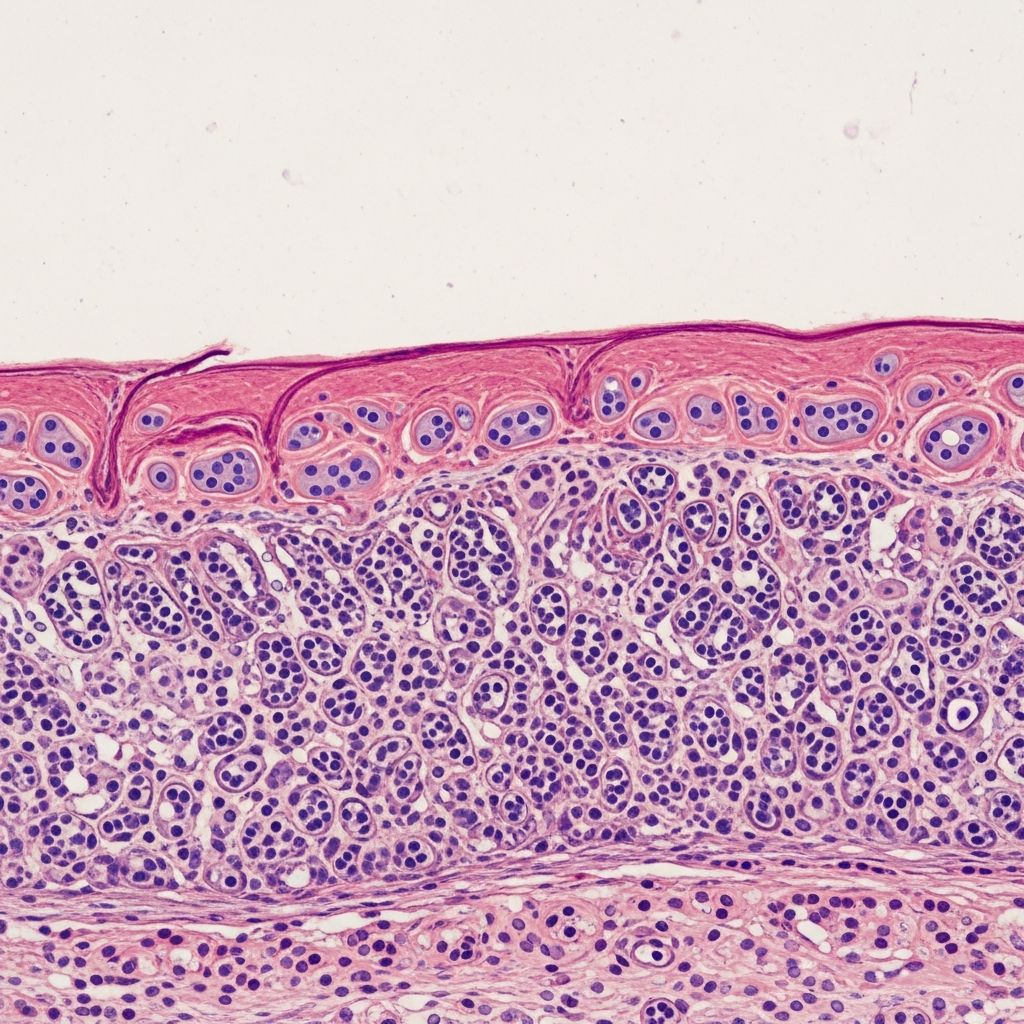
Hypergranulotic dyscornification is a histological reaction pattern seen in benign cutaneous keratoses.
Histology of hypergranulotic dyscornification
Hypergranulotic dyscornification represents a distinctive and rarely reported alteration in epidermal keratinization, primarily observed in solitary benign keratotic lesions. This pattern is characterized by exaggerated granular layer development combined with abnormal cornification, distinguishing it from more common reactive or neoplastic skin changes.
The lesion architecture often mimics aspects of verruca vulgaris, presenting as exo- or endo-endophytic with finger-like projections of epidermal hyperplasia. A prominent feature is the marked
hypergranulosis
, where the granular layer shows tightly clustered, clumped perinuclear keratohyaline granules. These granules appear coarse and aggregated, contrasting with the uniform distribution seen in normal epidermis.The overlying stratum corneum exhibits
compact orthokeratosis
basally, transitioning to a more laminated or basket-weave pattern superiorly. Critically, within this layer, one observes mounds or clusters ofrounded, glassy, eosinophilic corneocytes
—anucleate cells that retain a plump, refractile appearance rather than flattening completely. This dyscornification reflects disordered maturation, with parakeratotic foci often intermingled.In the dermis, a mild to moderate lymphocytic infiltrate occupies the superficial papillary dermis, typically without significant vascular or melanocytic changes. No viral cytopathic effects, such as koilocytes, are present to suggest human papillomavirus infection, despite clinical similarities to inflamed warts.


Ultrastructural findings
Electron microscopy reveals dense perinuclear bands of keratin intermediate filaments corresponding to the clumped keratohyalin areas observed on light microscopy. Unlike epidermolytic hyperkeratosis, there are no pale cytoplasmic zones devoid of tonofilaments, confirming distinct pathogenesis.
Immunohistochemistry
Keratin stains highlight the perinuclear aggregations, supporting abnormal keratin filament assembly without the reticular degeneration of epidermolytic changes. This aids in distinguishing HD from mimics.
Clinical context
Hypergranulotic dyscornification emerges in the context of irritated or inflamed benign keratoses, most frequently excised from lower extremities (e.g., legs), followed by trunk. Less common sites include upper limbs, though contrary to early reports, head and neck involvement occurs.
Patients span adults with mean age ~57 years, showing female predominance (nearly 2:1). Lesions clinically resemble inflamed seborrheic keratosis, Bowen disease (squamous cell carcinoma in situ), hypertrophic actinic keratosis, or inflamed verruca vulgaris. Size varies, but all reported cases prove benign post-excision.
- Common precursors: Inflamed seborrheic keratosis, hypertrophic lichen simplex chronicus, porokeratosis, inflamed verruca.
- Rare associations: Epidermoid cysts (incidental finding).
Differential diagnosis
Related Stories



The pattern requires distinction from several entities:
| Feature | Hypergranulotic Dyscornification | Epidermolytic Hyperkeratosis | Verruca Vulgaris | Porokeratosis |
|---|---|---|---|---|
| Granular layer | Clumped perinuclear granules | Hypergranulosis with reticular degeneration | Normal to mild hypergranulosis | Cornoid lamella |
| Corneocytes | Rounded glassy eosinophilic | Compact hyperkeratosis | Basket-weave, koilocytes | Parakeratotic column |
| EM findings | Dense perinuclear bands | Pale cytoplasm, clumped tonofilaments | Viral particles | N/A |
| Dermal infiltrate | Mild lymphocytic | Variable | Prominent with vessels | Minimal |
Epidermolytic hyperkeratosis (ichthyosis hystrix variant) shows perinuclear vacuolization and tonofilament clumping on EM, absent in HD.
Verruca lacks glassy corneocytes and viral inclusions.
Porokeratosis features diagnostic cornoid lamella.
Pathogenesis
The etiology remains elusive, posited as a keratinization disorder possibly linked to somatic keratin mutations or maturational defects in corneocytes. Unlike genetic epidermolytic syndromes, HD affects solitary acquired lesions, suggesting reactive or acquired keratin filament anomalies. No viral, inflammatory, or neoplastic drivers identified.
Frequently Asked Questions (FAQs)
What is hypergranulotic dyscornification?
A benign histological reaction pattern in keratoses with hypergranulosis and abnormal glassy corneocytes.
Is it cancerous?
No, all reported cases are benign; no malignant transformation noted.
How is it diagnosed?
Excisional biopsy with histopathological exam showing key features.
What causes it?
Unknown; likely keratinization disorder in irritated benign lesions.
Does it occur on the face?
Yes, though less common than limbs/trunk.
Related topics
- Seborrhoeic keratosis pathology
- Verruca pathology
- Porokeratosis pathology
- Epidermolytic acanthoma
References
- Hypergranulotic dyscornification: 30 cases of a striking epithelial reaction pattern — Roy A, Ko CJ, et al. J Cutan Pathol. 2019-07-01. https://pubmed.ncbi.nlm.nih.gov/31157457/
- Hypergranulotic dyscornification pathology — DermNet NZ. 2021-09-01. https://dermnetnz.org/topics/hypergranulotic-dyscornification-pathology
- Hypergranulotic dyscornification — DermNet NZ. 2021-09-01. https://dermnetnz.org/topics/hypergranulotic-dyscornification
- Hypergranulotic Dyscornification – Alba Variant — PubMed. 1974-10-01. https://pubmed.ncbi.nlm.nih.gov/41585829/
Similar Articles








Read full bio of Sneha Tete