Hyperkeratotic Palmar Dermatitis: Complete Guide
Understanding the causes, symptoms, diagnosis, and effective treatments for hyperkeratotic palmar dermatitis, a chronic hand skin condition.
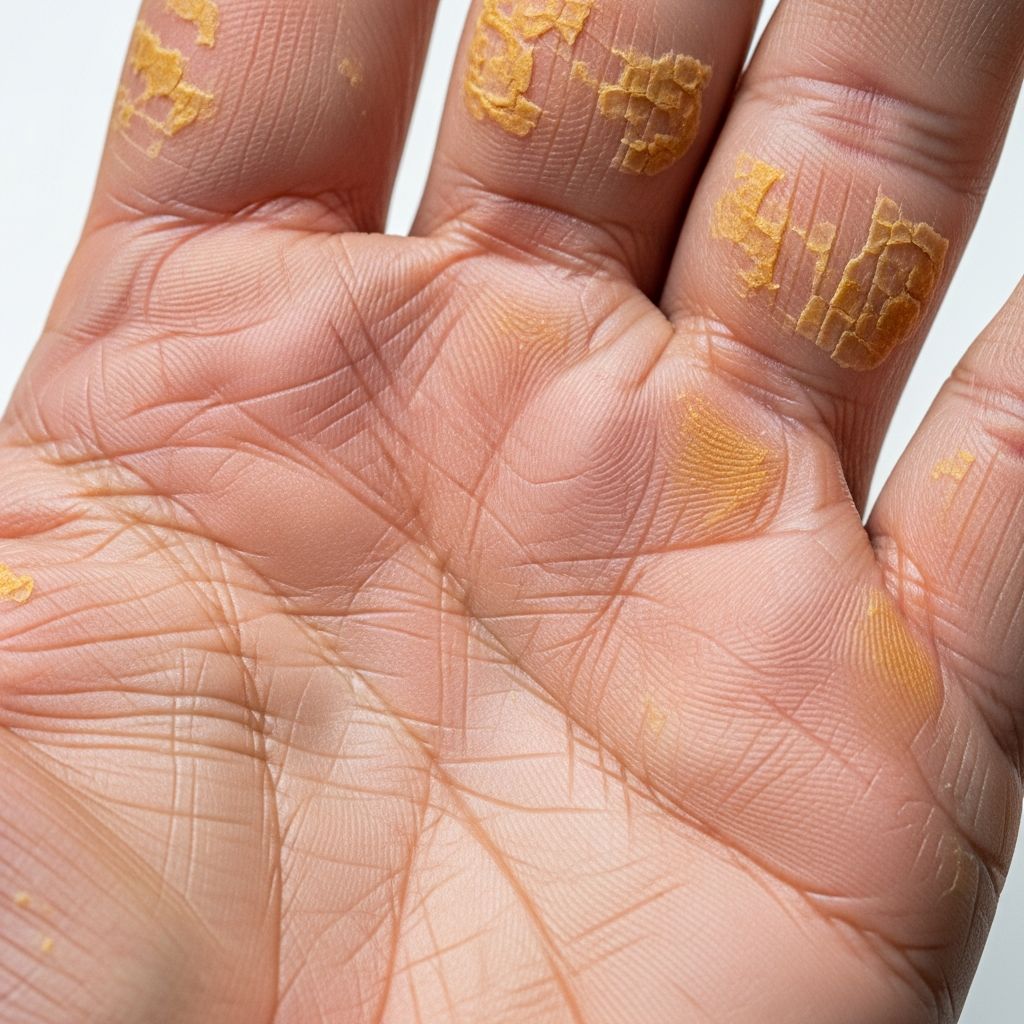
Hyperkeratotic palmar dermatitis, also known as hyperkeratotic hand eczema, is a chronic inflammatory skin condition characterized by sharply demarcated areas of hyperkeratosis and thick scaling primarily on the palms, often extending to the fingers. This condition manifests as dry, thickened, grayish plaques with painful fissures, distinguishing it from acute eczematous dermatitis.
What is Hyperkeratotic Palmar Dermatitis?
Hyperkeratotic palmar dermatitis represents a subtype of hand eczema defined by excessive thickening of the stratum corneum, the outermost layer of the skin, leading to hyperkeratotic plaques on the palms. Unlike typical vesicular or weeping eczema, it lacks acute inflammatory features and instead presents with persistent scaling and fissuring. The condition is often bilateral and symmetric, affecting the central palms most severely, and may involve the thenar and hypothenar eminences. Plantar involvement can occur in some cases, presenting similar hyperkeratotic plaques without significant erythema.
Histopathologically, it shows compact hyperkeratosis, acanthosis, and mild spongiosis, with upregulation of keratins such as K6, K16, K17, and early barrier proteins like involucrin. These changes suggest a response to chronic irritation or an intrinsic barrier defect. The pathogenesis involves a complex interplay of genetic predisposition, impaired skin barrier function, and environmental irritants, leading to keratinocyte hyperproliferation and immune dysregulation, potentially Th17-driven similar to psoriasis.
Who Gets Hyperkeratotic Palmar Dermatitis?
This condition predominantly affects adults, particularly those in occupations involving frequent hand wetting, exposure to irritants, or mechanical friction, such as healthcare workers, cleaners, and mechanics. It is more common in individuals with a personal or family history of atopy, though many cases lack active atopic dermatitis. Women may be slightly more affected due to occupational exposures. The chronic nature often leads to significant morbidity, impacting daily activities and work productivity.
- Prevalence: Common in chronic hand eczema cohorts, comprising up to 10-20% of cases in specialized clinics.
- Risk factors: Repeated irritant exposure, friction, pre-existing barrier defects, possible genetic variants in palmoplantar keratoderma-related genes.
Related Conditions
Hyperkeratotic palmar dermatitis must be differentiated from several mimicking conditions, as outlined in the table below:
| Condition | Key Characteristics | Etiology |
|---|---|---|
| Frictional hyperkeratotic hand dermatitis | Symmetric, lichenified plaques with erosions and pain | Repetitive mechanical friction, trauma, vibration |
| Psoriasis (palmar) | Erythema, thickening, scaling, deep fissures, possible pustulosis | Immune-mediated, Th17-driven |
| Palmoplantar keratoderma (PPK) | Diffuse or focal hyperkeratosis, hereditary forms | Genetic mutations |
| Tinea manuum | Diffuse scaling, possible annular lesions on dorsum | Dermatophyte infection |
| Irritant contact dermatitis | Erythema, erosions, burning | Chemical or physical irritants |
These distinctions are crucial, as treatments vary significantly.
History
Patients typically report an insidious onset of dry, rough palm skin that progressively thickens over months to years. Initial symptoms include mild itching or tightness, evolving into painful cracking with fissuring, exacerbated by water exposure, cold weather, or manual labor. Many note persistence despite emollient use, with relapses common after flares. Occupational history often reveals wet work or irritant contact. A history of childhood eczema or nickel allergy may be present, though not universal.
Clinical Features
The hallmark is well-demarcated, hyperkeratotic plaques on the palms, appearing as dry, gray-white, thickened skin with prominent scaling. Fissures, often deep and linear, traverse the plaques, causing significant pain and bleeding risk. Itching is variable, milder than in vesicular eczema, and erythema is minimal or absent. Finger involvement includes sides and pulps, occasionally with nail dystrophy. Plantar lesions, if present, mirror palmar changes.
Related Stories



- Primary features: Hyperkeratosis, scaling, painful fissures.
- Secondary: Mild pruritus, occasional superficial erosions.
- Severity: Ranges from mild thickening to disabling fissuring impairing grip.
Diagnosis
Diagnosis is primarily clinical, based on characteristic morphology and history of chronicity without acute eczema signs. Patch testing rules out allergic contact dermatitis, while fungal scrapings and KOH prep exclude tinea. Skin biopsy, if needed, reveals compact orthokeratosis, hypergranulosis, and mild acanthosis without Munro microabscesses (vs. psoriasis). Immunohistochemistry may show elevated K17 and involucrin. Genetic screening for PPK is considered in early-onset or familial cases.
What’s the Differential Diagnosis for Hyperkeratotic Palmar Dermatitis?
Differential includes psoriasis, PPK, frictional dermatitis, tinea, and contact dermatitis, as detailed in the related conditions table. Psoriasis often has more erythema and nail changes; PPK is genetic and starts earlier; fungal infections show positive microscopy.
Investigations
- Patch testing for allergens.
- Mycology: Scraping and culture.
- Biopsy for atypical cases.
- Gene sequencing if hereditary suspected.
Treatment of Hyperkeratotic Palmar Dermatitis
Treatment is multifaceted, focusing on barrier repair, inflammation control, and irritant avoidance. Chronicity necessitates long-term management.
General Measures
- Irritant avoidance: Use cotton gloves under occlusives for wet work; frequent emollient application (e.g., petrolatum).
- Occlusion: Overnight with plastic gloves over emollients or steroids.
Topical Therapies
- Corticosteroids: Potent topical (clobetasol) under occlusion for 2-4 weeks, then taper.
- Keratolytics: Urea 20-40%, salicylic acid 6-10% to reduce hyperkeratosis.
- Calcineurin inhibitors: Tacrolimus for steroid-sparing.
Systemic Therapies
For refractory cases: Oral retinoids (alitretinoin, acitretin), methotrexate, or cyclosporine. Phototherapy (PUVA, narrowband UVB) effective for palmar involvement. Biologics like IL-17/23 inhibitors if psoriasiform.
| Treatment | Dosage/Regimen | Efficacy Notes |
|---|---|---|
| Topical clobetasol | 0.05% ointment, occlude nightly x2wks | High response rate, monitor atrophy |
| Urea cream | 20-40% bid | Softens plaques, combine with steroids |
| Alitretinoin | 30mg daily x24wks | Approved for chronic hand eczema |
Prevention
Primary prevention involves minimizing irritant exposure from an early stage. Secondary prevention includes proactive topical steroids and rigorous emollient use during remissions. Occupational counseling is key.
Hyperkeratotic Palmar Dermatitis in Adults
In adults, the condition is often occupationally triggered and refractory, requiring multidisciplinary input from dermatology and occupational health. Quality of life impacts are profound due to pain and functional impairment.
Hyperkeratotic Palmar Dermatitis in Children
Rare in children, usually linked to genetic keratodermas or severe atopic eczema. Management mirrors adults but with milder topicals.
Complications
- Painful fissuring leading to secondary infection (bacterial, candidal).
- Functional disability: Impaired dexterity, grip strength.
- Psychosocial: Anxiety, depression from chronicity.
Possible Causes
Multifactorial: Barrier disruption from irritants induces K6/16/17 expression, hyperproliferation. Intrinsic defects amplify susceptibility. Th17 cytokines may drive chronicity.
Further Reading
- Hand dermatitis overview.
- Chronic hand eczema management guidelines.
Frequently Asked Questions
Is hyperkeratotic palmar dermatitis contagious?
No, it is not infectious; it stems from inflammatory and irritant factors.
Can it be cured?
It is chronic but manageable with consistent therapy; complete cure is uncommon.
How long does treatment take?
Initial response in 4-8 weeks, maintenance lifelong.
Does it affect fingernails?
Occasionally, with dystrophy if extensive.
References
- Hyperkeratosis: Symptoms and Treatment — WebMD. 2023. https://www.webmd.com/skin-problems-and-treatments/hyperkeratosis
- Hyperkeratotic hand eczema: Eczema or not? — PMC – NIH. 2020-09-28. https://pmc.ncbi.nlm.nih.gov/articles/PMC7496397/
- Hyperkeratotic Plaques on Hands — American Academy of Family Physicians (AAFP). 2016-06-01. https://www.aafp.org/pubs/afp/issues/2016/0601/p945.html
- Managing Hyperkeratotic Eczema of the Hands and Feet — HMP Global Learning Network. 2023. https://www.hmpgloballearningnetwork.com/site/thederm/article/4257
- Hyperkeratosis: What It Is, Types, Causes & Treatment — Cleveland Clinic. 2023. https://my.clevelandclinic.org/health/diseases/hyperkeratosis
Similar Articles








Read full bio of Sneha Tete