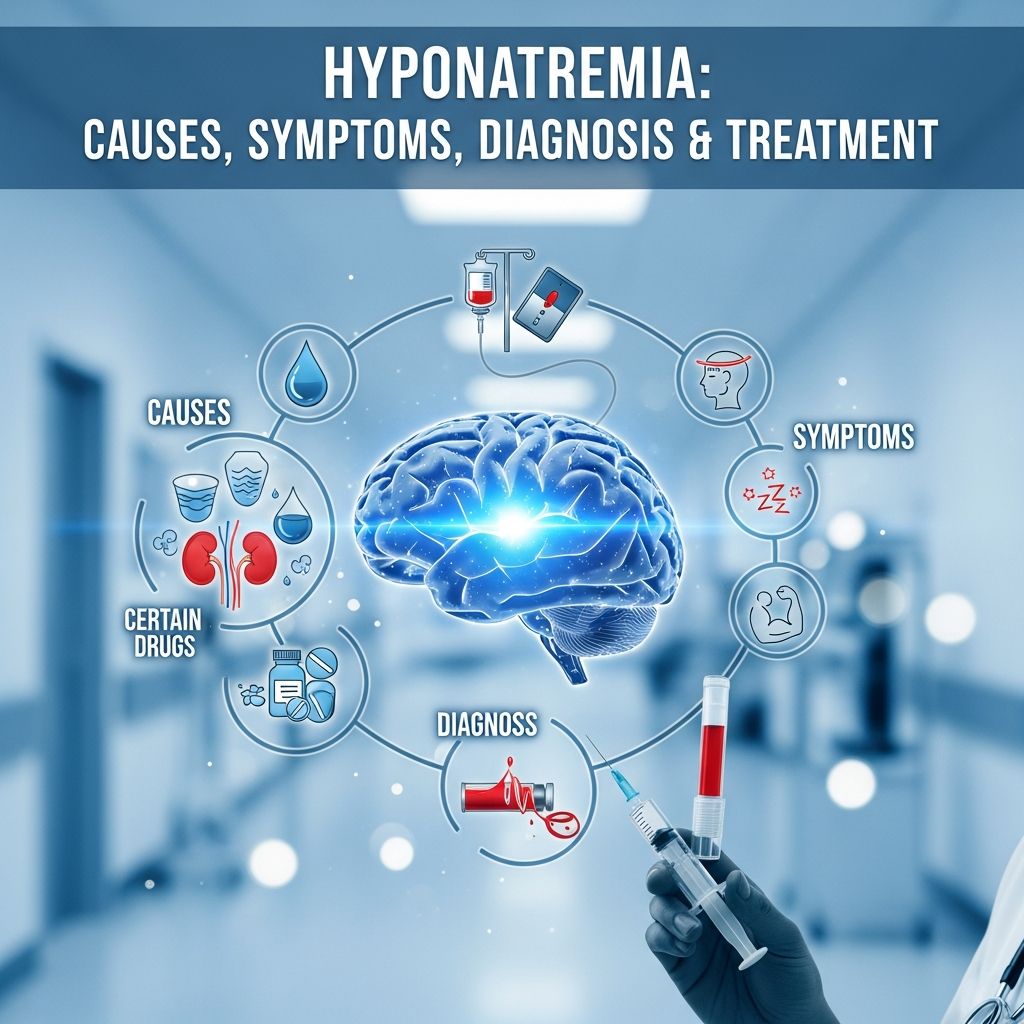
Hyponatremia: Causes, Symptoms, Diagnosis & Treatment
Understanding low sodium levels: causes, symptoms, diagnosis, and effective treatment options.
Understanding Hyponatremia: Low Blood Sodium Levels
Hyponatremia is a medical condition characterized by an abnormally low concentration of sodium in your blood. Sodium is one of the most important electrolytes in your body—a mineral that plays a crucial role in maintaining proper fluid balance, nerve function, and muscle contraction. When sodium levels fall below 135 millimoles per liter (mmol/L), the condition is diagnosed as hyponatremia. This electrolyte imbalance can range from mild to severe and may develop gradually over time or emerge suddenly, depending on the underlying cause.
What Causes Hyponatremia?
Hyponatremia develops when there is either too much water in your bloodstream relative to sodium, or too little sodium overall. The causes are diverse and can be related to various medical conditions, medications, or lifestyle factors.
Medical Conditions Associated with Hyponatremia
Several serious medical conditions can lead to dangerously low sodium levels. Heart disease, particularly congestive heart failure, can impair the kidneys’ ability to excrete excess water appropriately. Liver disease affects the body’s fluid regulation mechanisms, while kidney disease directly compromises the organs responsible for maintaining electrolyte balance. Thyroid disorders and adrenal gland dysfunction can also disrupt sodium regulation through hormonal mechanisms. Additionally, certain brain conditions and injuries can trigger hyponatremia through inappropriate antidiuretic hormone (ADH) secretion.
Medications and Hyponatremia
Numerous medications can contribute to hyponatremia as a side effect. Diuretics, commonly prescribed for high blood pressure and heart failure, increase water and sodium loss through urine. Selective serotonin reuptake inhibitors (SSRIs) and other psychiatric medications may cause the syndrome of inappropriate antidiuretic hormone secretion (SIADH). Carbamazepine, used for seizure management, can also trigger hyponatremia. Thiazide diuretics, in particular, are well-known culprits in medication-induced hyponatremia.
Lifestyle and Environmental Factors
Excessive water consumption, particularly in endurance athletes or individuals engaged in intense exercise without proper electrolyte replacement, can dilute blood sodium levels. A condition known as “beer potomania,” where individuals consume large quantities of beer while eating very little food, creates a critically low solute environment that prevents normal free water excretion. Severe sweating without adequate sodium and electrolyte replacement, as might occur during marathon running or other strenuous activities, can also precipitate hyponatremia.
Hormonal Regulation Issues
The hormone vasopressin, also known as antidiuretic hormone (ADH), plays a central role in water balance. When this hormone is produced or released inappropriately—a condition called SIADH—the kidneys retain excessive water, diluting blood sodium. This can occur with certain medications, lung diseases, malignancies, or head injuries.
Recognizing the Symptoms of Hyponatremia
The symptoms of hyponatremia vary significantly depending on how quickly sodium levels drop and how severe the deficiency has become. Because sodium is critical for nerve function and brain activity, neurological symptoms predominate.
Mild to Moderate Symptoms
When hyponatremia develops gradually, symptoms may be subtle and easily overlooked. Patients often experience nausea, loss of appetite, and mild headaches. Some individuals report muscle cramps, weakness, or fatigue. These milder symptoms reflect the body’s attempt to adapt to slowly declining sodium levels.
Severe Symptoms Requiring Emergency Care
Acute hyponatremia with rapid sodium level decline produces more serious neurological manifestations. Severe headaches, confusion, disorientation, and restlessness may develop. In critical cases, patients may experience seizures, loss of consciousness, respiratory depression, coma, or life-threatening cerebral edema. These severe symptoms represent a medical emergency requiring immediate hospitalization and aggressive treatment.
Chronic vs. Acute Hyponatremia
Chronic hyponatremia develops over days to weeks, allowing the brain to gradually adjust to lower sodium concentrations through osmotic mechanisms. Because of this adaptation, chronic hyponatremia often produces fewer symptoms than acute hyponatremia, even at similarly low sodium levels. Acute hyponatremia, by contrast, develops within hours, preventing the brain from adapting, and therefore causes more severe symptoms even at higher sodium concentrations. The body’s failure to adapt in acute situations means that cerebral edema and serious neurological consequences occur more readily.
Related Stories



Diagnostic Approaches for Hyponatremia
Proper diagnosis of hyponatremia requires a systematic clinical and laboratory approach to confirm the condition and identify its underlying cause.
Laboratory Tests and Measurements
The cornerstone of hyponatremia diagnosis involves measuring serum sodium concentration, which should be performed using direct potentiometry methods when pseudohyponatremia is suspected, as this method bypasses dilutional steps that can artificially lower readings. Serum osmolality testing confirms that the patient has a true hypo-osmolar state, with levels below 275 mOsm/kg indicating genuine hyponatremia rather than artifacts of laboratory processing.
Urine osmolality and urine sodium concentration tests provide critical information about kidney function and the body’s response to hyponatremia. These tests should ideally be obtained before initiating treatment to guide therapeutic decisions. Additional laboratory markers, including serum uric acid concentration, help assess the patient’s extracellular fluid volume status and guide treatment selection.
Assessment of Symptom Severity and Duration
Clinicians must carefully assess whether serious signs or symptoms suggesting cerebral edema are present, as this dramatically affects treatment urgency and approach. Determining whether hyponatremia developed acutely (less than 48 hours) or chronically (more than 48 hours) is essential, as this distinction fundamentally influences treatment strategy and correction rates.
Volume Status Evaluation
Understanding whether the patient has normal, excessive, or depleted extracellular fluid volume guides treatment selection. Clinical examination combined with laboratory data helps categorize hyponatremia into euvolemic, hypervolemic, or hypovolemic types, each requiring different therapeutic approaches.
Medication and Dietary Review
A comprehensive review of all medications, including intravenous antibiotics and nutritional support such as total parenteral nutrition or tube-feeding solutions, helps identify potential iatrogenic causes. Identifying medications like thiazide diuretics that may rapidly correct with simple discontinuation is particularly important.
Treatment Strategies for Hyponatremia
Treatment of hyponatremia is individualized based on symptom severity, duration of hyponatremia, and underlying cause, with careful attention to correction rates to avoid complications.
Emergency Treatment for Severe Symptomatic Hyponatremia
Patients presenting with serious signs or symptoms of cerebral edema, including seizures or altered mental status, require urgent treatment with hypertonic (3%) saline administered intravenously. The initial phase aims to reverse cerebral edema through rapid partial correction at approximately 1 mL/kg/hour for the first several hours. In some cases, more aggressive correction at rates of 1.5 to 2 mmol/hour for the first 3 to 4 hours may be necessary until serious symptoms resolve. However, correction beyond 10 to 12 mmol/L in the first 24 hours should be avoided even in acute situations to prevent osmotic demyelination syndrome.
Correction Rate Guidelines
Once severe symptoms have resolved, hypertonic saline is promptly discontinued and replaced with appropriate therapy based on volume status and underlying cause. For most patients, sodium levels should not rise more than 12 mmol/L in 24 hours and no more than 18 mmol/L over 48 hours. For patients with chronic hyponatremia who present with cerebral edema, even slower correction rates—less than 10 mmol/L in the first 24 hours—are recommended to minimize the risk of osmotic demyelination syndrome.
Fluid Restriction
Fluid restriction remains the first-line treatment for most forms of chronic hyponatremia without severe symptoms. By limiting water intake, the concentration of sodium in the blood gradually increases toward normal levels. This approach is particularly effective for SIADH and other conditions causing dilutional hyponatremia.
Treatment Based on Volume Status
Hypovolemic hyponatremia (from excessive losses) typically requires isotonic saline administration to restore intravascular volume while allowing sodium levels to normalize. Hypervolemic hyponatremia (from conditions like congestive heart failure) may require loop diuretics combined with fluid restriction. Euvolemic hyponatremia often responds to fluid restriction alone or, in certain cases, to vasopressin antagonists.
Advanced Treatment Approaches
For severe cases, particularly with low-solute conditions like beer potomania, a proactive approach involves administering desmopressin (a selective vasopressin V2 receptor agonist) alongside 3% sodium chloride to carefully control sodium correction—a strategy known as the desmopressin clamp. This technique limits free water excretion while allowing clinicians to raise serum sodium to precalculated daily targets. Vasopressin antagonists represent a newer therapeutic option for managing certain types of chronic hyponatremia by blocking the kidney’s response to vasopressin, thereby promoting free water excretion.
Prevention of Overcorrection
Overcorrection of chronic hyponatremia can cause osmotic demyelination syndrome, a serious neurological condition. Risk factors for this complication include sodium levels lower than 120 mmol/L before treatment, rapid sodium correction, alcoholism, hypokalemia, female sex, and recent liver transplantation. If overcorrection occurs or is projected to occur, rescue strategies including dextrose 5% in water infusion and desmopressin administration can lower or slow the rise in serum sodium.
Managing Different Types of Hyponatremia
Treatment varies significantly based on the classification of hyponatremia according to volume status and underlying pathophysiology. Asymptomatic hyponatremia without serious signs or symptoms of cerebral edema generally proceeds cautiously with diagnostic evaluation and slower correction. Patients with symptomatic cerebral edema require urgent intervention but must still respect safe correction limits.
Frequently Asked Questions About Hyponatremia
Q: Can drinking too much water cause hyponatremia?
A: For most people with normal kidney function, excessive water intake rarely causes hyponatremia unless the person is severely dehydrated (such as after running a marathon) and fails to replace electrolytes simultaneously. However, in individuals with certain medical conditions or those taking specific medications, excessive water consumption can definitely precipitate hyponatremia.
Q: What is the difference between acute and chronic hyponatremia?
A: Acute hyponatremia develops over hours, causing rapid sodium level drops that prevent the brain from adapting, often resulting in severe symptoms and potential neurological emergencies. Chronic hyponatremia develops over days to weeks, allowing gradual brain adaptation through osmotic mechanisms, typically producing milder symptoms despite similarly low sodium levels. This distinction is critical because it determines treatment urgency and safe correction rates.
Q: What medications commonly cause hyponatremia?
A: Medications frequently associated with hyponatremia include diuretics (especially thiazides), SSRIs and other psychiatric drugs, carbamazepine for seizures, and various other medications that either promote water retention or interfere with normal sodium regulation.
Q: How quickly can sodium levels be corrected?
A: Safe correction rates typically do not exceed 12 mmol/L in 24 hours for most patients and 18 mmol/L over 48 hours. For chronic hyponatremia with severe symptoms, even slower correction—less than 10 mmol/L in the first 24 hours—is recommended to prevent osmotic demyelination syndrome.
Q: What is osmotic demyelination syndrome?
A: Osmotic demyelination syndrome is a serious neurological complication that can occur when hyponatremia, particularly chronic hyponatremia, is corrected too rapidly. The rapid increase in serum osmolality causes fluid shifts that damage the protective myelin coating around nerve fibers, potentially causing permanent neurological damage.
Q: When is hyponatremia considered a medical emergency?
A: Hyponatremia becomes a medical emergency when accompanied by severe symptoms such as seizures, severe confusion, loss of consciousness, respiratory depression, or signs of cerebral edema. These conditions require immediate hospitalization and urgent hypertonic saline administration.
References
- Management of hyponatremia: Providing treatment and avoiding harm — Cleveland Clinic Journal of Medicine. 2010. https://www.ccjm.org/content/ccjm/77/10/715.full.pdf
- Diagnosis and Treatment of Hyponatremia — PubMed Central/National Institutes of Health. 2017. https://pubmed.ncbi.nlm.nih.gov/28174217/
- Severe Hyponatremia: Are You Monitoring The Urine Output? — Cleveland Clinic ConsultQD. 2023. https://consultqd.clevelandclinic.org/severe-hyponatremia-are-you-monitoring-the-urine-output
- Hyponatremia: Causes, Symptoms, Diagnosis & Treatment — Cleveland Clinic Patient Education. 2024. https://my.clevelandclinic.org/health/diseases/17762-hyponatremia
- Hyponatremia: Why it matters, how it presents, how we can manage it — Cleveland Clinic Journal of Medicine. 2010. https://www.ccjm.org/content/ccjom/73/9_suppl_3/S4.full.pdf
Similar Articles








Read full bio of medha deb