Ichthyosis Vulgaris: Guide To Symptoms, Causes & Treatment
Understanding the most common inherited skin disorder: causes, symptoms, diagnosis, and effective management strategies for dry, scaly skin.
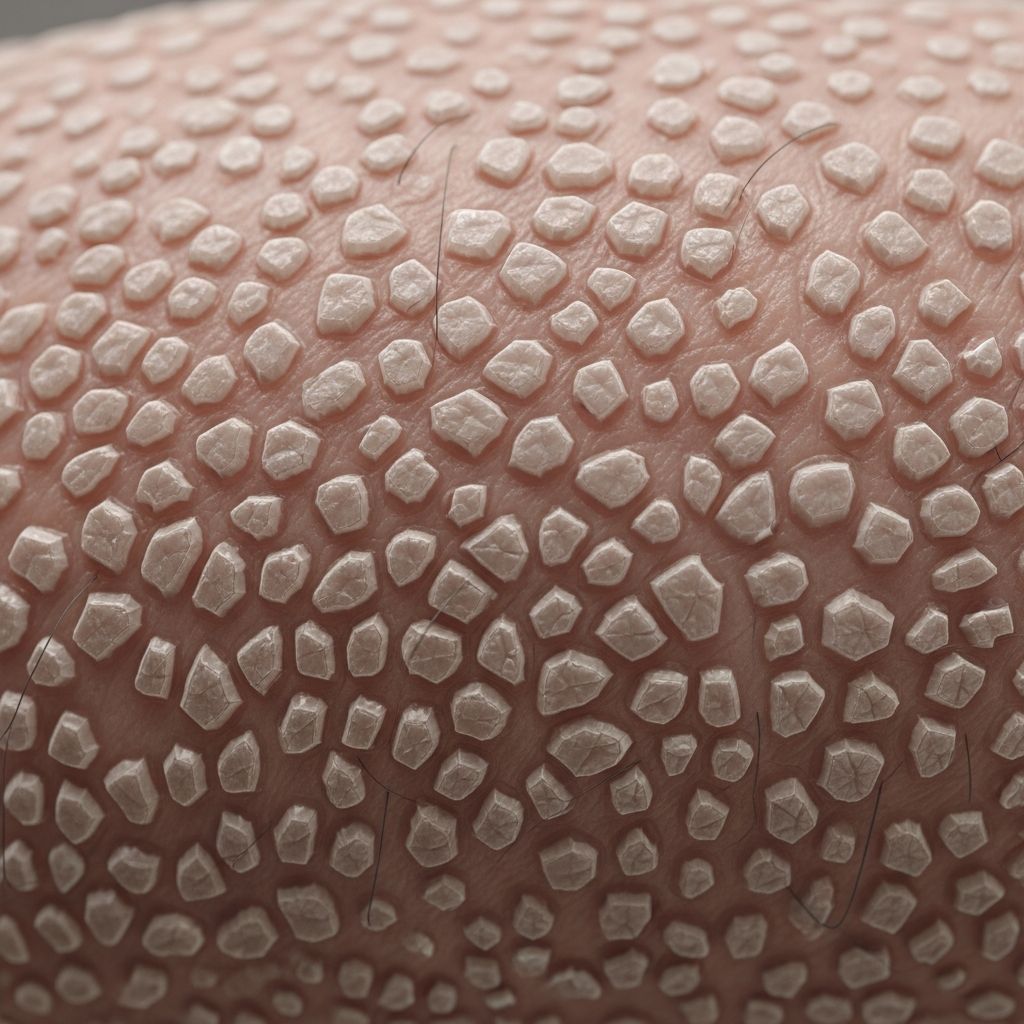
Ichthyosis vulgaris is the most common type of ichthyosis, a group of inherited skin disorders characterized by dry, rough, scaly skin resembling fish scales. It affects approximately 1 in 250 people worldwide, making it a prevalent genetic dermatological condition.
What is Ichthyosis Vulgaris?
Ichthyosis vulgaris, often simply called common ichthyosis, results from a mutation in the filaggrin gene (FLG), which impairs the skin’s ability to shed dead cells properly. This leads to accumulation of scales on the skin surface. The condition typically manifests after infancy, with normal skin at birth that gradually becomes dry and scaly. Unlike more severe ichthyoses present at birth, ichthyosis vulgaris develops around 3-12 months of age, starting on the legs and spreading to arms, trunk, and face.
Symptoms vary in severity and are often worse in low-humidity environments like winter, improving in warm, humid climates. It is autosomal dominant, meaning a single copy of the mutated gene from one parent is sufficient to cause the disorder.
Who Gets Ichthyosis Vulgaris (Epidemiology)?
Ichthyosis vulgaris has a prevalence of about 1 in 250 individuals, accounting for over 95% of all ichthyosis cases. It affects both males and females equally and is more noticeable in populations with lighter skin tones due to the white or gray scales contrasting against the skin.
The condition often runs in families with a history of atopic diseases. Up to 50% of individuals with ichthyosis vulgaris also have atopic dermatitis (eczema), and conversely, 8% of those with atopic eczema exhibit ichthyosis features. There is an elevated risk of asthma, allergic rhinitis, and food allergies in affected individuals.
- Prevalence: ~0.4% of the general population
- Age of onset: 3 months to puberty
- Genetic inheritance: Autosomal dominant
- Associations: Atopic dermatitis (50%), keratosis pilaris
Clinical Features of Ichthyosis Vulgaris
The hallmark of ichthyosis vulgaris is fine, white, polygonal scales, most prominent on the extensor surfaces of the extremities (outer arms and legs), trunk, and flexures. The scales are thin, dry, and adhere loosely to the skin.
Skin in affected areas feels rough, like sandpaper, with accentuated skin markings (hyperlinear palms and soles). Common symptoms include:
- Severely dry skin (xerosis)
- Fine scaling, often white or gray
- Mild to moderate itching
- Polygonal or rhomboidal scales
- Sparing of face, scalp (though dandruff-like scaling may occur), central back, and skin folds in mild cases
- Keratosis pilaris: Rough, follicular bumps on upper arms and thighs
Symptoms exacerbate in cold, dry weather and improve with humidity and warmth. Cracks in thick scales can lead to pain, bleeding, and secondary bacterial infections.
Associated Conditions
Ichthyosis vulgaris frequently coexists with atopic dermatitis, where eczema is more severe, early-onset, and persistent. Hyperextensible joints and atopic features like hyperlinear palms are common.
Diagnosis of Ichthyosis Vulgaris
Diagnosis is primarily clinical, based on characteristic scaling pattern, family history, and improvement with moisturizers. Differential diagnoses include other ichthyoses (e.g., X-linked recessive ichthyosis with darker scales), eczema, psoriasis, or acquired ichthyosis from malignancy or medications.
Skin biopsy shows compact orthokeratosis (thickened stratum corneum) with absent or reduced granular layer, confirming filaggrin deficiency. Genetic testing for FLG mutations is available but not routine.
| Feature | Ichthyosis Vulgaris | X-linked Ichthyosis | Acquired Ichthyosis |
|---|---|---|---|
| Onset | Childhood | Infancy | Adulthood |
| Scales | Fine, white | Dark, large | Uniform, dirty |
| Distribution | Extensors spared flexures | Generalized | Trunk/legs |
| Cause | Genetic (FLG) | STS gene | Underlying disease |
Genetic Defect in Ichthyosis Vulgaris (Pathogenesis)
Related Stories



Caused by loss-of-function mutations in the profilaggrin gene (FLG) on chromosome 1q21, leading to reduced or absent filaggrin protein. Filaggrin is crucial for:
- Terminal differentiation of keratinocytes
- Formation of the skin barrier
- Desquamation (shedding) of corneocytes
Deficient filaggrin results in impaired skin barrier function, increased transepidermal water loss, dry skin, and scale retention. Null alleles increase atopic dermatitis risk by 2-3 fold.
Rarely, acquired forms occur in adults due to malignancies (e.g., lymphoma), sarcoidosis, thyroid disease, or drugs like clofazimine.
Treatment of Ichthyosis Vulgaris
There is no cure; management focuses on hydration, exfoliation, and infection prevention through daily skincare. Treatment reduces dryness, scaling, splitting, and thickening.
Daily Skincare Regimen
- Bathe daily or as directed: Use lukewarm water (10-15 min) with mild, fragrance-free soap. Add bath oil or salt to reduce stinging.
- Exfoliate gently: While skin is wet, use pumice, buff puff, or washcloth to remove scales.
- Moisturize immediately: Within 2-3 minutes post-bath, apply thick emollients (petrolatum, lanolin) to damp skin. Use 2-3 times daily.
Active Ingredients
- Keratolytics: Urea (10-20%), lactic acid (6-12%), salicylic acid, alpha-hydroxy acids to loosen scales.
- Emollients: Glycerol, petrolatum for occlusion.
- Humectants: High-lipid creams like lanolin.
Avoid irritants like harsh soaps or hot water. Petroleum jelly for cracks.
Prescription Therapies
- Topical retinoids: Tazarotene for severe scaling.
- Oral retinoids: Acitretin or isotretinoin for refractory cases (monitor lipids, liver).
- Antibiotics: For infections; bleach baths (1/2 cup per tub) to reduce bacteria.
Treat underlying atopic dermatitis with topical steroids if present.
Atopic Dermatitis and Ichthyosis Vulgaris
50% overlap: Ichthyosis worsens eczema severity and persistence. Shared filaggrin mutations impair barrier, increasing allergen penetration and atopy risk (asthma, rhinitis). Management integrates eczema therapies: emollients prevent flares.
Clinical Variants
Predominantly affects shins, thighs, upper arms; mild cases subclinical. Severe: erythroderma, ectropion rare. Keratosis pilaris common comorbidity.
Investigations
Rarely needed: Biopsy for confirmation, FLG genetic testing research-only.
Management and Prevention
Lifelong daily regimen essential. Humidifiers, loose clothing aid. Patient education key. Monitor for infections, psychological impact.
Prognosis and Complications
Mild, non-life-shortening; cosmetic issue mainly. Complications: Infections from cracks, heat intolerance, self-esteem effects.
Frequently Asked Questions (FAQs)
Q: Is ichthyosis vulgaris curable?
A: No, but symptoms are manageable with daily moisturizing and keratolytics.
Q: When does ichthyosis vulgaris appear?
A: Typically 3-12 months, worsening in childhood.
Q: Can ichthyosis vulgaris be prevented?
A: No, as it’s genetic, but flares prevented with skincare.
Q: Does it affect life expectancy?
A: No, rarely impacts health beyond skin.
Q: Is it contagious?
A: No, purely genetic.
References
- Ichthyosis Vulgaris – Symptoms, Causes, Treatment — NORD (rarediseases.org). 2023. https://rarediseases.org/rare-diseases/ichthyosis-vulgaris/
- Ichthyosis Vulgaris: Causes, Symptoms, Treatment & Recovery — Cleveland Clinic. 2024-05-23. https://my.clevelandclinic.org/health/diseases/21069-ichthyosis-vulgaris
- Ichthyosis vulgaris — MedlinePlus (NIH). 2024. https://medlineplus.gov/ency/article/001451.htm
- Ichthyosis vulgaris: Diagnosis and treatment — AAD (aad.org). 2023. https://www.aad.org/public/diseases/a-z/ichthyosis-vulgaris-treatment
- Ichthyosis — NHS (nhs.uk). 2023-10-25. https://www.nhs.uk/conditions/ichthyosis/
- Ichthyosis vulgaris — DermNet NZ. 2024. https://dermnetnz.org/topics/ichthyosis-vulgaris
Similar Articles








Read full bio of medha deb