Immunohistochemistry: Detecting Disease with Antibodies
Understanding how immunohistochemistry uses antibodies to detect antigens and diagnose disease.
Understanding Immunohistochemistry: A Guide to Antibody-Based Tissue Testing
Immunohistochemistry (IHC) represents one of the most important diagnostic tools in modern pathology. This laboratory technique uses antibodies to detect specific antigens present in tissue samples, allowing pathologists to identify disease markers and guide clinical decision-making. Whether used to diagnose cancer, predict how a patient will respond to treatment, or determine disease outcomes, IHC has become an essential component of comprehensive patient care. This guide explains what immunohistochemistry is, how it works, and why it matters for your health.
What Is Immunohistochemistry?
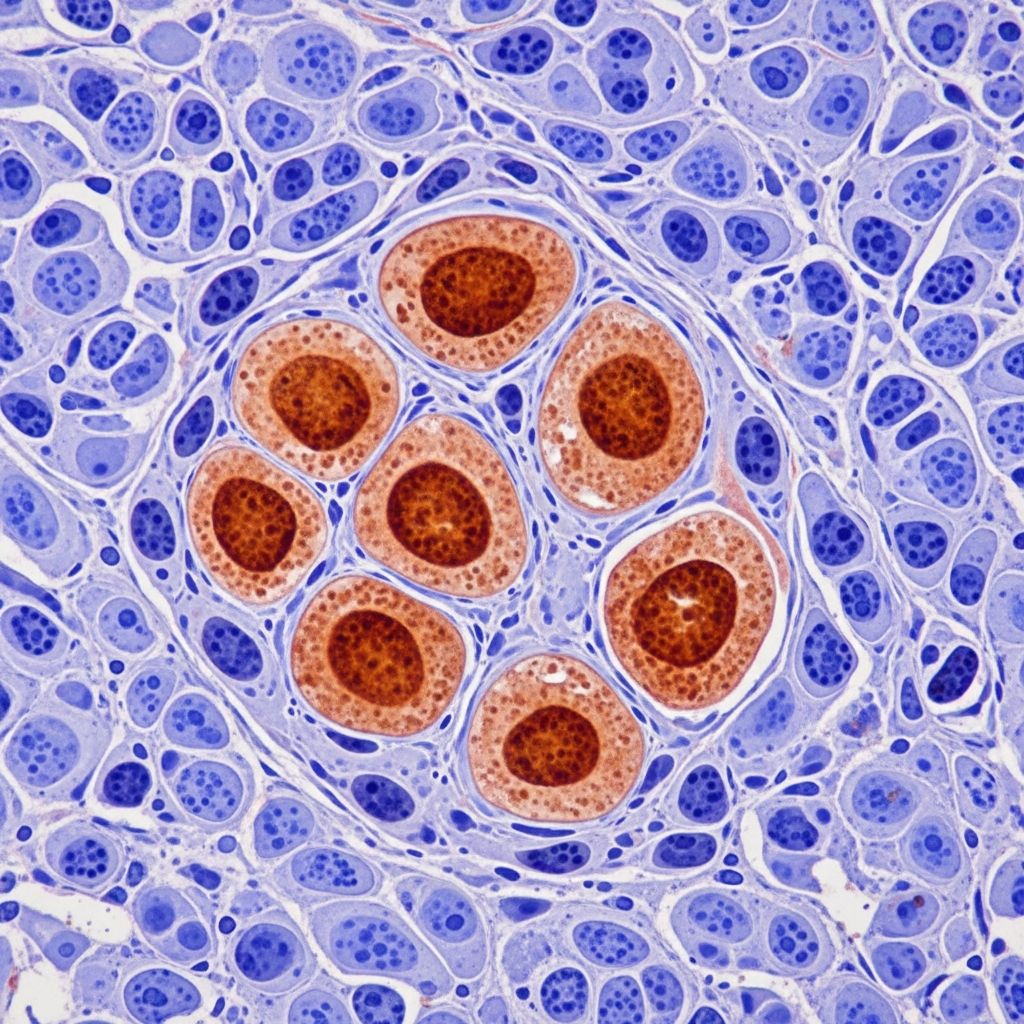
Immunohistochemistry is a specialized laboratory technique that uses antibodies to detect target antigens in tissue samples. An antigen is a marker that indicates the presence of a specific disease or condition. When antibodies recognize their corresponding antigens in a tissue sample, they bind to them—a process similar to a lock and key fitting together perfectly. Once binding occurs, the tissue sample displays a distinctive color when examined under a microscope, making it easy for pathologists to identify whether the target antigen is present.
IHC is the most common type of immunostaining, which is a broader category of techniques that use antibodies and special markers to label parts of a tissue sample for easier identification by pathologists. The term “immunohistochemistry” itself breaks down into its component parts: “immuno” referring to the immune system and antibodies, “histo” referring to tissue, and “chemistry” referring to the chemical reactions involved in the staining process.
What Are the Clinical Uses of Immunohistochemistry?
Immunohistochemistry has numerous applications in clinical medicine. The most common uses include:
- Cancer Diagnosis: IHC helps pathologists identify cancer types and confirm malignancy in tissue samples.
- Treatment Response Prediction: By identifying specific protein markers, IHC can help predict how well a patient might respond to certain cancer treatments, including immunotherapy drugs.
- Disease Prognosis: IHC results provide information about likely disease outcomes and progression.
- Disease Subclassification: The technique helps classify different subtypes of diseases, enabling more targeted treatment approaches.
- Tumor Origin Identification: When cancer has spread (metastasized), IHC can identify where the cancer originated with 70% to 90% accuracy.
- Infection Diagnosis: Beyond cancer, IHC is used to diagnose certain infections by detecting pathogen-specific antigens.
How Does Immunohistochemistry Work?
The immunohistochemistry process involves several carefully coordinated steps that pathologists must complete accurately for reliable results:
Sample Preparation
The first critical step is preparing the tissue sample so it will stain correctly. Pathologists begin by fixing the tissue to preserve its structure and prevent deterioration. The tissue is then embedded in paraffin wax, which allows technicians to cut extremely thin sections using a microtome. These tissue sections are mounted on glass slides to prepare them for antibody staining. Proper sample preparation is essential because it ensures that antigens remain intact and accessible to antibodies during the staining process.
Antibody Selection
Related Stories



Pathologists carefully select antibodies known to bind specifically to the target antigen they’re searching for. There are two main types of antibodies used in IHC:
- Polyclonal antibodies: These are a mixture of different antibodies that recognize multiple sites on the target antigen, providing broader recognition.
- Monoclonal antibodies: These are single, pure antibody types that recognize a specific site on the target antigen, offering greater specificity.
Antibody Preparation and Staining
Before staining tissue containing the target antigen, pathologists must prepare the antibody by linking it to a detection system. In traditional IHC, antibodies are linked to an enzyme such as horseradish peroxidase or alkaline phosphatase. When the enzyme encounters its substrate, it produces a colored reaction that makes the stained tissue visible when viewed under a microscope. This enzymatic labeling allows for clear visualization of where antigens are located within the tissue sample.
Microscopic Examination
Once staining is complete, pathologists examine the tissue sample under a microscope. If the target antigen is present, it will appear as a distinct colored segment against the background tissue. The pattern, intensity, and location of staining provide diagnostic information about the tissue composition and disease status.
The History and Evolution of Immunohistochemistry
The first successful immunohistochemistry techniques used a process very similar to modern methods, but with one important difference: researchers linked antibodies to fluorophores instead of enzymes. Fluorophores are molecules that absorb light and reflect it back, creating a glowing effect when the sample is viewed under a fluorescence microscope. This older technique is now recognized as a separate type of immunostaining called immunofluorescence. Modern enzymatic IHC developed from these early fluorescence-based methods and has become the standard approach used in most clinical laboratories today.
Quality Control and Accuracy
For immunohistochemistry to provide reliable diagnostic information, laboratories must implement rigorous quality control measures at every step of the process. These quality control procedures ensure that:
- Tissue samples are properly preserved during processing
- Antigens remain accessible for antibody binding
- Staining reactions occur consistently and completely
- Results are reproducible and accurate
One important quality control technique involves testing antibodies on tissue samples known to contain the target antigen before using them on unknown patient samples. This validation step confirms that antibodies will stain the tissue appropriately before applying the test to actual diagnostic cases. When performed correctly with proper quality controls in place, immunohistochemistry is recognized as a highly reliable method for cancer diagnosis and disease identification.
Immunohistochemistry vs. Other Immunostaining Techniques
While immunohistochemistry is the most commonly used immunostaining method, pathologists sometimes employ alternative techniques depending on clinical needs:
Immunofluorescence uses fluorophore-labeled antibodies instead of enzyme-labeled antibodies. The tissue sample is examined under a fluorescence microscope, where the fluorophores emit colored light. This technique is particularly useful for examining multiple antigens simultaneously because different fluorophores can emit distinct colors.
Flow cytometry is another related technique used primarily for analyzing blood samples and blood cells from tissues. Flow cytometry allows providers to test large sample volumes efficiently, though it requires a different type of preparation than tissue-based IHC.
Advanced Immunohistochemistry Applications
Modern IHC has expanded beyond simple antigen detection. Advanced applications include:
- Multiplex Staining: Double and triple staining techniques allow detection of multiple antigens in a single tissue sample, providing more comprehensive diagnostic information.
- In Situ Hybridization: Specialized platforms can investigate RNA expression in intact tissue, complementing protein detection provided by standard IHC.
- Automated Platforms: High-throughput automated staining systems like the Ventana Discovery Ultra generate highly reproducible results with minimal variation between samples.
- Quantitative Analysis: Advanced image analysis software can measure the intensity and distribution of staining, providing objective quantitative data rather than relying solely on visual interpretation.
Clinical Significance and Patient Impact
Immunohistochemistry results directly influence clinical decision-making in multiple ways. For cancer patients, IHC results help oncologists select the most appropriate treatment options. By identifying specific protein markers on cancer cells, pathologists can predict which patients are likely to benefit from targeted therapies or immunotherapy drugs. This personalized approach to cancer treatment, guided by IHC findings, has significantly improved patient outcomes and reduced unnecessary treatments for patients who would not benefit from specific therapies.
Beyond cancer, IHC helps diagnose other serious conditions, identify infections, and classify diseases into clinically meaningful categories that guide appropriate management. The accuracy and reliability of IHC make it an indispensable tool in modern clinical pathology.
Frequently Asked Questions About Immunohistochemistry
Q: What is the difference between immunohistochemistry and a regular tissue biopsy?
A: A tissue biopsy is the procedure used to collect a sample of tissue, while immunohistochemistry is one of several laboratory techniques used to analyze that tissue sample. A pathologist may perform multiple tests on a biopsy sample, with IHC being one option among many available diagnostic methods.
Q: How long does it take to get immunohistochemistry results?
A: Standard IHC testing typically takes several days to a week, depending on the laboratory and complexity of the case. Some specialized laboratory services offer expedited IHC testing for urgent clinical situations, with results available within 24-48 hours.
Q: Can immunohistochemistry be used on frozen tissue samples?
A: Yes, IHC can be performed on both frozen and paraffin-embedded tissue sections. Frozen sections allow faster processing and are sometimes used for urgent intraoperative consultations, while paraffin-embedded sections are standard for routine diagnostic cases.
Q: Is immunohistochemistry painful or dangerous?
A: Immunohistochemistry is a laboratory test performed on tissue samples after they have been removed from the body. The test itself is not painful or dangerous to patients. Any discomfort associated with diagnosis comes from the initial biopsy procedure to collect the tissue sample, not from the IHC testing performed in the laboratory.
Q: What does a positive immunohistochemistry result mean?
A: A positive IHC result means the target antigen was detected in the tissue sample, indicating the presence of a specific condition, disease marker, or cancer type. Pathologists interpret IHC results in the context of clinical presentation, imaging findings, and other laboratory data to reach a complete diagnosis.
Q: How accurate is immunohistochemistry for diagnosing cancer?
A: When performed correctly with proper quality controls, immunohistochemistry is highly reliable for cancer diagnosis. Studies show that IHC can accurately identify the primary location of metastatic cancer with 70% to 90% accuracy, making it one of the most dependable diagnostic tools in pathology.
References
- Immunohistochemistry (IHC) Uses Antibodies to Detect Antigens in Tissue — Cleveland Clinic. 2024. https://my.clevelandclinic.org/health/diagnostics/25090-immunohistochemistry
- Immunohistochemistry Core Facility Services — Cleveland Clinic Lerner Research Institute. 2024. https://www.lerner.ccf.org/cores/immunohistochemistry/
- What Is Immunophenotyping? Flow Cytometry and IHC Comparison — Cleveland Clinic. 2024. https://my.clevelandclinic.org/health/diagnostics/immunophenotyping
- Immunohistochemistry and Chromogenic in Situ Hybridization Stains Menu — Cleveland Clinic Laboratories. October 8, 2025. https://clevelandcliniclabs.com/ihc-stain-menu/
- What Is Immunostaining? Antibodies and Disease Detection — Cleveland Clinic. 2024. https://my.clevelandclinic.org/health/diagnostics/25080-immunostaining
- Enzyme Immunohistochemistry: Review of Technical Aspects — Cleveland Clinic Quarterly Journal of Medicine. 1971. Volume 48, Issue 2. https://www.ccjm.org/content/ccjom/48/2/245.full.pdf
Similar Articles








Read full bio of medha deb