Incontinence-Associated Dermatitis: Prevention, Treatment Tips
Understanding, preventing, and treating skin damage from urine and faecal incontinence exposure.
What is incontinence-associated dermatitis?
Incontinence-associated dermatitis (IAD), also known as perineal dermatitis or diaper dermatitis in adults, is a common form of moisture-associated skin damage (MASD) that arises from prolonged or repeated skin contact with urine, faeces, or both. This condition primarily affects individuals with urinary or faecal incontinence, particularly older adults in long-term care settings, where prevalence can reach 18–45.7% among incontinent populations. IAD results from the chemical and physical irritation that compromises the skin’s protective barrier function, leading to inflammation, discomfort, and potential complications like secondary infections.
The skin’s outermost layer, the stratum corneum, acts as a vital barrier against moisture, irritants, and pathogens. Incontinence exposes this barrier to excess hydration and enzymes, causing maceration (skin softening and breakdown) and increased permeability. Unlike pressure injuries, which stem from mechanical pressure, IAD is driven by moisture and irritants, though both can coexist and complicate diagnosis. Effective management of IAD not only alleviates pain but also preserves dignity and prevents progression to more severe skin injuries.
Who gets incontinence-associated dermatitis?
IAD predominantly impacts people with incontinence, with higher rates in vulnerable groups. Elderly residents in nursing homes face elevated risk due to age-related skin changes, such as thinning epidermis and reduced barrier function, compounded by comorbidities like mobility limitations and cognitive impairment. Infants and young children in diapers can also develop similar dermatitis, though adult cases are the focus here.
- High-risk populations: Nursing home residents (up to 50% prevalence in some studies), hospital patients with catheters or bowel issues, and community-dwelling adults with severe incontinence.
- Contributing factors: Faecal incontinence doubles the risk compared to urinary alone, due to proteolytic enzymes in stool that digest skin proteins. Double incontinence (urine and faeces) significantly heightens severity, often affecting labial, scrotal, thigh, and buttock areas.
- Prevalence data: Affects 18–45.7% of incontinent individuals; more common in females due to anatomical exposure.
Other risks include poor mobility, malnutrition, and improper hygiene practices, emphasizing the need for targeted prevention in care settings.
Causes of incontinence-associated dermatitis
IAD develops through a multifactorial process involving chemical, enzymatic, microbial, and mechanical insults to the skin.
Chemical and enzymatic damage
Urine and faeces disrupt the skin’s acid mantle (normal pH 4.5–5.5), raising it to alkaline levels (up to 7–9). Urea in urine is broken down by skin bacteria into ammonia, further elevating pH and permeability. Faeces contain proteases and lipases that directly erode skin proteins and lipids, accelerating barrier breakdown. Prolonged exposure leads to overhydration of corneocytes, maceration, and loss of structural integrity.
Mechanical factors
Friction from absorbent pads, underwear, or bed linens during movement exacerbates damage, especially on overhydrated skin. Aggressive cleaning with soap, water, or abrasive cloths causes further irritation and dryness. Inadequate product changes prolong irritant contact.
Microbial involvement
Alkaline conditions and barrier disruption allow commensal flora to invade, risking secondary bacterial or fungal infections.
| Factor | Mechanism | Source |
|---|---|---|
| pH elevation | Ammonia from urea; alkaline faeces | |
| Enzymes | Proteases/lipases digest keratin | |
| Moisture | Maceration and overhydration | |
| Friction | Shear from pads/linens |
Clinical features of incontinence-associated dermatitis
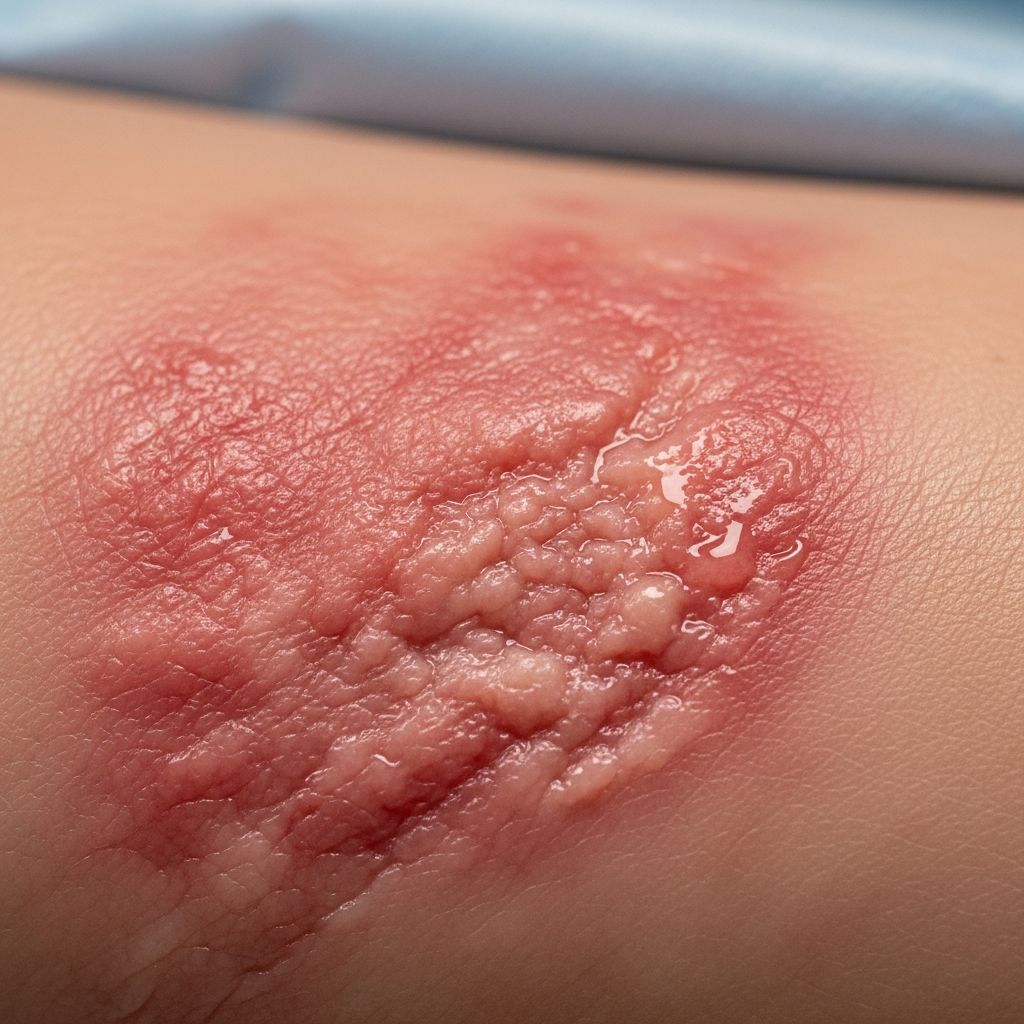
IAD presents with inflammation in incontinence-exposed areas: genitals, perineum, thighs, buttocks, and lower abdomen. Distribution follows convexities (e.g., labia majora, scrotum) and may be symmetrical or asymmetrical based on posture.
- Acute phase: Blanchable erythema (redness), oedema, glistening from exudate, pain, burning, itching, or tingling. Skin feels macerated and wet.
- Progressive signs: Erosion, denudation (partial-thickness loss), vesicles, bullae (blisters), or superficial ulcers.
- Chronic phase: Dryness, scaling, peeling; less severe in non-contact areas.
Symptoms like pain can occur even without visible breakdown, impacting quality of life. Faecal involvement worsens severity with deeper erosions.
Diagnosis of incontinence-associated dermatitis
Diagnosis is clinical, based on history of incontinence and exam findings in perineal areas. No specific tests are required, but tools like the IAD Severity Scale aid staging.
Differential diagnosis
IAD must be distinguished from similar conditions:
- Pressure ulcers/injuries: Over bony prominences; non-blanchable deep tissue damage.
- Contact dermatitis: Allergic reactions; patch testing if suspected.
- Infections: Candidiasis (satellite lesions), cellulitis (systemic signs).
- Other: Psoriasis, lichen simplex; biopsy rarely needed.
How is incontinence-associated dermatitis prevented and treated?
Prevention and treatment centre on minimizing irritant exposure, restoring skin barrier, and managing incontinence.
Prevention strategies
- Gentle, pH-balanced, no-rinse cleansers to remove irritants without stripping lipids.
- Regular moisturizers and barrier creams (zinc oxide, silicone-based) for protection.
- Absorbent products with superabsorbent polymers; timely changes.
- Address reversible incontinence causes (e.g., UTIs, constipation).
Treatment
- Cleanse: Use pH-balanced, moisturizing, leave-on products.
- Moisturize: Emollients to repair barrier.
- Protect: Barrier films/creams; all-in-one products ideal.
- Treat infections: Topical antifungals/antibiotics if confirmed.
- Manage incontinence: Behavioural interventions, pads.
Avoid soap/water, thick ointments, or friction. Evidence supports structured regimens reducing IAD incidence.
Frequently Asked Questions (FAQs)
Q: What is the difference between IAD and pressure ulcers?
A: IAD is caused by moisture/irritants in perineal areas, showing blanchable erythema; pressure ulcers result from sustained pressure over bony sites with non-blanchable damage.
Q: Can IAD be cured at home?
A: Mild cases improve with pH-balanced cleansers, moisturizers, and barriers, but consult a doctor for infections or severe erosion.
Q: How often should skin be cleansed in IAD prevention?
A: After each incontinence episode, using gentle products to minimize friction.
Q: Is faecal incontinence worse for IAD?
A: Yes, enzymes in faeces cause more damage than urine alone.
Q: Are there specific products recommended?
A: No single product is universally superior; choose pH-balanced, non-rinse cleansers and silicone barriers.
References
- Incontinence-Associated Dermatitis: Symptoms, Treatment, and More — Healthline. 2023-10-15. https://www.healthline.com/health/overactive-bladder/incontinence-associated-dermatitis
- Incontinence-associated dermatitis (IAD): Optimising skin barrier function — Wounds International. 2020-06-01. https://woundsinternational.com/made-easy/incontinence-associated-dermatitis-iad-optimising-skin-barrier-function-a-3-step-approach/
- Incontinence-associated dermatitis — DermNet NZ. 2024-01-20. https://dermnetnz.org/topics/incontinence-associated-dermatitis
- Moisture-associated skin damage caused by incontinence — UCC Today. 2023-05-12. https://www.ucc-today.com/journals/issue/launch-edition/article/moisture-associated-skin-damage-incontinence
- Incontinence-Associated Dermatitis (IAD) — NHG Health. 2024-03-10. https://www.nhghealth.com.sg/FindDS/diseases-conditions/incontinence-associated-dermatitis-iad
- Incontinence-associated dermatitis — Medline. 2023-11-05. https://www.medline.com/skin-health/incontinence-associated-dermatitis/
- Incontinence Associated Dermatitis (IAD) Best Practice Principles — Clinical Excellence Commission, NSW Health. 2020-06-18. https://www.cec.health.nsw.gov.au/__data/assets/pdf_file/0015/424401/Incontinence-Associated-Dermatitis-IAD-Best-Practice-Principles.pdf
Similar Articles








Read full bio of medha deb